


ALLTHATSINTERESTING.COM
A New Study Has Just Determined When Humans First Arrived To Australia
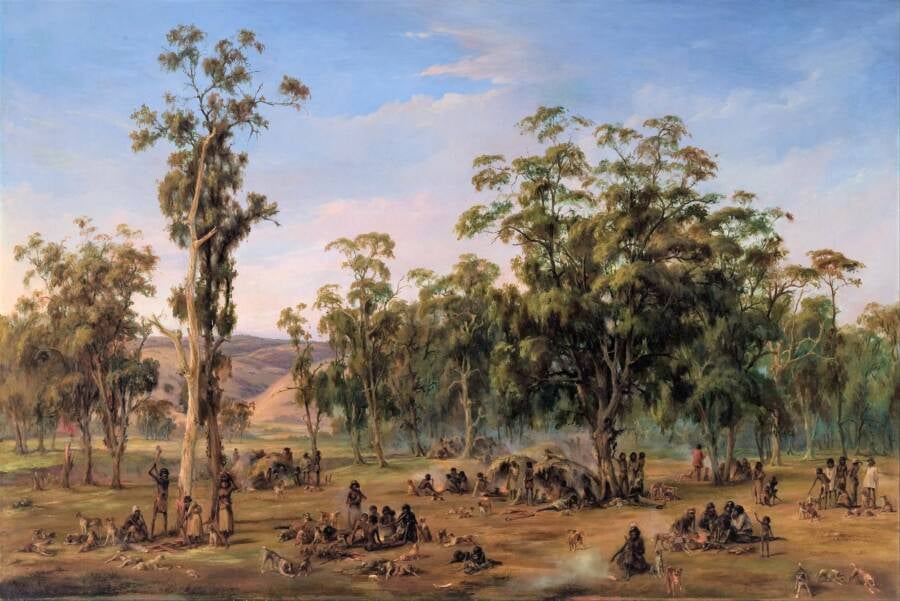
Public DomainAn 1854 painting by Alexander Schramm of an Aboriginal encampment.Nearly 250 years ago, Europeans established their first permanent settlement in Australia and came into contact with the continents Aboriginal people. Now, a new study published in Science Advances has determined when these Aboriginal inhabitants arrived in Oceania themselves.The study involved the analysis of nearly 2,500 genomes from Aboriginal communities across Australia, New Guinea, and other Pacific islands to clarify the timeline of when the first modern humans landed on Sahul, a prehistoric continent that included modern-day Australia, Tasmania, and New Guinea. Not only did the team find evidence of human habitation as far back as 60,000 years ago, but they also discovered what may be the earliest uncontested example of travel by boat. And some of those early arrivals may have even mated with other species along the way. New Technologies Spark Debate About Humans Arrival In AustraliaBetween the first European contact with Aboriginal Australians and today, numerous leaps in technology have enhanced the scientific understanding of when the continent was first settled. Radiocarbon dating techniques in particular helped to establish a timeline that pointed to thousands of years of occupation, far exceeding initial European estimates. This pushed the time of peoples arrival back to around 45,000 years ironically, now known as the short chronology,' Martin B. Richards, a professor of archaeogenetics at the University of Huddersfield and co-author on the study, writes for The Conversation. However, some archaeologists argued they may have arrived even earlier. The so-called long chronology theory started gaining traction around 2017, as newer scientific dating methods like optical luminescence dating were developed. This theory suggested that the first people arrived in Australia 60,000 years ago, but it was not widely accepted and remained contentious. Then, in 2024, more evidence emerged that once again turned the tide. Public DomainAn Aboriginal camp in Victoria, circa 1858.As Richards explains, geneticists then got involved in the debate, publishing a study that examined the genetic clock of prehistoric Australians. This suggested some interbreeding between early modern humans and Neanderthals, with an overlap of about 5,000 years. This would have occurred less than 50,000 years ago, suggesting the short chronology may actually have been more accurate. All present-day non-Africans carry around two percent Neanderthal DNA, suggesting they must all be descended from that small group, Richards writes. This research therefore supported the short chronology view. One potential explanation for this was that humans arrived in Sahul in two waves: one 60,000 years ago and a second 40,000 years ago, which entirely replaced that first wave. However, this explanation made little sense to some experts. Humans were already widespread in Sahul 40,000 years ago, after all. But the new study offers another explanation: Only one wave of humans arrived in Sahul 60,000 years ago, but they took two distinct routes to get there.The Earliest Seafarers Arrived In Two MigrationsAfter sequencing mitochondrial DNA genomes which are only inherited maternally from nearly 1,000 new samples collected with the help of Aboriginal elders and combining them with another 1,500 sequences that were already available, researchers were able to use what they called a molecular clock to determine that the deepest human lineages in Australia dated back 60,000 years. Our results suggest there were two distinct migrations into Sahul both around the same time 60,000 years ago, Richards writes. This is because the most ancient lineages fell into two groups.These groups were a major set and a minor set, the former having ancestry in the Philippines and the latter hailing from either South Asia or Indochina. Notably, the major sets DNA was distributed throughout both New Guineans and the Aboriginal Australians, while the minor set was only observed in Aboriginal people. Maximilian Drrbecker/Wikimedia CommonsA map of present-day Southeast Asia and Australia overlaid with the prehistoric continents of Sunda and Sahul.The simplest explanation for this was that each group arrived via a different route: a major path in the north and a minor southern one. In modern New Guineans and Aboriginal people, there was also evidence of an additional five percent of archaic human DNA on top of the standard two percent Neanderthal DNA, indicating prehistoric humans interbred with other archaic human species as they traveled.Most remarkably, however, is that despite lower sea levels at that time, the minor group would still have traveled at least 60 miles across the open sea, which marks some of the earliest evidence of human seafaring. They would have traveled on simple watercraft like bamboo rafts or canoes, but that makes their journey no less impressive. The authors noted that this doesnt fully settle the debate, but it certainly offers more compelling evidence for the long chronology. So far, studies have only been able to examine indirect evidence, but if researchers are ever able to recover any prehistoric DNA to apply the models directly, it could provide a definitive answer. After reading about when the first humans arrived in Australia, discover how humans may have arrived in Mexico 20,000 years earlier than previously thought. Then, learn about when the first humans arrived in Sicily.The post A New Study Has Just Determined When Humans First Arrived To Australia appeared first on All That's Interesting.
0 Σχόλια
0 Μοιράστηκε
14 Views

 English
 Arabic
 French
 Spanish
 Portuguese
 Deutsch
 Turkish
 Dutch
Dutch
 Italiano
 Russian
 Romaian
 Portuguese (Brazil)