The Great Northern War and the Rise of the Russian Empire
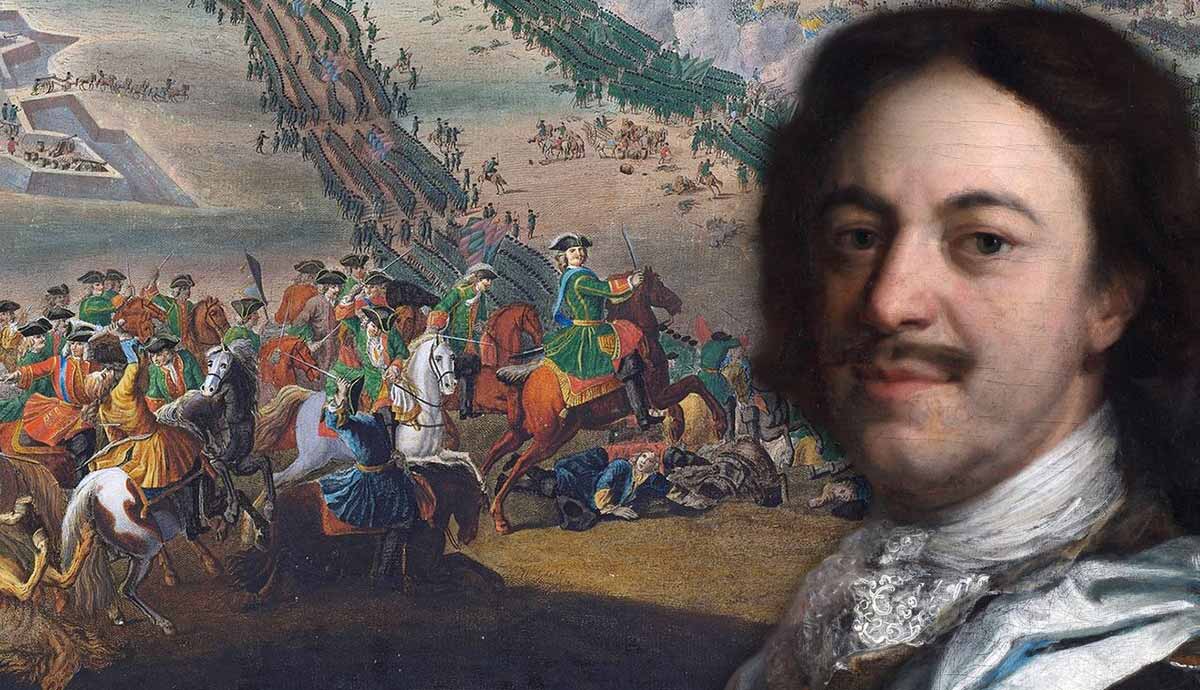
Tsar Peter the Great is usually credited with Russias modernization and rise to European great power status. For much of Peters reign, Russia was at war with Sweden in the Great Northern War (1700-1721). Despite a disastrous start to the conflict, Russias military capabilities strengthened over time, leading to the decisive battle of Poltava in Ukraine in 1709. By the end of the war, Peter had founded the city of St. Petersburg, established a permanent Russian foothold in the Baltic, and emerged as the dominant power in northern Europe.An Opportunistic AllianceAugustus II of Saxony-Poland. Portrait by Louis de Silvestre, 1700-1760. Source: National Museum of SwedenThe Great Northern War began in 1700 after the opportunistic monarchs of Denmark, Saxony-Poland, and Russia formed an alliance to take advantage of events in Sweden, where the 18-year-old King Charles XII recently attained his majority. Following its intervention in the Thirty Years War, Sweden retained extensive territories in the southern Baltic that presented tempting targets to the allied rulers.By the time the 29-year-old King Frederick IV of Denmark came to the throne in August 1699, Denmark had already signed alliances with Saxony and Russia directed against Sweden. The Danes were motivated by a desire to reclaim the provinces of Skne, Halland, Blekinge east of the resund strait, which had been lost to the Swedes in the mid-17th century.Elector Frederick Augustus of Saxony, who had been elected King Augustus II of Poland in 1697, hoped to conquer Livonia from Sweden to strengthen his dynastic prospects in the Baltic and improve his familys prospects of retaining Polands elective crown.Portrait of Peter I (1672-1725) by Jean-Marc Nattier, 17th century. Source: Hermitage Museum, Saint PetersburgTsar Peter I of Russia, who assumed sole control of his realm in 1696, was keen to reform and modernize his state. As a young man, he befriended western Europeans in Moscows foreign quarter and was keen to gain access to a warm water port to improve Russias commercial prospects. He initially sought to push his frontiers to the Black Sea at the expense of the Ottoman Empire, but was unsuccessful in his efforts to revive the anti-Turkish coalition during his Grand Embassy of 1697-98 and set his sights on the Swedish province of Ingermanland (Ingria) instead.The Young Military GeniusKing Charles XII of Sweden. Painting by Hyacinthe Rigaud, 1715. Source: National Museum of Sweden via Wikimedia CommonsThe anti-Swedish allies expected a swift victory when the war began in late 1699. The Danes moved first by attacking the Swedish client state of Holstein-Gottorp in northern Germany, while the Saxons laid siege to the Livonian capital of Riga in March 1700. By August, a Russian army was marching towards the Baltic from Moscow.Faced with a three-front war, Charles prioritized the Danish threat. Rather than face the Danes head on, the Swedish monarch targeted Copenhagen by landing an army of 10,000 men on Zealand in late July. Faced with a Swedish army marching on his capital, which was now subject to a naval blockade, the Danes sued for peace in desperation. Under the terms of the Peace of Travendal of August 18, 1700, Denmark evacuated Holstein-Gottorp and withdrew from the anti-Swedish coalition.By the time the Russian army left Moscow in late August, the Swedish army that had forced the Danes out of the war was already on its way eastwards to Estonia. The Saxons struggled to make progress against Riga and Augustus raised the siege in late September before ordering his men into winter quarters.On October 31, the 35,000-strong Russian force laid siege to the city of Narva in Estonia. While the Russians were building their siegeworks, Charles XII hurried to relieve the siege. Charles arrived on the scene on the morning of November 30 and launched his attack in the afternoon. Entrenched behind field fortifications, the Russians initially offered strong resistance, but the Swedes broke through the Russian lines at two points and routed their enemy. Estimates of Russian losses range between 10,000 and 20,000.From Defeat to VictoryPeter the Great on the Neva Embankment. Painting by Valentin Serov, 1907. Source: Russia Beyond the HeadlinesInstead of pursuing the remnants of the vanquished Russian army, Charles XII turned his attention towards Augustus and Poland. This gave Tsar Peter valuable time to rebuild his army and continue the fight.To make up for the losses at Narva, Peter accelerated efforts to create new-formation regiments equipped and trained to European standards, first introduced by his father Tsar Alexei in the mid-17th century. He also sought to introduce a meritocratic system of promotion among officers, many of whom came from the ranks of his Preobrazhensky and Semenovsky Guard regiments, though his senior generals mostly hailed from prominent noble families.Peter sought to create a standing army by establishing permanent regimental structures, and in 1705 he introduced a levy of one recruit for every 20 households with 25-year terms of service. These rapid reforms faced significant opposition among the rank and file, leading to high desertion rates and a series of major uprisings.While Peters reforms took time to take effect, Russian forces were already beginning to seize the initiative in the Baltic a year after Narva. On January 9, 1702, a Russian army under Boris Sheremetev defeated a much smaller Swedish force under Wolmar Anton von Schlippenbach at the Battle of Erastfer. On July 29, 1702, Sheremetev destroyed Schlippenbachs field army at Hummelshof. In October, Peter then joined Sheremetev to capture the Swedish fortress of Nteborg on the Neva River, enabling the Russians to move towards the mouth of the Neva, where the city of St Petersburg was founded in May 1703.The Polish Civil WarMap of Great Northern War Campaigns (1700-1709), by S. Bollmann, 2010. Source: Wikimedia CommonsThe Russian successes in the Baltic owed much to Charles XIIs fateful decision to turn south to confront Augustus. While this was a mistake in hindsight, the Polish-Lithuanian Commonwealth had been a major power in the 16th and 17th centuries, and less than 20 years earlier King Jan Sobieski led the famed Winged Hussars in a famous cavalry charge to relieve the Ottoman Siege of Vienna in 1683. The Polish and Lithuanian contingents were further strengthened by Augustuss own Saxons.However, the independent-minded Polish nobility or szlachta resisted royal initiatives to create a standing army, fearing that the centralization of military power in Warsaw would undermine aristocratic privileges. The kings ability to keep his armies on the field depended in large part on the willingness of noble magnates to answer the call to arms. Augustus failure to take Riga and Swedish victories over the Danes and Russians in 1700 led the Polish-Lithuanian Sejm (parliament) to withhold support for their kings military enterprises.With Augustus struggling to rally support in the Sejm, Charles XII hoped to work with the Polish opposition to depose Augustus. Although much of the szlachta remained loyal to Augustus and resisted the Swedish intrigues, Charles XII defeated the Saxons at Kliszw in 1702 and Putusk in 1703, leading several important Polish nobles to abandon Augustus and join the Swedes.Portrait of Stanisaw I Leszczyski by Jean-Baptiste van Loo, 17271728. Source: Culture.plIn February 1704, a Sejm convened under Swedish protection deposed Augustus and elected Charless candidate Stanisaw Leszczyski king in July. Augustus was not willing to give up his throne without a fight and formalized an alliance with Russia in which Peter agreed to send more than 15,000 Russian troops to Poland to support Augustus.In February 1706, a Swedish army under General Carl Gustaf Rehnskild crushed a larger allied Saxon-Russian army at the Battle of Fraustadt by executing a double envelopment with his cavalry. Rehnskilds success allowed Charles XII to invade Saxony, forcing Augustus to sign the Treaty of Altranstdt in which he renounced his claim to the Polish throne and broke his alliance with Russia.Although Charles had successfully forced Augustus out of the war, King Stanisaw struggled to gain acceptance among the Polish nobility, many of whom believed that Augustus had been unlawfully deposed. Some of those who had turned against Augustus in 1704 hoping to claim the throne for themselves were bitterly disappointed by Stanisaws elevation and quickly abandoned the Swedish cause. Charles was a talented battlefield tactician with few equals in the 18th century, but his intervention in Poland would prove a fatal strategic mistake.PoltavaThe Battle of Poltava. Painting by Pierre-Denis Martin, 1725. Source: Wikimedia Commons via Catherine PalaceWith his objectives in Poland seemingly secure, by 1707 Charles could turn his full attention to Russia. With an almost unblemished record of military success behind him, Charles XII was full of confidence as he sought to defeat the Russians in battle and force Peter to give up his gains in the Baltic.In April 1707, Peter and his generals opted to withdraw from Poland into the Russian heartland. Just as they were to do a century later against Napoleon, the Russian army pursued a scorched earth strategy as they retreated. As the Swedes struggled to replenish their food supplies, Russian irregular cavalry regularly raided Swedish foraging parties.Charles had little option but to turn south and seek more abundant resources in Ukraine. He did so without waiting for a large Swedish column under General Adam Ludwig Lewenhaupt, and on October 9, 1708, Peter intercepted Lewenhaupts isolated column at Lesnaya. While casualties on both sides were even, Lewenhaupt was forced to destroy much of his supply train to facilitate his southward march.Charles received a major boost with the defection of the Ukrainian Cossack hetman Ivan Mazepa in November 1708, followed by the rest of the Zaporizhian Cossacks in March 1709. By the summer of 1709, the Russians were prepared to give Charles the set-piece battle he desired.On July 8, 1709, the Swedes attacked the Russian fortified camp at Poltava on the banks of the Vorskla River in Ukraine. Charles XII had been wounded by a bullet a few days earlier, leaving Rehnskild in operational command. While the Swedes successfully overcame a network of redoubts protecting the approach to the Russian camp, the Russians sallied out from the camp and engaged the enemy in the open field, using their numerical superiority to overwhelm the Swedish attackers.The War in FinlandThe Battle of Gangut by Alexey Bogolyubov, 1877. Source: Central Naval Museum, St PetersburgWith hindsight, the Battle of Poltava signaled the decisive turning point of the Great Northern War, but Charles XII was not ready to give up and the war continued another 12 years. While his army of 17,000 soon fell into Russian captivity, the Swedish king escaped to the Ottoman Empire and urged the Ottoman sultan to join the war against Russia. While the Ottomans declared war on Russia in November 1710 and forced Peter and his army to surrender at the Pruth River in July 1711, Peter saved his army by agreeing to give up his fortresses on the Black Sea.The Swedish defeat at Poltava encouraged Denmark and Saxony to rejoin the anti-Swedish coalition. While the Danes struggled to retake Skne, Augustus II had retaken the Polish throne in October 1709. Meanwhile, the disintegration of the Swedish army enabled the Russians to seize full control of Estonia and Livonia by September 1710.The capture of Viborg by Russian forces in June 1710 gave the Russians a platform to invade Finland, which had been under Swedish control since the 13th century. While an initial invasion in 1712 by General Admiral Fyodor Apraksin was quickly abandoned, Peter and Apraksin adopted a new strategy in 1713 by using the Russian galley fleet to support military operations along the Finnish coast.In May 1713, the Russians laid siege to Helsingfors (Helsinki), which was abandoned and burned by the retreating Swedish garrison. By August, the Russians took control of Abo (Turku), then the capital and largest city in Swedish Finland. A Swedish fleet dispatched to contest Russian control of the Finnish coast was defeated at the Battle of Gangut off Cape Hanko on August 7, 1714, marking the first major victory in the history of the Russian navy. Between 1714 and 1721, Finland remained under Russian occupation.Shifting AlliancesKing George I of Great Britain. Painting by Sir Godfrey Kneller, 1714-1725. Source: National Portrait Gallery, LondonDuring this period, Charles XII had been absent from his kingdom. He remained in Ottoman exile and continued to urge the Ottomans to make war against Russia, but decided to leave in late 1714 after the officials who governed the kingdom in his absence threatened to make a peace with Russia, Poland and Denmark. Charles arrived in Stralsund in Swedish Pomerania in November 1714.Charles return to northern Europe did little to dissuade Swedens regional rivals from taking advantage of its weakness. In July and August 1715, the Prussians took Wolgast and Peenemnde in Swedish Pomerania, while the Hanoverians (whose elector had recently become King George I of Great Britain) seized Bremen and Verden in October. Charles returned to Sweden in December 1715 a few days before Stralsund fell to the Prussians.Despite being surrounded by enemies, Charles refused to contemplate peace negotiations and instead attacked Norway in an effort to force Denmark out of the war. During his second Norwegian campaign, he was killed by a bullet at the siege of Frederiksten on December 11, 1718. He was succeeded by his sister Ulrika Eleanora, who in turn passed the throne to her husband, King Frederick I, in May 1720.By the time of Charles death, Swedens diplomatic position had improved considerably owing to disagreements among its enemies. None of Russias allies welcomed the Russian presence in the western Baltic, and Peters designs on Mecklenburg clashed with George Is efforts to establish Hanover as the leading power in northern Germany. Meanwhile, Augustus II and Frederick William I of Prussia clashed over Poland.These considerations allowed Sweden to make peace with Hanover, Britain, and Prussia at the Peace of Stockholm in February 1720, in which Sweden gave up most of its northern German territories while retaining Wismar, Rgen, and Stralsund. In June 1720, the Swedes made a favorable peace with Denmark at the Treaty of Frederiksborg which saw the Danes abandon their claims to the provinces east of the resund.A New EmpireImperial Crown of Russia, commissioned by Catherine the Great in 1762. Modern copy by the Smolensk Diamond Company. Source: Wikimedia CommonsAs a result of these diplomatic developments, Russia was faced with the prospect of its erstwhile allies joining Sweden to take back the Russian conquests in Finland and the Baltic. However, Russian maritime superiority and regular Russian raids on the Swedish coast prevented Sweden from making much progress on its own.The Great Northern War came to an end on September 10, 1721, with the Treaty of Nystad. Under the agreement, the Russians evacuated much of Finland, but formally secured possession of Estonia, Livonia, Ingria, and parts of southeastern Finland. A few weeks later, Peter formally adopted the title of Imperator or Emperor.While the Great Northern War saw Russia eclipse Sweden as the dominant power in northern Europe,Peters imperial title and Russias status as a European power was not immediately recognized. It was only during the latter half of the 18th century, following Russian battlefield successes in the Seven Years War and Catherine the Greats expansion at the expense of Poland and the Ottoman Empire that Russia was widely acknowledged as a major European power.










 English
 French
 Spanish
 Portuguese
 Deutsch
 Turkish
 Dutch
Dutch
 Italiano
 Russian
 Romaian
 Portuguese (Brazil)
 Greek
Greek