How the Teutonic Order Wiped Out the Last Pagan Stronghold in Europe
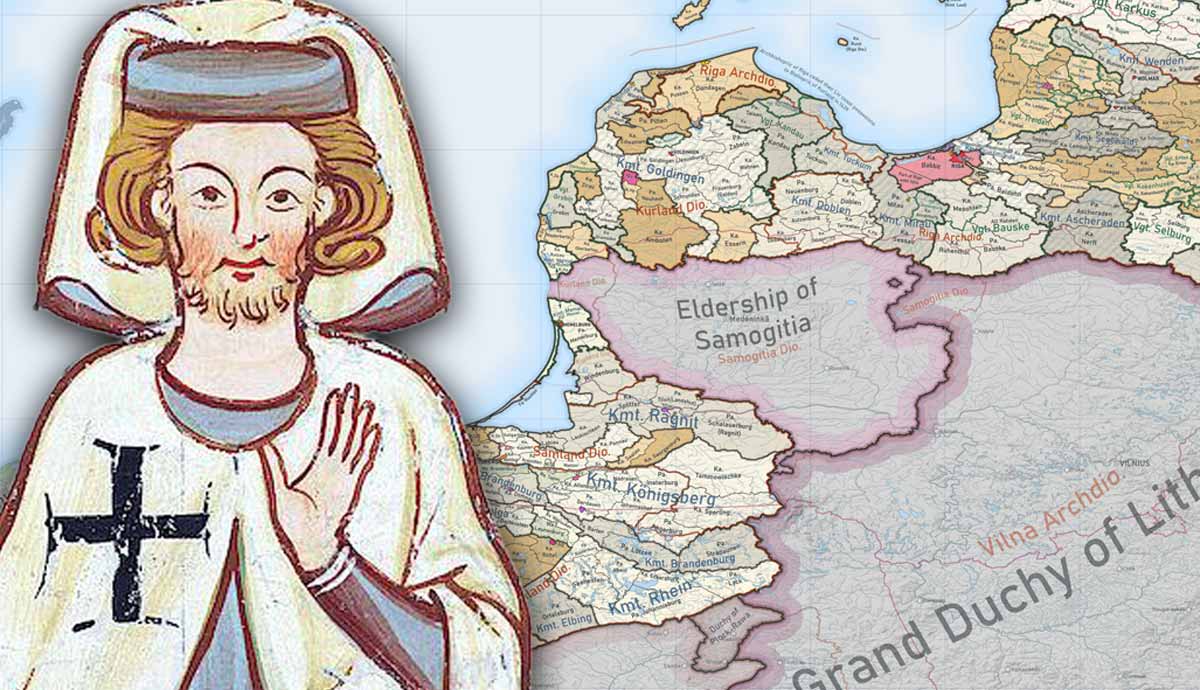
Also known as Deutscher Order and Brothers of German House of St. Mary in Jerusalem, the Teutonic Order was a key player in the medieval expansion in Eastern Europe. During the Baltic Crusades in Prussia, present-day Latvia and Estonia, and Lithuania, the Teutonic Knights virtually wiped out the pagan population living in these areas, replacing the established authorities with a theocratic state.Read on to discover more about the Teutonic Order and its role in the Christianization of Europes last strongholds of paganism.The Crusades & the Origin of the Teutonic OrderPhilip II of France and Richard the Lionheart receive the keys of Acre, miniature from the 14th century. Source: Wikimedia Commons/Gallica Digital Library, Bibliothque nationale de France, ParisIn 1189, the Crusading forces led by Guy of Lusignan were besieging the town of Acre, which was then controlled by Saladin, the sultan of Egypt and Syria. In 1187, Saladin had also conquered the city of Jerusalem, leading to the fall of the Kingdom of Jerusalem, a Crusader state established by the Crusaders in 1099 after the end of the First Crusade.When news of the fall of Jerusalem reached Europe, Pope Gregory VIII initiated the Third Crusade to restore the city to Christian control. In 1190, during the siege of Acre, a number of German merchants, mostly from Bremen and Lbeck, decided to form a fraternity to care for the sick. A year later, after the Crusaders managed to capture Acre, the fraternity established its headquarters in a hospital in the town and became known as the Hospital of St. Mary of the German House in Jerusalem.Then, in 1198, when the death of Holy Emperor Henry VI of the Hohenstaufen dynasty led a number of Crusaders to leave the Holy Land, the brotherhood was militarized, becoming a religious order put under both monastic and military rule. The newly formed Teutonic Order (Deutscher Order) adopted the rules and organizational structure of the Knights of the Hospital of St. John (Hospitallers) and Templars (named after their headquarters in the Temple of Solomon in Jerusalem).Saladin, by Cristofano dellAltissimo, 16th century. Source: Wikimedia CommonsLike these older military groups, the Teutonic Knights were initially founded to protect the Christians living in the Holy Land. Thanks to the support of the papacy, they soon began to receive extensive privileges and grants of lands, extending their hold in the Kingdom of Jerusalem and Germany. In 1205, Pope Innocent III allowed the members of the Teutonic Order to wear a white habit and mantle adorned with a black cross.In 1291, when the Mamluks besieged and conquered Acre, the last Christian stronghold in the region, causing the definitive loss of the Crusader states, the Teutonic Knights left Palestine forever. By then, however, they had already shifted the focus of their religious and military efforts in Eastern Europe, where they led the expansion of Christendom into the last areas populated by pagan tribes.The Teutonic Order in PrussiaStatue of Hermann von Salza, the grand master of the Teutonic Order from 1210 to 1239, photograph by Jan Jerszyski, 2005. Source: Wikimedia CommonsIn the 13th century, Grand Master Hermann von Salza, who became a confidant of Emperor Frederick II Hohenstaufen, strengthened the Teutonic Orders authority and territorial possession in Europe with a series of military campaigns. In his chronicle of the order, written in the 1330s, chaplain Nikolaus von Jeroschin praised von Salza, extolling his virtues as a shrewd leader: Master Hermann acquired for his order the most useful and best papal and imperial privileges. Also the order was given many a territory in Apulia, Greece, Cilicia, and Germany, Transylvania, Livonia, and Prussia.Indeed, in 1211, the Teutonic Knights, following King Andrew II of Hungarys request for assistance against border raids launched by the Cumans, a nomadic Turkish group acting as auxiliary forces for a number of Russian princes, occupied large parts of Transylvania. In 1225, however, after their excessive demands caused conflict with the royal and ecclesiastical authority, the knights were expelled from Hungary.By then, Hermann von Salza had already secured a new opportunity for the order. Indeed, the Polish Duke Conrad of Mazovia turned to the Teutonic Order for military assistance against the Prussians, a pagan population that lived in tribes in the region between the Vistula and Neman River and spoke a Baltic language. Previous attempts to convert the Prussians to Christianity had been largely unsuccessful, with the local tribes often reacting violently to the missionary efforts.Map of the Order State in Europe, by S. Bollmann. Source: Wikimedia CommonsThe Duke of Mazovia assumed the knights would become his vassals after the conquest of the Prussians land. However, Hermann von Salza, seeking to avoid an outcome similar to that of the orders campaign in Hungary, used his personal connection with Emperor Frederick II to obtain the Golden Bull of Rimini. Issued in 1226, the decree confirmed to the Teutonic Order the lands already promised by the duke, as well as any territory the knights may conquer during the Prussian Crusade. The 1226 bull, the de facto legal basis for the Teutonic Orders settlement in Prussia, was confirmed by the Bull of Rieti, issued by Pope Gregory IX in 1234.Having obtained legal immunity from the imperial and papal authority, the Teutonic Order began its violent conquest and Christianization of Prussia. To secure their hold in the region, the knights built a series of castles and, most importantly, imported German settlers, mainly German peasants, to populate the previously pagan lands. In the course of its conquest of Prussia, the Teutonic Order formed the so-called Ordensstaat (Order State), a theocratic state that controlled a vast area spanning from Estonia to present-day Poland.The Christianization of Eastern EuropeRemains of the Teutonic Orders Marienburg fortress in present-day Romania, photograph by Andrei Kokelburg, 2010. Source: Wikimedia CommonsIn the 13th and 14th centuries, the Order State emerged as the dominant authority in the Baltic region, profoundly altering its religious, social, and economic landscape. Besides the crusading spirit and rhetoric underlying the conquest that led to the Christianization of Eastern Europe, political and economic factors were also at play. Indeed, a number of Polish and German nobles backed the Teutonic Orders campaigns, hoping to extend their territories and strengthen their authority.After 1263, when the pope released the knights from their vow of poverty, the order quickly established an economic monopoly of the Baltic, collaborating with the Hanseatic League, a trading network formed by German merchants that dominated the trading activity in northern Europe until the 15th century. In 1309, the grand master relocated the orders headquarters from Venice to Marienburg, an imposing fortress that embodied the power of the Teutonic Knights in Eastern Europe.By then, the Teutonic Order had incorporated among its ranks the Order of the Brothers of the Sword (also known as Livonian Order), a religious military body founded in 1202 by Albert von Buxhoevden, the bishop of Livonia, an area roughly corresponding to present-day Latvia and Estonia. In the first half of the 13th century, the Sword Brothers launched a ruthless campaign of conquest and conversion in Livonia to Christianize the local Finnic-speaking pagan populations.Alexander Nevskiy during the 1242 Battle on the Ice from the Laptev Volume of the Illustrated Chronicle of Ivan the Terrible, 16th century. Source: Wikimedia CommonsFollowing a crushing defeat in 1236, the pope, dissatisfied by the Livonian Orders brutal tactics, dissolved it and merged it with the Teutonic Order. In the following decades, the Teutonic Knights continued the expansionist exploits in Livonia. In 1242, however, their advance into Eastern Europe suffered a setback after the defeat at the Battle on the Ice at Lake Peipus, where the forces of Alexander Nevsky repelled the crusading knights.Despite the defeat, the Teutonic Order was ultimately successful in securing its hold in Livonia, thereby extending the territories of the Order State to include Eastern Pomerania, the city of Danzig (present-day Gdask, Poland), and extensive lands in central and southern Germany. As a result of the Christianization, most of the pagan tribes were exterminated, their leaders forced to accept baptism.The Lithuania CrusadeKing Wadysaw II Jagieo, detail of the Triptych of Our Lady of Sorrows, 15th century. Source: Wikimedia Commons/Wawel Cathedral, PolandIn the 15th century, the Teutonic Order concentrated its expansionist efforts against the Grand Duchy of Lithuania, a state comprising the territories of Lithuania, present-day Belarus, western Ukraine, and, at its greatest extent, portions of Russia and Poland. In the first half of the 14th century, when the crusading Teutonic Knights were already pressing against their borders, the Lithuanians, at the time still retaining their pagan religion, formed the grand duchy to resist the German threat.Meanwhile, the Teutonic knights aggressive policy of territorial aggrandizement provoked hostility from the Poles, who especially resented their lack of access to the Baltic Sea, a leading center of European trade. In 1385, Poland formed an alliance with Lithuania (Treaty of Krewo), and the two countries formed a dynastic union, with the Lithuanian grand duke, Jogaila, agreeing to convert to the Catholic faith and marry the Polish queen. Baptized a Roman Catholic the following year, Jogaila was crowned king of Poland with the name Wadysaw II Jagieo. Thus, the Teutonic Order lost its religious pretext for the crusading war against Poland and Lithuania.In 1409, tensions between the Teutons and Lithuania reached a critical point when the Samogitians, inhabitants of a Lithuanian territory previously ceded to the Teutonic Order, rose against the knights. The uprising soon led to a war, with Poland and Lithuania uniting their forces against the Germans. Despite scoring some early victories, the Teutonic Knights suffered a crushing defeat at the Battle of Grunwald (known as the Battle of Tannenberg in Germany).In the Treaty of Thorn, signed in 1411 in present-day Toru (Poland), the Teutons had to cede Samogitia to Lithuania and Dobrzy to Poland.The Decline & Fall of the Teutonic OrderThe Battle of Grunwald by Jan Matejko, 1878. Source: Wikimedia CommonsThe Battle of Grunwald shifted the power balance in the Baltic region, marking the end of the Teutonic Orders military and political might. In the following decades, its authority in Eastern Europe saw a rapid decline. In 1454, the Prussians rose against the Order State, petitioning the king of Poland for aid against the knights. In the ensuing Thirteen Years War (1454-1466), several vassals of the Teutons joined forces with Poland, and in 1462, the order lost the Battle of Puck.According to terms of the Second Treaty of Thorn (signed in 1466), the Teutonic Knights were forced to give up Eastern Pomerania, the bishopric of Warmia, and their territories along the Vistula River. Additionally, the grand master, while retaining control of eastern Prussia, became a Polish vassal. Finally, membership of the order was opened to the Poles.The Teutonic rule in Prussia would come to an end less than a century later, when Grand Master Albert, influenced by the Protestant movement, became a secular lord under Polish control. In the second half of the 16th century, the Teutonic Order also lost its territories in Livonia and the Low Countries.The order was ultimately dissolved during the Napoleonic Wars, and Emperor Napoleon Bonaparte distributed its remaining territories to various principalities. Reestablished by the Habsburg emperor in 1834 as an ecclesiastical institution, the Teutonic Order took on charitable and pastoral activities. The order still exists today, and its headquarters are located in Vienna.











 English
 Arabic
 French
 Spanish
 Portuguese
 Deutsch
 Turkish
 Dutch
Dutch
 Russian
 Romaian
 Portuguese (Brazil)
 Greek
Greek