The Persecution of the Conversos in Spain and Portugal
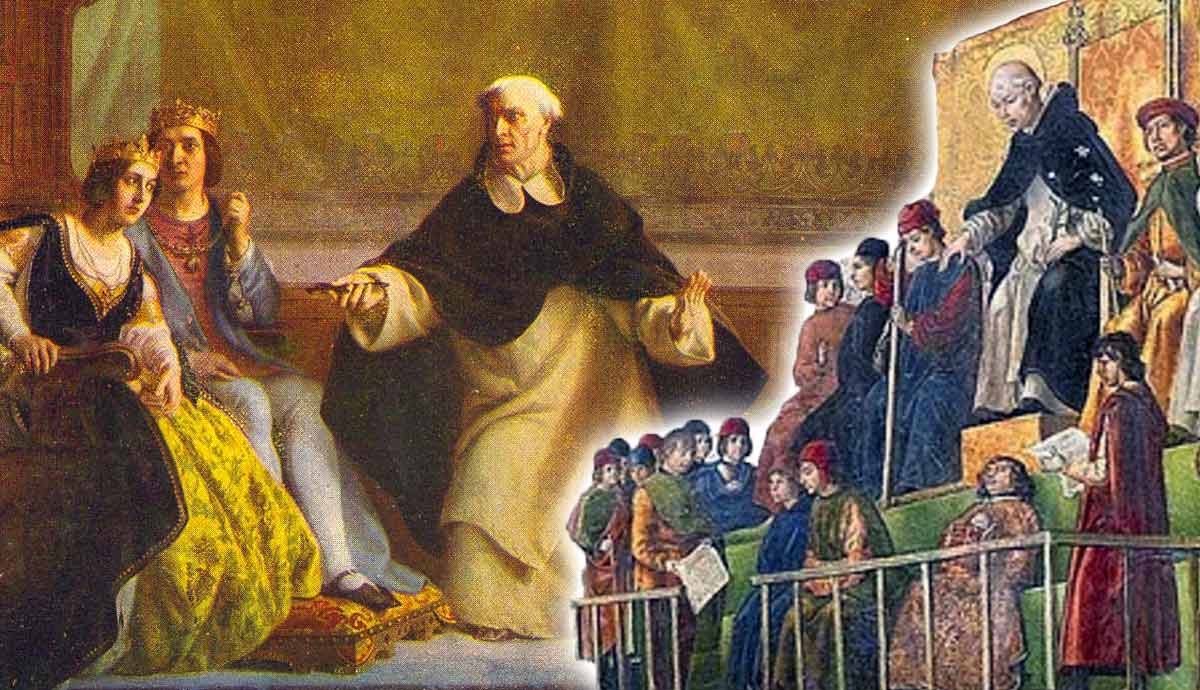
Early Modern Europe was a region plagued by anti-Jewish sentiment. Jews across the continent were viewed as dangerous enemies of Christianity. Jewish communities faced intense persecution for their religious practices, as well as their economic activities.In the Iberian Peninsula (modern-day Spain and Portugal), Christian rulers made it their mission to convert Jews to the Catholic Church. Jews who were baptized as Catholics became known as Conversos. Yet even those Conversos who were sincere in the Catholic religion fell under suspicion from hostile non-Jewish neighbors. Could they actually be practicing Jewish rites in secret?Jews and Conversos in IberiaMap of the Spanish kingdoms in 1210. Source: University of Texas at AustinJewish people have lived in Iberia since the Late Roman Period. Their communities existed alongside the growth of Christianity across the Mediterranean region. Christianity spawned from ancient Judaism, but by the 5th century, Jews and Christians were distinct social groups. Early Christians often resented the Jews, since Jewish leaders rejected the belief that Jesus Christ was the Messiah.Because they rejected the messianic status of Jesus, Jews were persecuted across Europe. Sometimes these persecutions devolved into mob murders or pogroms. Pogroms became more common during the Late Medieval Era, both in Iberia and in the rest of Europe. The Conversos would emerge from Jewish communities forced to accept the supremacy of the Catholic Church in the 15th century.A Persecutory TurnPanel with the Angel Appearing to Zacharias, by Domingo Ram, c. 1464-1507. Source: The Metropolitan Museum of ArtAnti-Jewish sentiment was already prevalent during the Late Middle Ages. Since religious scriptures forbade Christians from engaging in certain economic activities, such as moneylending, those jobs fell on Jews. A few wealthier Jews were actually employed in Christian kings courts. Yet the relative financial success of some Jews only fueled the hatred that ordinary Christians already felt toward them.Medieval Christianity did not only hold the Jews responsible for rejecting Jesus Christit was also supersessionist. This meant that theologians believed the messages of Judaism had been fulfilled (and replaced) by the gospel of Jesus. To Christian clerics, the Jews defied the will of God and deserved punishment.The Conversos in SpainScene from the Book of Games depicting Alfonso X of Castile, 1283. Source: Wikimedia CommonsIn the 14th century, authorities in Spain started to devote considerable attention to the Jewish communities in their domains. They wanted to solidify their own power in both the religious and secular spheres. So their initial ideas revolved around converting Jews en masse to the Catholic Church. These campaigns would mark the birth of a new category of people in medieval Spain: the Conversos.The word converso refers specifically to a Jewish person who converted to Christianity. Some Jews did convert to Catholicism voluntarily, but more were coerced into converting. Christian authorities believed this was a viable way to rid the world of a false religion and save Jewish souls.Saint Dominic Presiding Over an Auto de F, by Pedro Berruguete, 1490s. Source: Museo Nacional del Prado, MadridOver time, attitudes toward the Conversos took a darker turn. In 1391, pogroms in the kingdoms of Castile and Aragon saw thousands of Jews murdered. These pogromsegged on by an archdeacon named Ferrand Martnezwere condemned by civil authorities, but they reflected widespread attitudes toward the Jewish presence at the end of the 14th century.In the 15th century, more Conversos genuinely professed Catholicism. Yet they could not shake the taint of their Jewish ancestry. Spanish Christians feared the Jewish newcomers as potential subversives. The doctrine of limpieza de sangre (purity of blood) developed as a reaction to the growth of the Conversos. Legal statutes labeled Conversos as New Christians, in opposition to Old Christians with long Catholic lineages. Religious hatred started to morph into ethnic hatred.The Proposal of the Jews to Ferdinand and Isabel, by Solomon Alexander Hart, 1870. Source: Mutual ArtLife was not exclusively difficult for Jewish communities, though. Historian Mark Meyerson argues that one Jewish community in Valencia, called Morvedre, actually recovered and thrived during the 1400s (Meyerson, 2004). Jews and Conversos in Morvedre forged new social and economic relationships, both with Old Christians and with each other.Overall, the end of the 15th century was marked by the decline of the Conversos status. King Ferdinand II and Queen Isabel I united the Spanish kingdoms for the first time after 1469. They wanted to solidify Catholic supremacy and saw the Conversos as dreaded enemies. The Spanish Inquisition was created to enforce Catholic orthodoxy and royal authority. Conversos suspected of retaining Jewish practices faced especially severe punishments at the inquisitors hands.In March 1492, the Spanish Crown officially declared that all Jews were to be expelled. Some Conversos remained but thousands fled Spain altogether.The Crackdown on Conversos in PortugalExpulsion of the Jews, from the Quadros da Histria de Portugal, by Alfredo Roque Gameiro, 1917. Source: Tribos de PinceisCompared to Spain, the persecution of Jews in Portugal wasnt as intense at first. Thousands of Spanish Jews actually escaped westward to Portugal after 1492. But their new refuge would prove fleeting. Potent anti-Jewish attitudes existed in Portugal, too.The Portuguese King Manuel I issued a decree in 1497 authorizing the mass conversion of Jews. Manuels motives for issuing the edict are not entirely clear, but older scholars believed he had been pressured by the Spanish monarchy. Regardless of the kings reasoning, his decree made life even more difficult for Portugals Jewish and Converso communities.The bloodiest outbreak of violence against Conversos occurred at a church in Lisbon in April 1506. Conflict among parishionersOld Christians and New Christiansled to thousands of Conversos being murdered over the course of three days. King Manuel allowed Portuguese Jews to emigrate after this, but only briefly. His successor, Joo III, created his own Inquisition in 1536 and intensified persecution.Sao Tome and Principe, off the coast of West Africa. Source: Wikimedia CommonsThe persecution of the Conversos extended to Portugals new overseas territories. Manuel I punished hundreds of rebellious Conversos, including children, by abducting them and shipping them off to So Tom and Prncipe, off the coast of Africa. Many of these deportees died. Yet some So Tom Conversos survived and had children with enslaved Africans. Portuguese chroniclers did not fail to note their multiracial children.So Tom would be a thorn in the side of Portuguese authorities for hundreds of years. A document from 1632 describes the death of the local bishop. Notably, the author accused New Christians of poisoning the bishop. He decried the alleged prevalence of Jewish rituals among the islands Conversos (Newitt, 2010). However, it is difficult to separate the authors biases from his understanding of events.Where Did the Conversos Flee To?Portrait of Baruch de Spinoza, by Franz Wulfhagen, 1664. Source: Feel the ArtSpain and Portugal werent safe. So where could Iberian Jews and Conversos flee to? Their destinations would span the entire European continent and beyond.The Netherlands was one of the most popular destinations. Compared to other places in pre-modern Europe, the Netherlands (especially Amsterdam) was renowned for its religious pluralism. The Dutch Reformed Church coexisted with other Christian denominations, as well as some non-Christians. Relations between the Conversos and Dutch authorities changed over time, alternating between acceptance and tension. One of the most renowned (and controversial) philosophers of the 17th century, Baruch de Spinoza, came from a Portuguese Converso family.Sultan Bayezid II, by Paolo Veronese, 1528-88. Source: Bavarian State Painting CollectionAnother destination for fleeing Conversos was the Ottoman Empire. The Islamic Ottomans did persecute their non-Muslim subjects, but the extent of this persecution seemingly did not match the violence of Christian Europe. The Ottoman Sultan Bayezid II (r. 1481-1512) had economic reasons for welcoming the Jews and Conversos as well. Many exiled Iberian Jews had financial experience, and the sultan was keen on exploiting whatever he could to undermine his Christian adversaries.Smaller numbers of Conversos journeyed even farther afield for the Spanish and Portuguese American colonies. Officially, they werent allowed to travel overseas, but enforcement was not consistent. Mexican Inquisition records attest to a Converso presence in Spanish America during the first century of colonization. Conversos also settled in Brazil. Everywhere they went, they had to carefully balance their dual religious identities.Bibliography/Further ReadingMeyerson, Mark D. A Jewish Renaissance in Fifteenth-Century Spain. Princeton, NJ: Princeton University Press, 2004.Newitt, Malyn, ed. The Portuguese in West Africa, 1415-1670: A Documentary History. Cambridge, UK: Cambridge University Press, 2010.













 English
 Arabic
 Spanish
 Portuguese
 Deutsch
 Turkish
 Dutch
Dutch
 Italiano
 Russian
 Romaian
 Portuguese (Brazil)
 Greek
Greek