How Lynndie England Became The Poster Child Of Abu Ghraib Prison
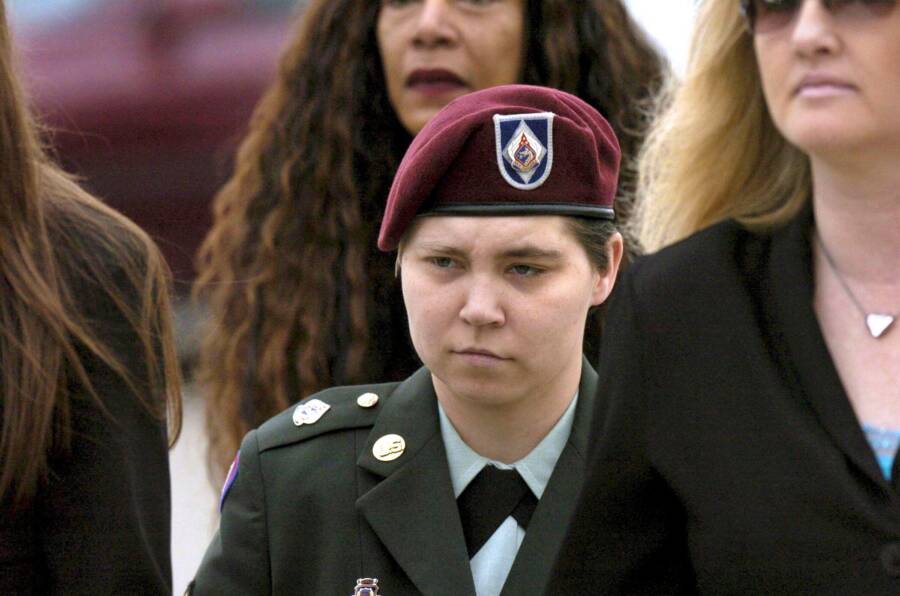
Bob Daemmrich/Alamy Stock PhotoLynndie England arriving at the courthouse at the Fort Hood Army post to face trial for prisoner abuse at Abu Ghraib.In 2004, a series of disturbing photographs leaked, highlighting the horrendous abuse of prisoners at the Abu Ghraib prison near Baghdad, Iraq. At the time, the prison was being used by the United States after the invasion of Iraq to detain and interrogate those the U.S. deemed suspicious.The images showed some Iraqi prisoners stripped naked, some with hoods placed over their heads, some forced to pose in compromising positions, some dragged around on leashes, and some with feces smeared on them. But what stood out even more was the smiling face of Private First Class Lynndie England, who seemed to be reveling in the abuse she inflicted.England was not the only U.S. soldier to appear in the leaked photos, but she became the face of the Abu Ghraib scandal, thanks in large part to a photo that showed her holding a leash around a naked prisoners neck. Just 21 years old at the time, England would later claim that she only posed in the pictures because a superior officer named Charles Graner Jr. who was also her boyfriend pressured her into it. Her lawyers also claimed that she suffered from learning disabilities and mental health issues.But while England apologized for appearing in the infamous photos, she later said that she had no regrets that the detainees were tortured. At one point, she even compared the prisoner abuse to hazing done at some American colleges. She also insisted, They werent innocent. Theyre trying to kill us, and you want me to apologize to them? Its like saying sorry to the enemy.However, intelligence officers of the U.S.-led coalition in Iraq estimated that about 70 to 90 percent of Iraqi detainees were arrested by mistake and shouldnt have been held in captivity in the first place.Lynndie Englands Life Before The MilitaryWikimedia CommonsLynndie England wanted to be a storm chaser, so she joined the military to save up money and reach her goal.Lynndie Rana England was born in Ashland, Kentucky, on Nov. 8, 1982, but her family moved to Fort Ashby, West Virginia, when she was two years old. Her father was a railway worker, and the family lived in a trailer park.As a child, she was diagnosed with selective mutism, an anxiety disorder that made it difficult for her to speak in certain social situations. She also reportedly had a learning disability. School psychologist Thomas Denne, who had worked with England when she was a special-education student, later recalled, She would seek some form of authority in order to follow. She almost automatically, reflexively complies, according to the CBC.Apparently eager to please, Lynndie England made it through high school with the support of Denne and others, graduating in 2001. She had also joined the United States Army Reserve back when she was still a high school junior, but her intention was never to stay in the military very long. England had only planned to earn enough money through her service to pay for college and pursue her real dream of becoming a storm chaser.She was eager for change, especially after working at a local chicken factory where rules were often broken by her fellow employees, and her manager reportedly made little effort to correct their behavior.England seemingly had a happy love life, as she had married a man named James Fike in 2002, but their relationship would ultimately end in divorce.In 2003, England was deployed to Iraq and her life changed forever.Lynndie Englands Deployment In Iraq And Her Assignment At Abu GhraibWikimedia CommonsLynndie England and her then-boyfriend Charles Graner Jr. at Abu Ghraib prison. Before going to Iraq, then-20-year-old Lynndie England was working as an army administrative clerk in Cresaptown, Maryland, where she met Charles Graner Jr., a military specialist about 14 years older than her. The two began a relationship (while England was still married to Fike) that continued into their deployment, which proved to be problematic for England in particular. When they first arrived in Iraq in June 2003, they were initially stationed at Al Hillah, about 60 miles south of Baghdad, but that soon changed. The situation at Abu Ghraib had grown out of control. The prison had started the summer with just 700 prisoners, but in a matter of months, that number had risen to 7,000, while the staff members saw no meaningful gains. Janis Karpinski, the commanding officer who was in charge of Abu Ghraib and 14 other prisons like it in Iraq, said that the situation was understaffed, overwhelmed, and harried, according to The Guardian.So, the 372nd Military Police Company which England was part of was tasked with helping out with guard duties at the prison. Most of the guards insisted that many of the detainees were dangerous, but it was later reported that not every prisoner at Abu Ghraib was an insurgent. In fact, intelligence officers of the U.S.-led coalition in Iraq estimated that about 70 to 90 percent of Iraqi detainees were arrested by mistake.Wikimedia CommonsOne of the most notorious photos from Abu Ghraib, showing a hooded prisoner with wires attached to his hands.It was a disaster, there was no doubt about that. The United States had also approved the use of harsher interrogation methods in the wake of the 9/11 terror attacks, techniques that were sometimes described as torture. It was the hope of the U.S. government that the typical rules would not apply during their War on Terror, that more extreme methods would be legally permissible. When the Abu Ghraib scandal broke months after England and the 372nd Military Police Company arrived at the prison, President George W. Bush appeared shocked at the abuse. According to the BBC, he declared, We will learn all the facts and determine the full extent of these abuses. Those involved will be identified. They will answer for their actions. But given the nature of the War on Terror and the approval of harsher-than-usual interrogation techniques, was it really all that shocking that abuse would permeate through some military prisons? In Abu Ghraib, cruelty wasnt simply allowed; it was encouraged. The American public just didnt know the extent of that cruelty at least not at first.The Leak Of The Infamous Abu Ghraib Prison Abuse PhotosWikimedia CommonsCharles Graner Jr. punching handcuffed prisoners.The Associated Press had been reporting about the allegations of human rights abuses at Abu Ghraib since November 2003 just a month after the 372nd Military Police Company arrived at the prison but it wasnt until April 2004 that graphic photos would confirm the reports. Those photos would have never reached the public if it wasnt for a U.S. soldier named Joseph Darby. Darby had received a CD from Graner, which Darby thought contained memento photographs of their time in Iraq. When he looked at the images, however, he was shocked by the prisoner abuse that he saw and he alerted the Armys Criminal Investigation Division.Some of what Darby later described seemed to corroborate England and Graners accounts, that when the 372nd Military Police Company arrived at Abu Ghraib, the prisoner abuse was already rampant. Karpinski claimed to have had no knowledge of any abuse, and no one ranked higher than a sergeant was ever convicted of wrongdoing at Abu Ghraib, but Darby, England, and Graner all described their initial shock at the conditions. Wikimedia CommonsFormer U.S. soldier Sabrina Harman smiling to the camera while stitching a wound on a bound detainee at Abu Ghraib.Nobody has ever said that publicly, but there were things going on before our unit even got there, Darby said in 2006. The day we arrived, back in October of 2003, we were getting a tour of the compound and we saw like 15 prisoners sitting in their cells in womens underwear. This was day one; nobody from our unit had ever set foot in the prison.Graner, who would later be described as the ringleader of the abuse, was also on record as having raised some initial objections. Lynndie England, meanwhile, had been assigned to administrative duties at Abu Ghraib and only spent time in the cellblocks so she could see Graner.When [Graner] first started working on that wing, he would tell me about it and say, This is wrong,' England said. He even told his sergeant and platoon leader. He said he tried to say something. Regardless of their initial shock, though, Graner and England would ultimately become central to the prisoner abuse.Wikimedia CommonsCharles Graner Jr. and Sabrina Harman posing with a stacked human pyramid of prisoners.They said we will make you wish to die and it will not happen, recalled one detainee, Ameen Saeed Al-Sheik, to The Washington Post. They stripped me naked. One of them told me he would rape me.Another, Hiadar Sabar Abed Miktub al-Aboodi, said, They forced us to walk like dogs on our hands and knees. We had to bark like a dog, and if we didnt do that, they started hitting us hard on our face and chest with no mercy.In fact, a photo of England holding a naked prisoner on a leash was a large part of the reason why she became the so-called poster child of the Abu Ghraib scandal. Another reason was her apparent joy in a different picture, which showed her smiling at a group of other naked prisoners, at least one of whom was forced to simulate masturbation.Wikimedia CommonsThe most infamous photo of Lynndie England showed her holding a naked prisoner on a leash.CBS showed those photographs to the American public for the first time on April 28, 2004, followed shortly by a report from The New Yorker, which added further context and details from a leaked Army report.It had been Graners idea to take many of the infamous photographs. He was also the one who gave the CD to Darby. Graner had taken other shocking photos too, one of which showed England simulating sex with a drunk soldier who had passed out. But while Graner was ultimately put on trial for his actions at Abu Ghraib and sentenced to 10 years in prison for his crimes, the focus remained largely on Lynndie England.The Aftermath Of The Abu Ghraib ScandalWikimedia CommonsLynndie England posing with a naked prisoner who was forced to simulate masturbation.In total, 11 U.S. soldiers were eventually convicted of crimes at Abu Ghraib. Graner received the longest sentence of those convicted (though he ultimately served about six-and-a-half years of his 10-year sentence). Some other soldiers who faced legal consequences included Ivan Frederick, Jeremy Sivits, Sabrina Harman, Roman Krol, Armin Cruz, Javal Davis, and Megan Ambuhl (who was also having a relationship with Graner).Janis Karpinski, the commanding officer in charge of Abu Ghraib, was never criminally charged, but she was punished with a demotion.As for Lynndie England, she had pleaded guilty to prisoner abuse at Abu Ghraib by 2005 and was sentenced to three years in prison for her crimes, though she ultimately only served about half of that sentence. While she apologized for appearing in the infamous photos, she claimed that Graner had pressured her into taking them. I didnt want them, she later said. But he was so persistent. Go on! Just for me! If you loved me, youd do it. Im like, gee, okay, just take the damned picture.Notably, England later said that she didnt feel bad for detainees who were subjected to torture, even though the majority of the detainees at Abu Ghraib were eventually released without charge.Surprisingly, England has also said that she doesnt regret her relationship with Graner even though he ended up marrying Ambuhl because Graner is still the biological father of Englands child, Carter. I couldnt have Carter exactly as he is without anybody else except Graner, England told The Daily Independent in 2009, so to me thats the whole reason for me meeting him.Wikimedia CommonsLynndie England, pictured in handcuffs.Since it was Englands face, not Graners, that got the most attention, England faced arguably the most public scrutiny when she tried to return to civilian life. She received death threats, and she also reported receiving a note from a stranger that told her that she should kill herself and her child. Lynndie England has largely stayed out of the public sphere, resurfacing for occasional interviews, like in 2009 and 2012. Back in 2009, she said that she was struggling with depression and anxiety, she was unable to find anyone willing to hire her, and she was depending on her parents and welfare to get by. The question was, had she learned anything since her trial?I had a lot of time to think about it after the trial and what Id learned, England reflected. Thinking back I dont want to say I matured more, but I realized that I was so naive and trusting. But what happens in war, happens. It just happened to be photographed and come out.After reading about Lynndie England, take a look at the declassified CIA torture manual from the Cold War. Or, learn about the death of Pat Tillman and how the U.S. military tried to cover up how he died.The post How Lynndie England Became The Poster Child Of Abu Ghraib Prison appeared first on All That's Interesting.





 English
 Arabic
 French
 Spanish
 Portuguese
 Deutsch
 Dutch
Dutch
 Italiano
 Russian
 Romaian
 Portuguese (Brazil)
 Greek
Greek