The Types, Tactics, and Art That Shaped the Japanese Castle (Shiro)
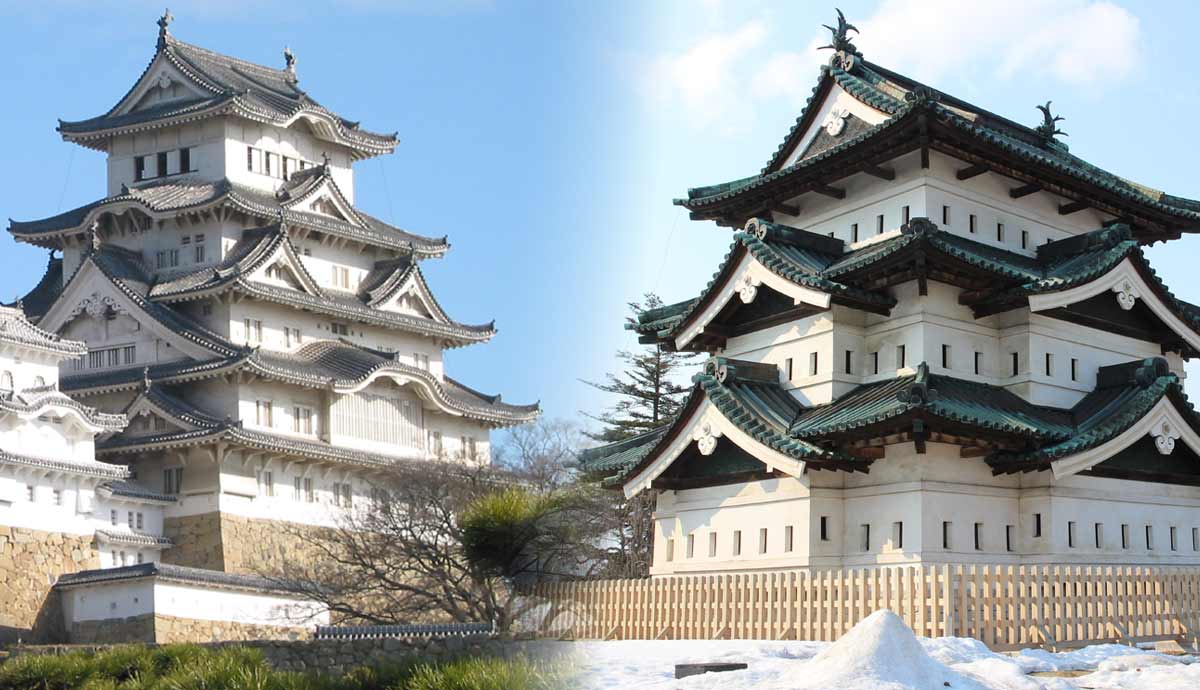
Japanese castles, or (o)shiro, might be symbols of the countrys feudal past but they have played a key role in shaping modern Japan. It was through the building, taking, and destroying of castles that powerful feudal lords managed to reunite the country after the imperial and military governments collapsed in the 15th century. Once peace returned to the land, castles became important administrative centers around which Japans major cities eventually sprouted. Let us explore the history, design, and legacy of Japanese castles in more detail.From Earthworks to Engines of WarNorth sluice of the Iwakisan Kogoishi, by TT mk2, 2014. Source: Wikimedia CommonsThe earliest fortifications in Japan, dating back to the 6th-7th centuries CE, would not be recognized as the shiro we know today. Constructed primarily from earth and wood, these early defensive structuresknown as kogoishi when inspired by Korean/Chinese fortifications or chashi among the Ainurelied primarily on the landscape rather than any masonry. However, some did feature stone walls and foundations for buildings. On the whole, though, these were temporary outposts with simple defenses; bases from which troops were dispatched and battles directed, rather than permanent strongholds. Most were abandoned once they served their purpose.By the Nara Period (710794), permanent fortresses began to be constructed. They were protected by a great embankment [where water] was collected. This was called the mizuki (water fortress). (Turnbull, p. 9) These constructions remained rudimentary yet laid the foundation for later castle architectural advancements.During the Heian Period (7941185), the emerging samurai class began engaging in private wars, prompting feudal lords to construct their own fortified residences. These featured simple defenses such as palisades or moats. The Kamakura Period (11851333) saw a further development of shiro in response to internal unrest and external threats like the Mongol invasions of 1274 and 1281. However, it was not until the Sengoku Period (15th16th centuries), a time of near constant civil war, that Japanese castles started to take the form that we are familiar with nowadays.Osaka Castle in Osaka, Japan, by Otto Domes, 2018. Source: Wikimedia CommonsDuring the Sengoku or Warring States period, powerful feudal lords erected thousands of strongholds all over Japan. Some estimates suggest that 30,000 to 40,000 mountaintop castles were built during this time. These strategically placed fortresses prioritized natural elevation for both visibility and defense. However, castles built on flatland also started making appearances, as did temporary siege encampments especially favored by Toyotomi Hideyoshi, the second great unifier of Japan.The development of different types of strongholds was an adaptive response to the changing nature of warfare that continued to evolve as samurai warlords kept battling for supremacy in a country without a functioning central government.As Japanese castles became bigger and stronger, they also changed samurai battle tactics, the Sengoku Period witnessing more protracted sieges than direct assault. The arrival of firearms in Japan in 1543 also had an impact on castle architecture. Earthen walls and wooden palisades proved inadequate against musket fire, prompting the introduction of bigger stone walls, fortified stone foundations, labyrinthine layouts to confuse the enemy, and extensive moats.Azuchi Castle, built by Oda Nobunaga, the first great unifier of Japan, is widely recognized as the countrys first modern castle with its keep and artillery-resistant granite walls. Toyotomi Hideyoshis Osaka Castle built during the 1580s is probably the pinnacle of shiro design. Its gargantuan walls, multiple moats, and a massive central keep effectively made it the Death Star of feudal Japan.Types and Architectural Features of Japanese CastlesView of Himeji Castle from Nishinomaru, by Reggaeman, 2002. Source: Wikimedia CommonsJapanese castles were not monolithic in their design. Incidentally, while these fortresses were military installations focused on defensive goals, they were not Spartan on the outside and inside. A lot of thought often went into a shiros aesthetics, especially the castle keep. This ultimately depended on a variety of factors, primarily the type of the castle, of which there were five:Yamajiro: Built on mountain peaks, these castles offered advantages in visibility and natural defenses but presented logistical limitations like secure supply lines or paths to retreat.Hirajiro: Located on flat terrain, these castles depended on moats, rivers, and swamps for defense while offering easy access to roads and farmland.Hirayamajiro: A hybrid of mountain and flatland styles, these Japanese castles were constructed on low plain hills, combining good visibility with easy access.Shijo: These were satellite or branch castles that supported a larger central stronghold, forming a defensive network. A feudal lord during the Sengoku period would sometimes construct a shijo between his primary base of operations and enemy fortifications in order to make it easier to stage an attack.Jinshiro: Temporary encampments built for sieges. Notable for their flexibility and offensive utility.Plan of Edo Castle, by Anonymous, 1608. Source: Tokyo City LibraryCentral to most castle structures was the system of enclosures. The honmaru was the innermost area, housing the main keep and the feudal lords palatial residence. A typical castle had two more outer enclosures, although Edo Castle (today the Tokyo Imperial Palace) had a total of seven. These areas had administrative, residential, and logistical functions. Each enclosure was protected by strong walls and often a moat, usually an artificial construct but sometimes utilizing natural waterways. Each enclosure additionally had its own gates and turrets.This modular layout created multiple layers of defense, which were positioned above each other, putting attackers at a serious disadvantage of having to breach multiple fortifications while the defenders had the advantage of higher ground.Additional defenses included intentionally complex paths full of dead-ends, blind corners, and bottlenecks leading to the main keep. But, in the end, the stone walls were a castles most powerful protection. These evolved from stacking unshaped rocks to create simple barriers that were relatively easy to climb until Japanese masons were able to create seamless surfaces of stone that protected the castle from infantry and artillery fire. And becausesimilar to Japanese wooden joinery techniques used at the Horyu-ji Templethese stone walls relied on precise cuts and did not use mortar, they had a certain degree of earthquake resistance.Tenshu of Nagoya Castle, by Miramimi, 2015. Source: Wikimedia CommonsConvoluted paths were not the only examples of psychological warfare used in the design of Japanese castles. Vertical and horizontal trenches dug into slopes were good for slowing down enemies, but more than anything they were meant to blunt the momentum of advancing troops. Water moats that were unexpectedly deepened in seemingly random locations served a similar purpose, as did the gates, some of which were deliberately angled to face awkward directions to further confuse attackers and expose their flanks. Other types of gates like the masugata forced attackers into enclosed spaces that quickly became kill boxes. Similar designs were also used in the fortified temples of the Ikko-Ikki Buddhist zealots.Interestingly, the tenshukaku/tenshu main keep, possibly the most iconic part of any Japanese castle, served very few functions. It did have loopholes for archers and later riflemen but its use was primarily symbolic. The grander the main keep, the more powerful the lord of the castle looked to outsiders. Some keeps were standalone structures while others were connected to a network of buildings through corridor turrets.Shiro turrets (yagura) were as important to a castles defenses as the stone walls. Positioned at corners of the enclosures or above gates, they served a number of functions. Some were for guards, others stood above wells to protect the water supply, while others served as armories. Exterior shiro walls were often finished with thick plaster (hence the iconic white appearance of so many Japanese castles) to protect against fire and projectile weapons.Restoration and ConservationRestoration of the Fukuyama Castle main keep, by m-louis, 2020. Source: Wikimedia CommonsJapanese castles have faced numerous existential threats, starting as early as the Edo Period (16031868). After Tokugawa Ieyasu, the third great unifier of Japan, ended the warring states period and created the Tokugawa shogunate in 1603, his first goal was to weaken provincial feudal lords. One of the ways he went about it was the Ikkoku Ichijo Rei (Decree of One Castle per Province), which limited each domain/province to one fortification. The rest had to be destroyed.Then in 1873, the Meiji government issued the Haijo (Castle Abolition) edict due to the belief that castles were a symbol of an old, uncivilized Japan, and the new emperor wanted the country to project a more modern image. By some estimates, two thirds of Edo-period castles were destroyed by the edict. Between that and natural disasters and bombings during World War II, the vast majority of Japanese castles did not survive. Of the hundreds that once dotted the archipelago, only twelve main keeps from before 1868 still remain. Many were rebuilt and are invaluable tools for picturing Japans feudal landscape, but they are far from historic structures. The current castle keep of Osaka Castle was renovated as recently as 1997 and now includes an elevator.Hirosaki Castle Keep Tower, by Suicasmo, 2017. Source: Wikimedia CommonsThe surviving castles are incredibly rare and the Japanese government has gone to impressive lengths to preserve them. In the case of Hirosaki Castle (built in 1611) in Aomori Prefecture, a centuries-old engineering technique was used to move the keep without dismantling it. The entire project, which spanned 15 years, successfully repaired the castles foundation and reinforced it against earthquakes. Thanks to similar efforts all around the country, Japanese castles are being preserved for posterity as symbols of majesty, resilience, and ingenuity.Sources:Turnbull, S. (2008). Japanese Castles AD 2501540.












 English
 Arabic
 Spanish
 Portuguese
 Deutsch
 Turkish
 Dutch
Dutch
 Italiano
 Russian
 Romaian
 Portuguese (Brazil)
 Greek
Greek