• ALLTHATSINTERESTING.COM
    At Least 32 Skeletons Have Been Found At A 16th-Century Gallows In France Where The Dead Were Publicly Displayed After Execution
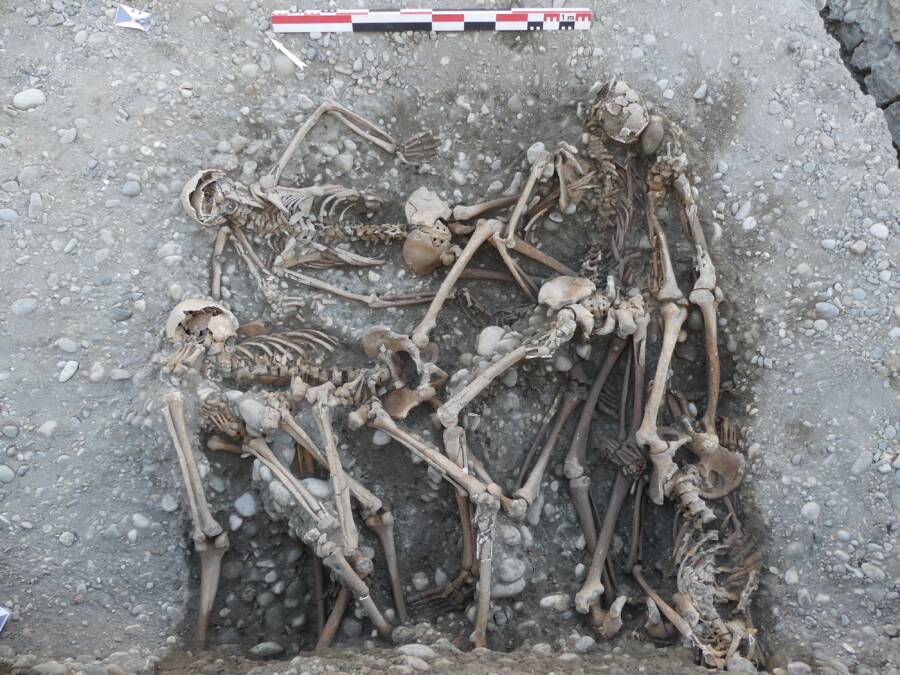
    Anne-Galle Corbara/INRAPJust some of the nearly three dozen skeletons unearthed at the site in Grenoble.Archaeologists have unearthed a public execution site from the 16th century in Grenoble, France, revealing a grim chapter of religious persecution during the countrys Wars of Religion.The discovery at the citys Grande Esplanade includes the remains of 32 people and the stone foundation of a gallows structure, known as a gibbet, that once stood as a warning to those entering the city.How The Grenoble Gallows Public Displays Served As Grim WarningsAnne-Galle Corbara/INRAPThe stone foundation of the gallows.Researchers from Frances National Institute for Preventive Archaeological Research (INRAP) found the site during 2024 excavations near what was historically the citys northern entrance at Porte de France.This area along the Isre River was marshland until the 17th century, once valued for its sand and wood, though it was gradually occupied thereafter. The new excavation, though, has shown other ways in which this spot was put to use before it was developed.The stone structure found here initially puzzled researchers, who believed it may have been a religious building or hermit cabin, until archival research in departmental records identified it as the gibet du Port de la Roche.Cdric Jean/Departmental Archives of IsreA 16th-century plan for the framework of the gallows found in Grenoble.Historical documents show that this gallows was constructed in 1544 with eight stone pillars supporting a wooden frame that sat more than 16 feet high. It was the human remains found around that structure, however, that told the full story.They are buried without any care, without any care in the ornamentation and in the way of managing, archaeologist Nicolas Minvielle-Larousse told Radio France. The bodies can be moved, mutilated and put back in other places.Anne-Galle Corbara/INRAPA double burial found in one of the pits uncovered at the site.The remains included 30 men and two women. At least one individual showed clear evidence of decapitation. They were executed in a public square the Place aux Herbes in Grenoble before their bodies were displayed on the gibbets outside the city for varying lengths of time, a common execution practice centuries ago, intended to deter crime and dissent.Public gallows typically stood at city gates or crossroads, positioned for maximum visibility. The Grenoble structures location at the northern entrance would have ensured that merchants, pilgrims, and other travelers witnessed the consequences of defying civil or religious authority.The timing of the gallows construction also coincided with intensified persecution of Protestants in France, offering a macabre reminder of the tension during the French Wars of Religion.The Tense Period Of Religious Persecution In 16th-Century FranceAnne-Galle Corbara/INRAPA decapitated skeleton uncovered at the site.Grenoble, located in the Dauphin region of southeastern France, became a hotspot during the French Wars of Religion that ravaged the country from 1562 to 1598.The French Wars of Religion pitted Catholics against Huguenots, as French Protestants were known, in a series of brutal conflicts that left hundreds of thousands dead. The wars ended with the Edict of Nantes in 1598, which granted Huguenots substantial rights and freedoms, though religious tensions persisted for decades.Archival records link the Grenoble site to notable victims of this religious conflict. Protestant rebel Benot Croyet, who was accused of attacking Grenoble in 1573, was among those executed there. Charles Du Puy Montbrun, the Huguenot military leader of Dauphin, was also beheaded, and his body was displayed at the gallows in 1575 after his capture by Catholic forces.Anne-Galle Corbara/INRAPSeveral burials found in one of the outer pits at the Grenoble gallows.The discovery provides rare physical evidence of judicial practices from the period. While historical records document hundreds of execution sites across medieval and Renaissance Europe, few have been preserved or located by archaeologists.This excavation site, like many others, has been transformed multiple times over the centuries. The marshland was drained and developed in the 1600s, eventually becoming part of the citys urban landscape. The gallows itself was likely dismantled in the early 17th century as the area was repurposed which makes the discovery all the more remarkable.INRAP researchers are continuing to analyze the skeletal remains to learn more about the lives of the condemned before their executions. Such analysis might reveal information about their age, health, diet, and the precise details of how they died almost five centuries ago.After reading about this grim discovery in France, learn about some of the most horrific medieval torture devices. Then, read about some of the strangest medieval customs.The post At Least 32 Skeletons Have Been Found At A 16th-Century Gallows In France Where The Dead Were Publicly Displayed After Execution appeared first on All That's Interesting.
    0 Comments 0 Shares 1 Views
  • ALLTHATSINTERESTING.COM
    The Chilling Story Of Randy Kraft, The Scorecard Killer Who Kept An Eerie List Of His Victims
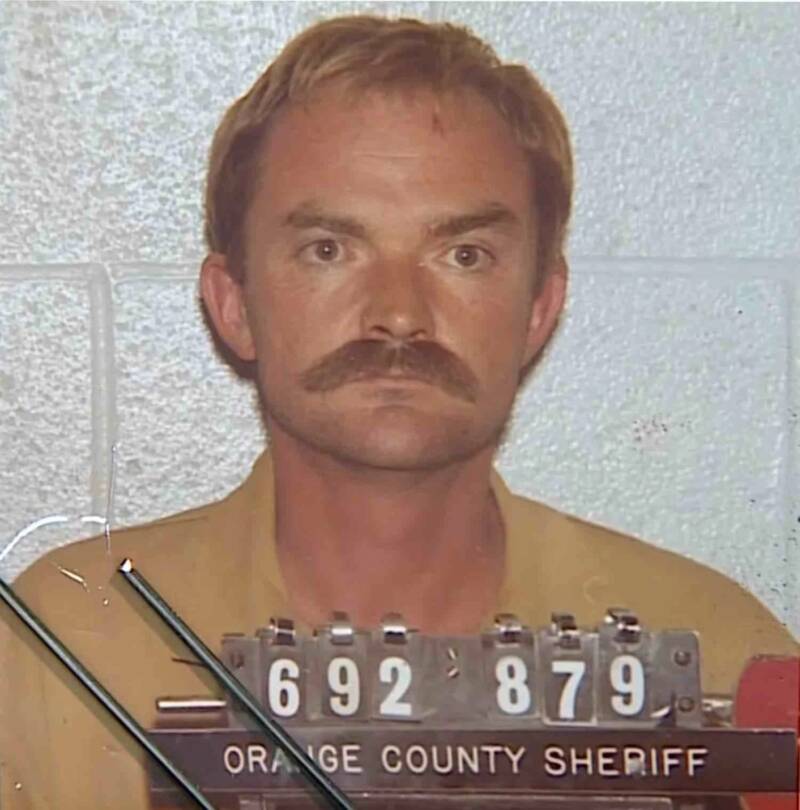
    Orange County Sheriffs DepartmentRandy Steven Kraft, the so-called Scorecard Killer.Randy Kraft has a few nicknames, including the Freeway Killer and the Southern California Strangler. But the Scorecard Killer was his most unique nickname. It was also the one that described him best.Between 1971 and 1983, Kraft murdered at least 16 young men. He usually picked up hitchhikers, whom he would ply with drugs or alcohol, before torturing them and murdering them. Kraft also had a peculiar habit: he kept a scorecard of his victims, using initials and characteristics for each one.Victim Edward Daniel Moore, for example, was listed as EDM. Meanwhile, MC HB Tattoo most likely described a Marine from Huntington Beach with a large tattoo. But eerily, though Kraft was found guilty of 16 homicides, his so-called death list has over 60 names.This is the chilling story of Randy Steven Kraft, the Scorecard Killer.How Randy Kraft Went From The Air Force To Attacking Young MenBorn on March 19, 1945 in Long Beach, California, Randy Steven Kraft struck those who knew him in his early life as quiet, gentle, and extremely intelligent. Few could have ever guessed that he would turn out to be one of the most prolific serial killers in the United States. Randy would always help you with your homework, one stunned classmate told the Los Angeles Times in 1987.In addition to playing tennis, Kraft was active in the Boy Scouts and eagerly joined a Students for Nixon group during the 1960 election. He and his academically-inclined friends were known as eggheads, and Kraft went on to study economics at Claremont McKenna College.After college, Kraft enlisted in the Air Force, but only spent a year in the service. He was discharged because of medical problems, though the Los Angeles Times reports that his discharge actually stemmed from circumstances related to his homosexuality. Orange County Sheriffs DepartmentRandy Krafts drivers license. Back in Long Beach, Kraft lived an openly gay lifestyle and made a living as a bartender at a number of gay bars in the area. He also made his first foray into violence. In 1970, longbeachize reports that Kraft picked up a 13-year-old runaway named Joey Fancher. Kraft offered Fancher a place to stay, brought him home, then plied him with marijuana, wine, and sedatives. Then, when Fancher was unable to resist, Kraft beat and raped him. After Kraft left for work, Fancher escaped and notified the police though he did not mention the sexual assault. Then, because police entered Krafts apartment without first filing a warrant, no charges were filed against him.And Randy Kraft would soon escalate his attacks on young men. Becoming The Scorecard Killer Who Tortured And Mutilated VictimsOrange County Sheriffs DepartmentThe scorecard that Randy Kraft kept, seemingly of dozens of victims. Randy Krafts first suspected victim was Wayne Dukette, a bartender who worked at a gay bar called Stables. Dukettes nude body was found dumped along Californias Ortega Highway in California on Oct. 5, 1971. Dukette had seemingly died from alcohol poisoning, but the state of his body suggested foul play. And the first entry in Krafts death list was the word Stable. Shortly thereafter, bodies began turning up alongside California highways. Krafts victims were young, between 14 and 35 years old, and many of them were former Marines. Some showed signs of being bound, beaten, and bitten, while others showed signs that they had been strangled. A few had been sodomized, castrated, or otherwise dismembered. Several were found with foreign objects inserted into their bodies. At one point, police even considered Kraft as a suspect in the murder of 19-year-old Keith Daven Crotwell, whose head was discovered in the Long Beach Marina in May 1975. But though Kraft admitted to meeting Crotwell, he assured investigators that hed left him alive and well at an all-night cafe. Public DomainKeith Crotwell, a 19-year-old victim of Randy Steven Kraft. At the end of that year, one of Krafts most gruesome murders occurred when he killed 22-year-old Mark Howard Hall. Hall disappeared after a New Years Eve party in 1975 hes believed to be New Years Eve on Krafts list and his body was found bound to a tree in Silverado Canyon in January 1976. Halls killer had burned his eyes and body with a lighter, and Hall was found with dirt stuffed in his mouth and his genitals removed. All the while, those who knew Kraft had no inkling that he was leading a double life. His colleagues at Lear Siegler, an aerospace firm, seemed to universally like him. One described him as the kind of man I would want as a father for my children, and another remembered Kraft taking the time to help her understand computers when he noticed she was falling behind. But on May 14, 1983, Randy Krafts true nature came to light. Then, the Orange County Sheriffs Department reports that Kraft was pulled over while driving erraticaly. When Kraft failed a sobriety test, police put him in handcuffs. They then noticed there was another person in the car, covered by a jacket. It was the body of 25-year-old Marine Terry Lee Gambrel.Orange County Sheriffs DepartmentThe interior of Randy Krafts car.Though Kraft asked investigators, hows my friend? and tried to claim that Gambrel was a hitchhiker, police noticed ligature marks on Gambrels wrists and bruising on his neck. They also found a belt in Krafts car that matched the marks on Gambrels throat. Randy Steven Kraft was arrested on the spot. After searching his car and his home, investigators also found photos of known murder victims and their belongings. Whats more, they uncovered a list of 67 names like Marine Carson and 2 in 1 Beach in Krafts car, which investigators came to believe was a list of his victims. The Conviction Of The Scorecard KillerSan Quentin State PrisonKrafts 2007 mugshot at San Quentin State Prison.The trial of Randy Steven Kraft began on Sept. 26, 1988 and lasted 13 months. On May 12, 1989, Kraft was found guilty on 16 counts of murder and later sentenced to death. I cant imagine doing these things in scientific experiments on a dead person, much less someone alive, Santa Ana Superior Court Judge Donald A. McCartin stated, according to the Los Angeles Times. However, Randy Kraft maintained his innocence. I have not murdered anyone, and any reasonable review of the record will show that, he stated. Instead, Kraft claimed that he was the victim of discrimination. He claimed that the death list found in his car was actually a list of potential guests hed put together for a surprise party for his boyfriend. The names were in code, he told The Pride LA, so his boyfriend wouldnt recognize them. But the Scorecard Killer remains behind bars to this day. And investigators are using genetic genealogy to identify John Does from the 1970s and 1980s, which they believe they can connect to Randy Kraft. Next, read about the chilling crimes of Harvey Glatman, the Glamour Girl Slayer. Then read about the story of the Acid Bath Killer.The post The Chilling Story Of Randy Kraft, The Scorecard Killer Who Kept An Eerie List Of His Victims appeared first on All That's Interesting.
    0 Comments 0 Shares 1 Views
  • ALLTHATSINTERESTING.COM
    Schlitzie: The Sideshow Pinhead With Microcephaly Who Audiences Called Cretin And Moron
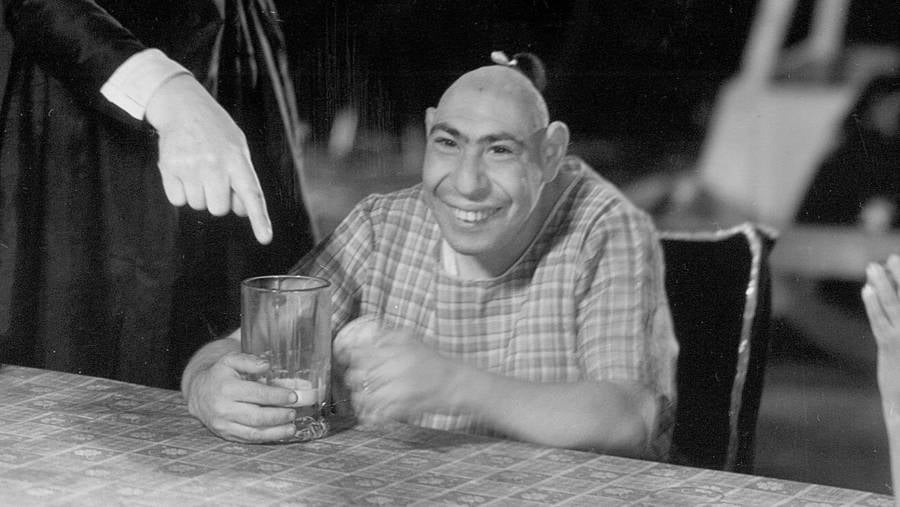
    MGMSchliztie in the 1932 film Freaks.Circus barkers called him Monkey Girl and the Last of the Aztecs. Audiences jeeringly referred to him as pinhead, cretin, or moron. But his fellow sideshow performers called him Schlitzie.In the first half of the 20th-century, Schlitzie whose real name is not known for certain performed in all of the major circus of his day as well as moves like The Sideshow (1928) and Freaks (1932). Though hed been born with physical and developmental disabilities, he was able to perform simple tasks, and spent his life under circus tents or on film sets.But we know very little about Schlitzies life outside of sideshows. Though he made an impression on audiences, and was beloved by his fellow performers, many of details of Schlitzies life are sadly lost to time.The Birth Of A Sideshow Performer: Inside Schlitzies Mysterious ChildhoodVery little is know about Schlitzies early life, but its believed that he was born around 1901, possibly in the Bronx, New York, and possibly as Simon Metz. However, other sources claim that Schlitzie was born in Santa Fe, New Mexico, and that the name Metz came from one of his early caretakers. It was also long believed that Schlitzie was born in Mexico, but this rumor is likely linked to his sideshow persona as the Last of the Aztecs. MGMSchlitzie in Freaks. The performer stood only four feet tall, and had the mental capacity of a child. What is known is that Schlitzie was born with a condition called microcephaly, a medical condition that gave Schlitzie short stature, a small head, skull, and brain, and the mental capacity of a three- or four-year-old. Its unknown what caused microcephaly in Schlitzies case, as the condition can be genetic, caused by an infection (like Zika), or triggered by alcohol or drug use by the mother. Some claim that Schlitzie had a sister, who also had microcephaly, but these reports are unconfirmed and likely rumor. According to the Brooklyn Daily Eagle, Schlitzies parents sold him around the age of eight to Stephen and Augusta Mills, who ran a traveling sideshow. As a child, he would have joined other sideshow performers of his day, largely people with physical or developmental deformities. From that point on, Schlitzie, whose microcephaly gave him a misshapen skull, would perform for jeering audiences as a pinhead.The Sideshow Freak Made Famous In MoviesMGMSchlitzie performing with other actors in Freaks. . From childhood on, Schlitzie performed with virtually every major circus of the early 20th century, including the Dobrich International Circus, Ringling Bros. and Barnum & Bailey Circus, the Tom Mix Circus, and the Clyde Beatty Circus. Though born male, he was often presented as female or androgynous, and performed in a dress. (This may have helped his caretakers more efficiently change the diaper that he needed to wear.) One of his most popular acts was to count to ten. However, it is said that Schlitzie would often skip the number seven, possibly because he forgot it or because he knew it would make the audience laugh. But while Schlitzie was a popular sideshow performer, his fame truly skyrocketed in 1932, when he appeared in the horror film Freaks. A story of love and betrayal set in the world of sideshows, the film is most well-known today for featuring a number of actual sideshow performers like Schlitzie.The movie was widely criticized for its grotesque horror, including the implication (later removed) that the sideshow performers castrated a man. The movie was largely assailed in the press (The Hollywood Reporter called it an outrageous onslaught upon the feelings, the senses, the brains and the stomachs of an audience) and banned in some places. One woman even threatened to sue MGM after claiming that the film caused her miscarriage. Wikimedia CommonsPoster for the 1932 film Freaks.Despite the negativity surrounding the film, however, critics adored Schlitzie, who appeared in two scenes and spoke in a soft, slurred tone. His innocent demeanor charmed them, just as it had charmed the cast and crew. Schlitzie was a triumph, journalist Faith Service wrote, according to the Brooklyn Daily Eagle, a favorite of the MGM lotBut though briefly famous, Schlitzies position in life remained precarious. He remained at the mercy of his caretakers for better and for worse. The Final Years Of The Famous Sideshow PerformerMGMSchlitzie performing with another actor in Freaks. After the success of Freaks, Schlitzie continued to perform in sideshows. In 1936, he was adopted by George Surtees, who signed him to the Tom Mix Circus. (This is why Schlitzies name is sometimes documented as Schlitzie Surtees.) But while George, a chimpanzee trainer, cared for Schlitzie for decades, his death in 1965 left the sideshow performer without protection. At that point, Surtees daughter who had no interest in caring for him had Schlitzie committed to Los Angeles Hospital. Schlitzie was committed there for two sad, lonely years. Though hed never had a family or a permanent home, circus life was the only life hed ever known. No longer was Schlitzie surrounded by a cast of colorful performers. Hospital life was sterile, frigid, and lonely.By happy coincidence, however, a sideshow sword swallower named Bill Unks happened to recognize Schlitzie at the hospital in 1967. Unks immediately lobbied to be made Schlitzies caregiver, and the hospital allowed Schlitzie to leave the hospital under his care. Though the world of sideshows had changed since the early 20th century freak shows were no longer in vogue, and performers were more likely to be snake charmers or sword swallowers than people with disabilities Schlitzie was able to find performance opportunities. He performed in Toronto, New Mexico, and Pennsylvania, and even appeared at the LA Memorial Sports Arena with Ed Sullivan in 1969. After his subsequent retirement, Schlitzie also entertained people in Los Angeles by dancing and feeding pigeons at MacArthur Park, according to the Hollywood Reporter. Then, in 1971, Schlitzie died at the age of 70. Despite his fame, Schlitzie had never made any significant amount of money. He couldnt even afford a gravestone, and was initially buried in an unmarked grave. However, fans ultimately raised money to mark his resting place at Queen of Heaven Cemetery in Rowland Heights, Los Angeles, with a simple black stone. It was a final act of kindness for a man who, despite the odds against him, had made an impact on countless people throughout his life.After this look at Schlitzie, discover the stories of other sideshow performers, such as the conjoined Hilton Sisters and Lobster Boy.The post Schlitzie: The Sideshow Pinhead With Microcephaly Who Audiences Called Cretin And Moron appeared first on All That's Interesting.

    0 Comments 0 Shares 1 Views
  • 0 Comments 0 Shares 3 Views
  • WWW.BGR.COM
    iPhone Fold Isn't Even Out Yet, But Samsung Might Already Be Copying The Design
    Apple is still months away from revealing its first foldable iPhone, but there's already evidence that Samsung could release a phone with a similar design.
    0 Comments 0 Shares 1 Views
  • TECHCRUNCH.COM
    I hate that I love Riversides AI-driven Rewind for podcasters
    Riverside's year-end review is amusing, but it represents a creative culture that's increasingly entwined with AI.
    0 Comments 0 Shares 1 Views
  • TECHCRUNCH.COM
    Disneys OpenAI deal is exclusive for just one year then its open season
    After the one year is up, Disney is free to sign similar deals with other AI companies.
    0 Comments 0 Shares 1 Views
  • WWW.DOGINGTONPOST.COM
    How to Choose Dental Care Dog Treats for Your Pet
    Your dogs oral health directly impacts their overall wellbeing, yet 80% of dogs show signs of dental disease by age three. Poor dental hygiene leads to pain, tooth loss, and serious health complications.We at DogingtonPost know that selecting the right dental care dog treats makes a significant difference in preventing these problems. The right treats actively remove plaque while keeping your pet engaged and happy.Understanding Your Dogs Dental Health NeedsWhat Dental Problems Should You Watch ForYellow teeth, bad breath that clears the room, and red gums signal serious dental trouble in your dogs mouth. The American Veterinary Medical Association reports that most pets suffer from dental health problems, with periodontal disease affecting the majority of adult dogs.Watch for loose teeth, excessive drool, difficulty chewing, or pawing at the face. These symptoms indicate bacteria buildup that can spread to vital organs through the bloodstream and cause heart, liver, and kidney damage.How Dental Treats Fight Plaque and TartarDental treats work through mechanical action as your dog chews, with studies showing they can reduce plaque coverage by 30% to 40%. The textured surfaces scrub teeth clean while they promote saliva production, which naturally fights harmful bacteria.Products approved by the Veterinary Oral Health Council must meet specific standards to earn their seal. Daily tooth brushing remains the gold standard, but dental treats offer an effective alternative for dogs that resist brushing.Why Breed Size Matters for Dental CareSmall breeds face higher dental risks due to crowded teeth in tiny mouths, which makes them prone to faster plaque accumulation and tooth loss. Large breed dogs need harder, bigger treats to effectively clean their 42 teeth, while toy breeds require smaller, softer options to prevent choking.Brachycephalic breeds (like bulldogs) struggle with breathing during chewing and require specially designed treats that clean efficiently without extended chew time. Match treat size to your dogs mouth treats should be large enough to prevent swallowing whole but small enough for comfortable chewing.The right dental treat depends on more than just your dogs size. Specific features in these treats determine how effectively they clean teeth and support oral health.Key Features to Look for in Dental Dog TreatsTexture Creates the Cleaning PowerThe texture of dental treats determines their cleaning effectiveness, with ridged and knobby surfaces providing superior plaque removal compared to smooth alternatives. Research shows that treats containing specific ingredients can efficiently decrease plaque and calculus accumulation in dogs. Hard treats scrape away stubborn plaque deposits, while softer options work better for senior dogs or those with sensitive teeth. Treats that crumble easily lose their mechanical cleaning action before your dog finishes chewing, making them ineffective for oral health.Size and Shape Selection StrategyMatch treat size to your dogs weight and jaw strength, not just their breed. A 20-pound dog needs treats roughly the size of their back molars to prevent gulping without chewing. Bone-shaped treats with textured ends clean back teeth effectively, while twisted or braided designs increase surface contact time during chewing. Dogs weighing under 25 pounds should receive treats no larger than 2 inches to prevent choking, while dogs over 50 pounds need treats at least 4 inches long for proper cleaning action.Active Ingredients That Fight BacteriaPolyphosphate coatings reduce tartar formation by 55% according to dental studies, making this ingredient a powerful tool for problem cases. Chlorophyll and parsley extract neutralize odor-causing bacteria, while enzymes like glucose oxidase break down biofilm formation on teeth. Natural fiber sources like sweet potato provide gentle abrasion, and calcium carbonate helps strengthen tooth enamel. Products with zinc compounds actively fight bacterial growth (though some dogs may experience stomach upset with high concentrations).What to Avoid in Dental TreatsSkip treats with excessive sugars or artificial colors that feed harmful bacteria in your dogs mouth. Products that dissolve quickly provide minimal cleaning benefit and waste your money. Treats harder than your dogs teeth can cause fractures and expensive dental procedures. Rawhide products without proper processing may contain harmful bacteria that pose health risks.The Veterinary Oral Health Council sets strict standards for dental product approval, requiring products to reduce plaque by at least 10% or tartar by 20%. These approved products represent the most effective options available for maintaining your dogs oral health.Which Dental Treats Actually WorkVOHC-Approved Treats Deliver Proven ResultsGreenies Regular Chewy Dental Dog Treats earn the most widespread veterinary recommendations among VOHC-approved options, with their unique texture and shape that reduces both plaque and tartar buildup. Virbac C.E.T. Enzymatic Rawhide Chews feature a distinctive Z-shape that increases contact with tooth surfaces, which makes them 42% more effective than standard round treats.OraVet Dental Hygiene Chews contain delmopinol, which has shown a 42% reduction in plaque and 54% reduction in halitosis with daily use. These VOHC-approved products must demonstrate proven effectiveness in controlled studies, which makes them the most reliable choices for serious dental care.Natural Chews Versus Synthetic OptionsNatural dental chews like WHIMZEES use limited ingredients such as potato starch and glycerin, which makes them suitable for dogs with food sensitivities. However, synthetic options like Greenies contain precisely controlled abrasives and enzymes that natural products cannot match for effectiveness.Natural rawhide chews provide excellent mechanical action but carry contamination risks and digestive concerns that synthetic alternatives avoid. Purina DentaLife Daily Oral Care treats use synthetic fibers that maintain their texture throughout the chew session, while natural alternatives often soften and lose their power. For maximum dental benefit, synthetic VOHC-approved treats outperform natural options (though natural chews work better for dogs with ingredient allergies).Size-Specific Product RecommendationsSmall dogs under 25 pounds need Greenies Petite or Virbac VeggieDent Extra Small to prevent choking while they provide adequate time for thorough teeth contact. Medium dogs between 25-50 pounds benefit from Greenies Regular or Blue Buffalo Wilderness Wild Bones, which offer the right balance of hardness and chew duration.Large breed dogs over 50 pounds require Greenies Large or Pedigree Dentastix Large, which provide sufficient challenge and action for powerful jaws. Giant breeds need extra-large options that prevent gulping while they last long enough to clean all 42 teeth effectively (these dogs can easily swallow smaller treats whole without any benefit).Final ThoughtsEffective dental care dog treats require VOHC approval, proper size for your dogs weight, and textured surfaces that provide mechanical action. Products with polyphosphate coatings and enzyme ingredients deliver superior plaque reduction compared to basic chews. Start new treats gradually with half portions for three days while you monitor for digestive upset or allergic reactions.Supervise initial sessions to verify your dog handles the size and hardness appropriately. Never switch multiple dental products at once (this prevents you from identifying which product causes any adverse reactions). Consistent daily use of quality treats reduces plaque by up to 40% and prevents costly veterinary dental procedures.Poor dental hygiene affects 80% of dogs by age three, but proactive care prevents pain and systemic health complications. Combined with regular brushing and professional cleanings, these treats maintain your dogs oral health throughout their lifetime. We at DogingtonPost provide comprehensive guidance on responsible dog ownership that enhances your pets quality of life.
    0 Comments 0 Shares 1 Views
  • YUBNUB.NEWS
    Watch Live: The WAR Zone Podcast With Wayne Allyn Root Presented by The Gateway Pundit- The Bondi Attack, Rob Reiner and More
    CLICK HERE TO WATCH RIGHT NOW!The Most Exciting, Intense, High-Energy MAGA/America First Podcast in the USA!2 Hours Daily, Monday-Friday, 6 to 8 PM Eastern, 3 to 5 PM Pacific
    0 Comments 0 Shares 1 Views
  • YUBNUB.NEWS
    Official Study Concludes Sitting Too Long Raises Heart Disease Risk
    An official new study has confirmed that prolonged sitting significantly increases the risk of heart disease and diabetes in adults over 60 even for those who exercise. Published in theJournal
    0 Comments 0 Shares 1 Views