



ALLTHATSINTERESTING.COM
33 Photos That Reveal How Terrifying Italys Years Of Lead Really Were
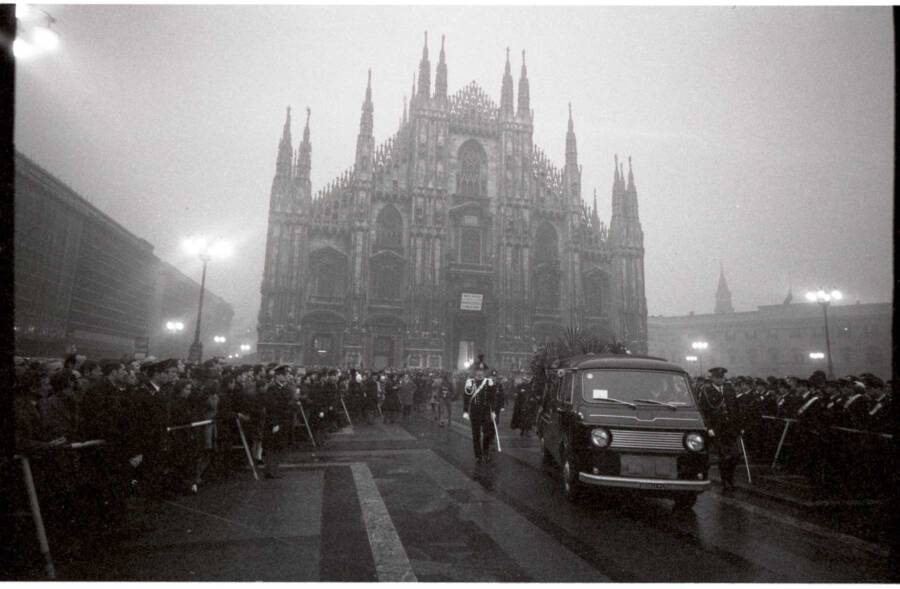
Beneath the familiar rhythms of Italian life in the 1970s, something had fractured. The caf tables still filled each evening along Romes Via Veneto, couples still strolled through Florences Piazza della Signoria, and the espresso machines still hissed in Milans fashionable bars. But things were not as peaceful as they may have seemed in these quiet moments.Click here to view slideshowBetween roughly 1969 and 1988, Italy descended into a period of political violence so pervasive that it earned a chilling nickname: Anni di Piombo, or the Years of Lead a reference to the lead bullets that became horrifically commonplace in the Italian streets. It wasn't a conventional civil war with clear front lines, nor was it a foreign invasion that united Italians against a common enemy. The Years of Lead represented a battle of extreme ideologies, and it was characterized by acts of terrorism and violence from both far-left and far-right groups. The country was simultaneously on the brink of a Marxist revolution and another fascist takeover. It was a dark chapter that casts a shadow to this day. The casualty count of the Years of Lead tells part of the story: tens of thousands of acts of political violence, hundreds dead, and thousands wounded. But numbers alone do not fully capture the psychological toll those decades took on a nation that had rebuilt itself from the ashes of fascism and World War II, only to find itself unable to guarantee its citizens' safety just a generation later.The Piazza Fontana Bombing Marks A Dark Turn For Italian DemocracyDec. 12, 1969, began as an ordinary Friday in Milan, but around 4:45 p.m., that normalcy was destroyed by a deadly tragedy. As customers stood in line at the Banca Nazionale dell'Agricoltura in Piazza Fontana, a bomb exploded with devastating force, tearing through the crowded bank. "I was sitting at my desk behind the bank counter. I heard a blast, a bolt which stunned me," clerk Michelle Carlotto told the BBC at the time. "In the smoke I saw a body fly from the public section above the counter and fall one yard away from me. I was shocked, I couldn't move."Three more explosions went off across Rome around the same time, leaving at least 16 people dead within the hour and dozens more wounded. In the aftermath, Italian Prime Minister Mariano Rumor called what came to be known as the Piazza Fontana Massacre "an act of barbarism which has no precedent in the history of the country." But while this extreme attack may have been unheard of at the time, it ultimately set the precedent for the next two decades of violent extremism. The bombing was a turning point that graduated political unrest to the mass casualty terrorism and insidious misdirection that marked the Years of Lead.La strage di Piazza Fontana e le bombe a Roma/Light HistoryA massive funeral in Milan for the victims of the Piazza Fontana massacre. December 1969.Police initially arrested Pietro Valpreda, an anarchist, along with other left-wing activists, feeding a narrative that leftist extremists were responsible. The media amplified this story, and for a time, it seemed to confirm the fears of conservative Italians that radical leftists posed an existential threat to social order. Only gradually, through years of investigations, trials, and revelations, did a different picture emerge.The evidence increasingly pointed not to anarchists but to neo-fascist terrorists, specifically members of the Ordine Nuovo (New Order), a far-right group with disturbing connections to elements within Italy's security services.Some investigators began to use the phrase strategia della tensione the "strategy of tension" to describe what they believed was actually happening: right-wing terrorists were conducting attacks designed to be blamed on the left. The goal of this strategy was to create public fear and disorder to effectively justify authoritarian measures and discredit leftist movements. And the confusion and murky investigation surrounding the Piazza Fontana bombing became the template for Italy's descent into chaos, one that would play out numerous times during the Years of Lead. The Early Days Of The Years Of LeadThe year 1974 was a particularly dark chapter in the Years of Lead, with two major attacks that showed just how far neo-fascist terrorists were willing to go. On May 28, during an anti-fascist demonstration in Brescia's Piazza della Loggia, a bomb exploded from within the crowd, killing eight people and wounding more than 100 others. It had been placed in a garbage can in the square, right where hundreds of citizens had gathered to protest against fascism, with the intent of eliminating as many of them as possible. Public DomainSmoke in the air just after the bomb went off at the Piazza della Loggia in Brescia. May 28, 1974.It wasn't the only attack that summer, though. On August 4, the Italicus Express, a train carrying vacationers from Rome to Munich, became the next target. As the train passed through a tunnel near San Benedetto Val di Sambro, a bomb went off in one of the cars, killing 12 people and wounding another 48. According to a New York Times report from the following day, investigators did not know at the time who had set off the bomb but said the attack "appears certain" to have been a terrorist act. Later investigation and trials once again pointed to neo-fascist groups, but like before, it was difficult to link specific individuals to the attack with any confidence.Regardless of who perpetrated the act, both of these bombings in such close succession drove home a terrifying reality that nowhere was safe not public squares where people exercised their democratic right to assembly and not even trains full of families on vacation. The Kidnapping And Murder Of Aldo Moro By The Red BrigadesOn the far-right side, neo-fascists aimed to terrorize through indiscriminate slaughter, but the far-left was not beyond terror either. The most notorious leftist organization during Italy's Years of Lead was the Red Brigades, and while its members did not typically resort to mass murder, their preferred methods were just as brutal: targeted assassinations and kidnappings designed to strike at the heart of the state. Of all their operations, though, none were as audacious as the one they pulled on March 16, 1978. That day, the Red Brigades kidnapped Aldo Moro, the former prime minister and president of the Christian Democracy party. As Moro's motorcade traveled through Rome's Via Fani, Red Brigades members staged an ambush that left his five bodyguards dead and the politician himself spirited away to a secret prison. For 55 days, Moro became a hostage and propaganda tool as the Red Brigades issued statements portraying themselves as revolutionary tribunals judging the crimes of the Italian state.Moro himself, a skilled negotiator who had been working to bring Italy's Communist Party into government a historic compromise that might have stabilized Italian democracy wrote increasingly desperate letters to colleagues and family, pleading for negotiation. Unfortunately for Moro, the Italian government, led at that time by Prime Minister Giulio Andreotti, adopted a firm policy of refusing to negotiate with terrorists. Public DomainA photo of Aldo Moro that was released by the Red Brigades after he was abducted.It was a decision that sparked agonizing national debate. Should the state bargain for one man's life, even its own former leader, and risk legitimizing terrorism? Or should it hold firm to principle regardless of the personal cost?Before anyone could settle on an answer, however, Moro's situation came to an abrupt end. On May 9, 1978, Aldo Moro's body was found in the trunk of a car parked on Via Caetani in Rome, halfway between the headquarters of the Christian Democrats and the Communist Party a clearly symbolic choice of location. He had been shot 11 times. The murder certainly shocked Italy and the world, but it did not bring the Red Brigades the revolution they sought. Instead, it galvanized public opinion against political violence and provided the impetus for a more robust state response to terrorism. In a way, the kidnapping and murder of Aldo Moro represented the height of the Red Brigades' operations and, ultimately, the beginning of their decline.And like the Piazza Fontana bombing, the specifics of who was involved in Moro's death are murky and still something of a mystery to this day. Several Red Brigades members were caught and imprisoned, but conflicting testimonies and an unclear timeline made it difficult to determine that the terrorist group had operated alone.Regardless, Moro's assassination marked a major turning point in Italian political discourse, but the Years of Lead still had yet to come to an end. In fact, the deadliest attack was still on the horizon. The Bologna Station Bombing, The Deadliest Attack During The Years Of LeadAt 10:25 a.m. on Aug. 2, 1980, a bomb that was hidden in an unattended suitcase at Bologna's Centrale train station detonated with catastrophic force. The explosion destroyed the waiting room and collapsed much of the station's western wing. The death toll climbed to 85, and 200 other people were wounded, making the tragedy the single deadliest attack of the Years of Lead.Like every other investigation, determining the actors behind the attack was complex. It would take years of trials, appeals, and retrials to secure convictions of neo-fascist terrorists from the Nuclei Armati Rivoluzionari (Armed Revolutionary Nuclei). Public DomainThe destruction at Bologna Centrale train station after the explosion on Aug. 2, 1980.But the legal proceedings also unveiled disturbing allegations about the Propaganda Due a secret Masonic lodge with connections throughout Italy's political and military establishment and its apparent involvement in covering up the truth about the bombing.The Bologna massacre also proved to be a breaking point for the public. The strategy of tension had reached its apex, and as the city of Bologna began to rebuild and remember victims, several larger factors impacting Italy as a whole began to converge. First, the Italian state developed more effective counter-terrorism capabilities, including specialized police units and the introduction of laws allowing pentiti repentant terrorists who agreed to cooperate with authorities in exchange for reduced sentences. It was a controversial policy, but it proved to be highly effective at enabling the police to break down terrorist cells. Second, the political landscape evolved in ways that undercut extremist narratives. The Italian Communist Party, for example, maintained its commitment to democratic processes and explicitly condemned political violence, denying terrorists any legitimate claim to revolutionary credibility. The political compromises and coalitions that Aldo Moro had died trying to achieve also eventually came to pass in modified forms, stabilizing Italian democracy even as it remained characteristically tumultuous.Finally, and perhaps most importantly, Italian society itself turned decisively against political violence. The Years of Lead had taken a toll, and young people who might have once been attracted to radical ideologies increasingly saw terrorism as morally and practically bankrupt. The culture decided that if change was going to happen, it would do so democratically not with bullets or bombs. The scars of those Years of Lead still exist in the Italy of today, but in the end, the country's democracy survived. It didn't happen overnight, but the power of the people not the shadowy institutions that divided them prevailed. After learning about Italy's Years of Lead, see our collection of photos from the worst riots in American history. Then, read the little-known story of the Colfax Massacre.The post 33 Photos That Reveal How Terrifying Italys Years Of Lead Really Were appeared first on All That's Interesting.
0 Comments
0 Shares
0 Views









 Arabic
 French
 Spanish
 Portuguese
 Deutsch
 Turkish
 Dutch
Dutch
 Italiano
 Russian
 Romaian
 Portuguese (Brazil)
 Greek
Greek