How Viking Raids Became Towns and Changed the Shape of Ireland
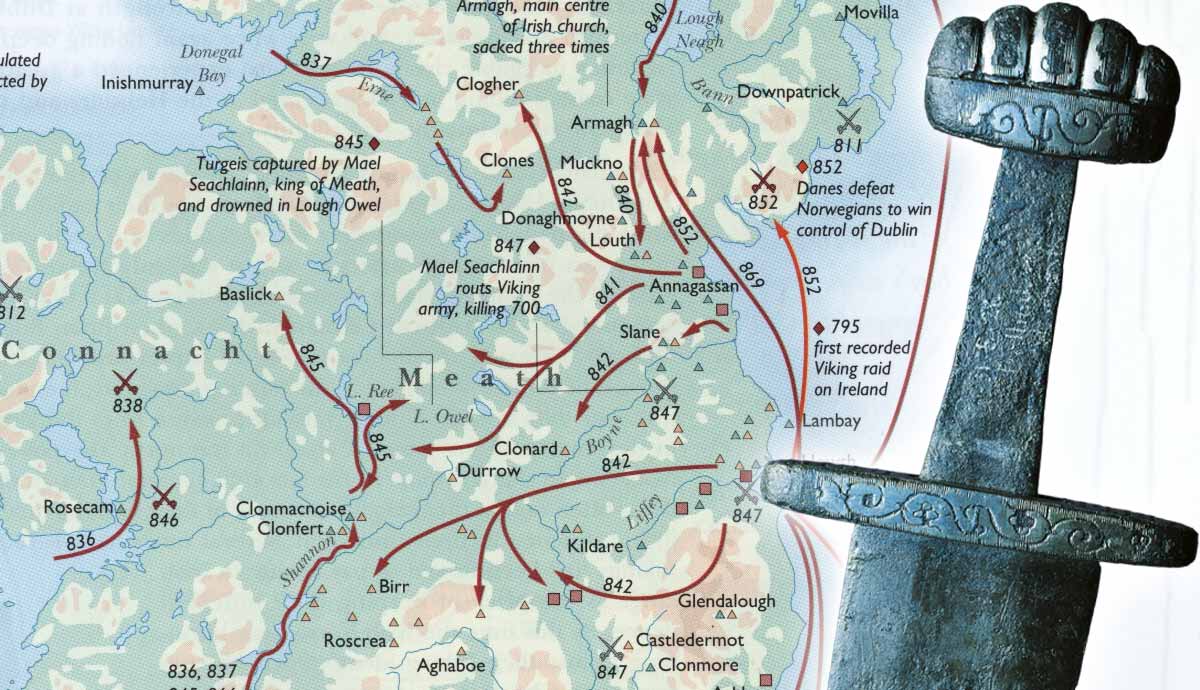
Stories about the Vikings often focus on their raids of England and France, their settlement of Iceland and Greenland, and their early trips to the New World. But the Vikings did not overlook the nearby Emerald Isle. The Vikings raided and then occupied much of Ireland for a short but intensive period in the 9th and 10th centuries. While they left a significant archaeological footprint in key strongholds like Dublin, their impact on Irish culture was less pronounced than on English culture. This is because the Norse arrivals were quickly Gaelicized and converted to Christianity, becoming part of the local landscape.Ireland Before the VikingsReverse of the Tara Brooch, c. late 7th or early 8th century, Co. Meath, Ireland. Source: Wikimedia Commons; Christ Enthroned, from the Book of the Kells, c. 800, Columban monastery of Ireland or Scotland. Source: Trinity College DublinIn the 8th century CE, before the Vikings set foot on the Emerald Isle, the local culture was Gaelic, a form of Celtic culture. It felt quite different from Britain, which had been heavily shaped by the Roman presence. Nevertheless, the country was already mostly Christianized, starting under the influence of Saint Patrick in the 5th century CE.The Irish people mostly lived in small rural communities, and there were also many monastic settlements. These were loosely organized around 150 semi-independent kingdoms, known as Tuatha, ruled by petty kings and chiefs. Fighting and alliance-building were common between the kingdoms, not unlike in the Viking world.Nevertheless, in the 8th century, Ireland was relatively peaceful and enjoying a Gaelic Golden Age. They were known for their fine artistic work, monumental Ogham inscriptions, and incredible illuminated Latin manuscripts, such as the famous Book of Kells.Early Viking RaidsPommel of the Ballinderry Sword, a Viking weapon found in an Irish bog, c. 10th century CE. Source: National Museum of IrelandThe start of Viking raids and influence in England is marked by their attack on the monastery of Lindisfarne in 793, probably carried out by Danish Vikings. Viking interest in Ireland, just a short sail over the Irish Sea for the seaborne raiders, started around the same time. The first recorded Viking raid on Ireland happened in 795. The raiders were probably Norwegian Vikings, who sailed around the Scottish coast and then south to raid the island of Lambay. They are then recorded raiding the coast of Braga in 798, and the coast of Connacht in 807.Just as in England, these initial raids were mostly small-scale, possibly involving just three or four ships. They launched smash-and-grab attacks, targeting wealthy monasteries, poorly defended and full of riches and literate monks, who would fetch a good price at Moorish and Volga slave markets. These sporadic raids continued for about two decades.By the 820s, the Vikings brought over many more ships, reportedly 50-100. They established fortified settlements along the Irish coast so that they could winter there and expand their activities. The earliest Viking camps were at Linn Duachaill (modern Annagassan) and Duiblinn (modern Dublin). From these bases, the Vikings could attack further inland, using their shallow ships to sail down rivers considered unnavigable by others. They raided wealthy settlements and then retreated to their seaside forts.Dublin-built Viking ship, tree-ring analysis shows that it was built in Dublin in 1042. Source: Roskilde Museum, DenmarkIn 836, the Vikings raided the lands to the south around Ui Neill. The following year, they sailed down the Boyne and Liffey rivers in the east and down the Shannon River in the west. In 840, the Vikings spent a year on Lough Neagh, targeting the monasteries of Armagh and Louth. Clonmacnoise, Birr, and Clonfert were pillaged in 845. As a result of these activities, some Irish monks took up arms themselves, while others relocated to the continent, Iceland, and the Faroe Islands.The Kingdom of LaithlindMap of Viking activity in Ireland, 795-873. Source: War HistoryThe Irish sources refer to a kingdom called Laithlind (or Lochlainn), which was once considered to be in Norway but is now identified as a group of Norwegian settlements in Scotland and on the Isle of Man. This kingdom fed much of the Viking activity in Ireland. Many of the larger actions in the early 9th century are believed to have been part of a coordinated effort to take Ireland for the King of Laithlind, known as Turgesius, or Thorgils in Old Norse.Thorgils has been variously identified. The Icelandic author Snorri Sturluson claimed he was the son of the first Norwegian king, Harald Fairhair, but Harald lived in the second half of the 9th century, making this chronologically impossible. Based on the testimony of the 12th-century chronicler Saxo Grammaticus, who states Ragnar Lodbrok raided Ireland, others have suggested that this king was Ragnar himself.A reference to Laithlind scribbled in the top margin, in St. Gallen manuscript Priscian Institutiones Grammaticae, Cod. Sang 904, p. 25, c. 9th century CE. Source: Stiftsbibliothek St. GallenWhile Thorgils identity remains unclear, he terrorized Ireland between 832 and 845. He reportedly oversaw the expansion of the Norse fortifications into full settlements, using them as a base to become the master of the northern half of Ireland. Snorri Sturluson says that he ruled this territory from Dublin, which was officially established in 841. The Annals of Ulster imply that his wife was a witch, or volva, casting aspersions on these pagan interlopers.In 845, Thorgils was captured by the King of Mide, Mael Sechnaill, and drowned in Loch Uair. This was followed by several other Irish victories, culminating in the destruction of Viking Dublin in 849 by the same Mael Sechnaill, who was by then the High King of Ireland. The new King of Laithlind reportedly sent 150 ships in retaliation, which caused chaos across Ireland.Dark Foreigners: Olaf and IvarWooden plank with Viking Ship and Weathervane graffiti, Dublin, c. 10th century CE. Source: National Museum of IrelandThe Viking dynamic in Ireland reportedly changed in 851 when, according to the Annals of Ulster, the Dubgenti (dark foreigners) came to Ath Claith, made a great slaughter of the Findgailll (fair foreigners), and plundered the naval encampment, both people and property. This seems to refer to the arrival of a new group of Vikings in Ireland, moving in to take advantage of the losses of the existing Vikings.In 853, a new Viking called Amlaib, probably representing the Norse name Olaf, made himself the king of Dublin. Mael Sechnaill tried to negotiate with him in 854, but with no success, as Olaf had already made himself the undisputed leader of all the Norsemen in Ireland. Olaf then reportedly raided throughout England and returned with his two sons, Imar and Asl, or Ivar and Asl in Old Norse.Ivar the Boneless and his brother Ubbe ravage the English countryside, Harley MS 2278, fol. 48r., c. 15th century. Source: British LibraryImar has been identified as Ivar the Boneless, the famous son of Ragnar Lodbrok, who was one of the leaders of the Great Heathen Army in England. Regardless of whether he was really the legendary son of Ragnar, he clearly had a significant influence on the Norse in Ireland. They became known as the Ui Imair, meaning descendants of Imar/Ivar. The same name was given to the Vikings in York in England, a city also believed to have been established by Ivar the Boneless.The following decades saw many battles and alliances between the Vikings and the various Irish kings. Initially, the decentralized nature of Irish politics, with scores of petty kings, may have led the Vikings to believe that they could take Ireland with a strategy of divide and conquer. But because there were so many kings, it was never just a simple case of removing an aristocrat and taking their territory. Every time a leader was killed, another would pop up in their place. Therefore, the Vikings always held pockets of territory, but were never able to carve out a larger kingdom in Ireland.The Hiberno-NorseHiberno-Norse silver with gold leaf brooch, Waterford, c. 1100 CE. Source: Waterford TreasuresThroughout their time in Ireland, the Vikings intermarried with the local Irish and formed alliances. Archaeological remains suggest that many Viking strongholds were occupied by a Viking elite ruling over a mostly Irish population. As the Vikings in Ireland also began to convert to Christianity, a new Norse-Gaelic or Hiberno-Norse population emerged.It is telling that when a group of Vikings led by a man called Hingamund was expelled from Ireland in the early 10th century and established themselves at Wirral in northern England, the English sources often refer to them as Irishmen.Power in DublinSilver Penny minted for Sithric Silkbeard, Dublin, c. 994 CE. Source: British MuseumThanks to Viking influence, Dublin quickly became an important settlement and trading outpost in Ireland. Control of the city changed hands frequently, shifting among Viking, Irish, and Hiberno-Norse control.Dublin is one of the most important Norse archaeological sites in Europe. Recent discoveries include the graves of five 9th-century Viking warriors. While the graves are Viking in style, Oxygen isotope analysis reveals that two were from Scandinavia and two from the British Isles, possibly Scotland, reinforcing a connection between early Dublin and the kingdom of Laithlind. These are among 100 Viking graves discovered across Dublin.The bones of a Viking warrior in a grave partly covered by the boss of his iron shield, Dublin, c. 9th century CE. Source: Archaeology MagazineThe Vikings were forced out of Dublin in 902, only for Viking leaders called Ragnall and Sithric to return with a large fleet and retake the city in 916 following the Battle of Confey. This marked a period of stability that enabled the Vikings to establish additional strongholds, including Waterford, Wexford, Cork, and Limerick.The Vikings in Ireland may have started to convert to Christianity not long after this, as, while the Vikings are described as actively raiding and slaving, in the 920s, they reportedly spared the prayer houses and the sick from destruction. They were certainly Christian by the time Sithric III Silkbeard minted the first Viking-Irish coins around 994 CE, featuring a Christian cross motif.Brian BoruVictor: Brian Boru at Clontarf in 1014, by James Ward, 1914. Source: Dublin City CouncilA High King of Ireland would later sack Dublin in 944, opening a period of Irish rule. The famous Irish leader Brian Boru then emerged on the scene at the end of the 10th century, first defeating the Norse of Limerick in 977. He apparently killed every man in the village, looted everything of value, and burned Limerick to the ground.Brian then entered an alliance with the Vikings at Waterford with the intention of attacking Dublin together. Instead, he let the Vikings attack on their own, and they were defeated. This tactic allowed him to weaken most of the leaders in southern Ireland and claim rulership over most of Ireland by 1000. He is considered the first real king of Ireland. He made the Viking leader Sithric Silkbeard ruler of Dublin, but only after he had formally submitted and handed over hostages, and after he had burned Caill Tomair, an oak grove sacred to Thor in Dublin.In 1012, the Vikings of Dublin would revolt with the help of Sigurd Hlodvirsson, a Viking leader in Orkney, and more Viking allies from the Isle of Man. A great battle was fought on Good Friday in 1014, with the Irish winning a decisive victory. While Brian died in the battle, this put an end to major Viking political domination in Ireland.Viking Impact on IrelandSurviving High Cross and Round Tower at Kilree. Source: Wikimedia CommonsThe Vikings left a smaller footprint in Ireland than in England. In England, they influenced language and culture, and even dominated politics for a period under the Viking kings of England. In Ireland, the Vikings were quickly Gaelicized, partially explaining their early conversion to Christianity by the end of the 10th century.Nevertheless, early Viking raids seem to have been a terrifying prospect. A 9th-century monk scribbled in the margin of a manuscript that: The wind is fierce tonight. It tosses the seas white hair. I fear no wild Vikings, sailing the quiet main. Irish monasteries started to be built with stone towers known as round towers. Access doors to the towers were placed one floor up, so they could only be reached by ladder. Inside the tower, each floor was also accessible only by ladder, allowing the monks to pull up the ladders when they sighted the Vikings.It was also during the age of the Viking raids that the Irish started replacing their wooden crosses with large stone High Crosses. The suggestion is that they made them big and heavy so that the Vikings could not knock them over or destroy them. Similar, but smaller, elaborate stone crosses emerged in England at the same time, some displaying themes from Norse mythology, such as the famous Gosford Cross. This suggests that these crosses may also have been influenced by the Viking practice of erecting enormous runestones with runic inscriptions and images from mythology. This may suggest one way in which Viking culture left its mark on the Irish landscape.








 English
 Arabic
 French
 Spanish
 Portuguese
 Deutsch
 Turkish
 Dutch
Dutch
 Russian
 Romaian
 Portuguese (Brazil)
 Greek
Greek