The Life, Death, and Legacy of the Opera Legend That Was Maria Callas
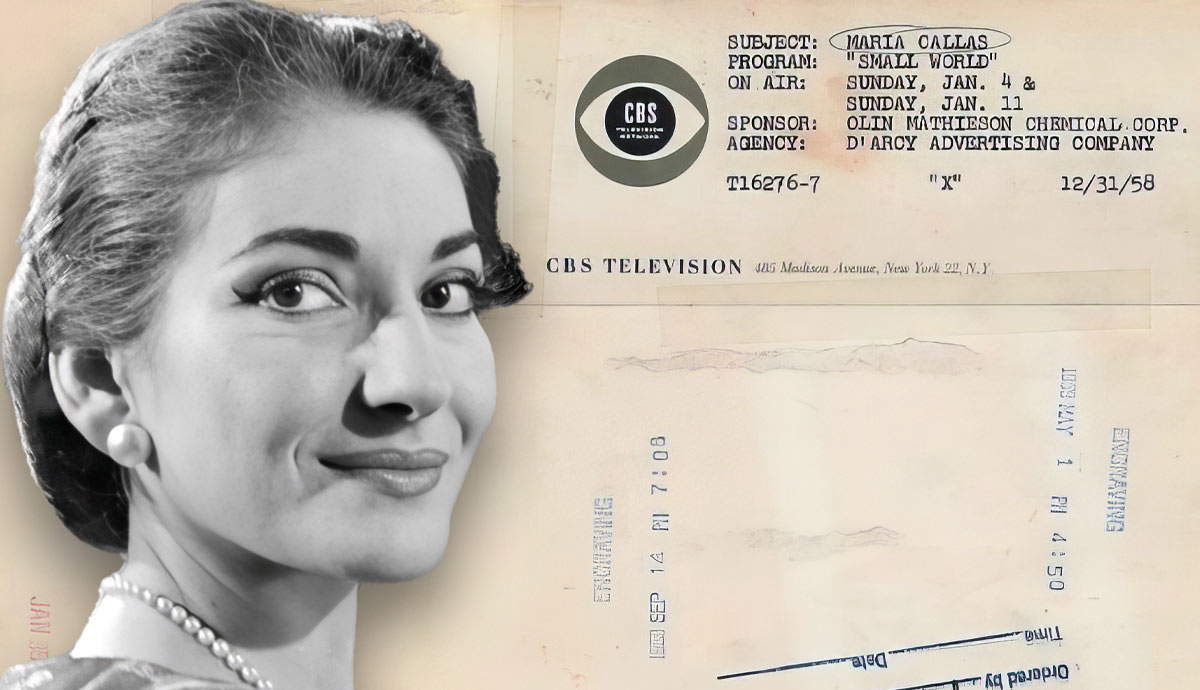
Maria Callas, a Greek-American operatic soprano, was one of the most influential opera singers of the 20th century. Her distinctive voice and charismatic stage presence dazzled audiences at the most famous opera houses, from La Scala in Milan to the Metropolitan in New York City, turning her into an icon in the 1950s and 1960s. As she began experiencing vocal problems, however, her career declined until she retired from the scene in 1965, when she was only 41 years old.Maria Callas Biography: The Early YearsPhoto of Maria Callas for the CBS talk show Small World, by CBS Television, 1958. Source: Wikimedia CommonsMaria Callas was born Maria Cecilia Sophia Anna on December 2, 1923, in New York City, the third child of Evangelia and George Kalogeropoulos. Her father later changed the family name to Callas, a word easier for English speakers to pronounce. Her parents, both Greek immigrants, already had a daughter, Yakinthi (Jackie), and a son, Vassilis, who died of meningitis in 1922 when he was only two years old. The increasingly worsening relationship between her parents turned Maria Callas childhood years into a challenging period. In 1937, after the end of her marriage, Evangelia returned to her native Greece with her two young daughters (Maria was 13 at the time).From an early age, Maria Callas musical talent became evident to her mother, who pushed her youngest daughter to perform. The relationship between Maria and her mother, however, was rocky, with the young singer feeling her mother preferred her older sister.My sister was slim and beautiful and friendly, and my mother always preferred her. I was the ugly duckling, fat and clumsy and unpopular. It is a cruel thing to make a child feel ugly and unwanted Ill never forgive her for taking my childhood away. During all the years I should have been playing and growing up, I was singing or making money. Everything I did for them was mostly good and everything they did to me was mostly bad, declared Maria Callas in a 1956 interview with Time.Maria Callas house in Athens, photograph by DIMSFIKAS, 2005. Source: Wikimedia CommonsUpon her return to Greece, young Maria enrolled at the National Conservatory, where she studied with singer Maria Trivella. At the time, her voice was still in the contralto range, the lowest female singing voice. However, when she continued her studies at the Athens Conservatory under the guidance of Elvira de Hidalgo, Callass voice rose to the soprano range, the highest human vocal register. The word soprano comes from the Italian sopra (meaning above), which, in turn, can be traced back to the Latin superius, a term used to refer to the highest register in the 13th-16th centuries polyphonic (multipart) music.In 1942, the young singing prodigy was ready to start her professional career, making her debut in the title role of Italian composer Giacomo Puccinis Tosca in Athens. By that time, Fascist Italy had already invaded Greece. The following year, the Italian forces were joined by the German army. Greece remained under Axis control until 1944. Little is known about Callas life during World War II, but the singer later accused her mother of forcing her to entertain Italian and German soldiers with her singing. As a result, Maria severed all contact with her mother. While Callas operatic career was set back by World War II, she nevertheless continued to perform.La Divina: An Opera IconMaria Callas with Italian tenor Mirto Picchi in Milan for Cherubinis Medea, by Carlo Cisventi, 1957. Source: Wikimedia Commons / Archivio Storico Ricordi, MilanAfter the end of the war, 22-year-old Maria Callas returned to her native New York City. By that time, she had already sung in seven operas with a total of 56 performances. While her scheduled performance as the title role of Puccinis Turandot for the inauguration of a new theater in Chicago fell through, her career soon took off in Italy. In 1947, she made her debut at the Arena in Verona in the title role of Amilcare Ponchiellis La Gioconda in a production featuring the Italian conductor Tullio Serafin, her future mentor.In the 1950s, her career skyrocketed, with Maria Callas performing in all the most prestigious opera houses in Europe and overseas. In the 1940s, she had mainly tackled traditional heavier roles, such as Giuseppe Verdis Aida, Isolde in Richard Wagners Tristan und Isolde, the mysterious Kundry (in Wagners Parsifal), and Brnnhilde (the valkyrie from the Norse mythology that inspired Wagner for his Ring Cycle). Tullio Serafin, however, encouraged her to take on lighter roles, especially from the so-called Italian bel canto repertoire.Meaning beautiful singing, bel canto is a type of operatic singing born in the 16th century that requires vocal agility and control from the performers. In the mid-1950s, Maria Callas took the operatic world by storm, performing in operas by Vincenzo Bellini and Gaetano Donizetti (both bel canto composers) as well as Verdi, Rossini, and Cherubini. Due to her success in these roles, the singer is often credited with reviving bel canto after a period of decline due to its technical difficulties.Maria Callas in the Netherlands, by Fotopersbureau De Boer, 1959. Source: Wikimedia Commons / Noord-Hollands ArchiefIn 1950, Callas made her debut at the prestigious La Scala theater in Milan in the title role of Verdis Aida. In the following decade, she was the lead singer in the theaters opening night six times. Her performance as Violetta, the tragic courtesan of Verdis La Traviata (literally meaning the fallen one), in the 1953 production directed by award-winning Italian stage and film director Luchino Visconti, is still considered a benchmark. Outside of Italy, she dazzled audiences in New York City, Mexico City, Berlin, London, Paris, Chicago, and Vienna, earning the nickname La Divina (The Divine One) from her fans. Maria Callas, with her distinctive eyes (and capped teeth), appeared on multiple magazine covers and in television shows.Besides her distinctive vocal tone (almost melancholic in quality), Maria Callas became known for her acting ability. While most operatic singers tended to stand in the middle of the stage and sing, Callas had an innate sense of theater and the ability to portray her roles with charisma and passion. She had an unusual ability to seek out the emotional nuance in phrases, in her arias and in her dramatic roles that went along with that particular timbre she had, remarks opera critic Conrad L. Osborne.Renata Tebaldi (Callas notorious rival) as Puccinis Madama Butterfly for the television program The Bell Telephone Hour, by NBC Television, c. 1959-1967. Source: Wikimedia CommonsWhile her exacting standards and dedication to her roles made her an icon of the operatic world, they also earned her a reputation as a demanding diva, causing disagreements with theater managers. In 1958, for example, Antonio Ghiringhelli, the manager of La Scala, lowered the curtains while she was still bowing to the audience. In the same year, her dispute with the general manager of the Metropolitan Opera was widely reported in the media.Callas also made headlines due to her feud (that divided the operatic world into two opposing factions) with Italian soprano Renata Tebaldi, whose melodious and bright voice earned her the nickname voce dangelo (angelic voice) and turned her into an international star.What Were Maria Callas Most Famous Roles?Maria Callas during the opening night of La Scala in Milan with theater manager Antonio Ghiringhelli, by AP Photo / Armando Trovati, December 7, 1970. Source: Wikimedia CommonsThroughout her career, Maria Callas sung more than 40 roles and recorded 20 operas. While her vocal range allowed her to perform a wide variety of roles, Callas moved theatergoers worldwide with her heartfelt interpretations of two operas: Vincenzo Bellinis Norma and Giacomo Puccinis Tosca.Written by the 19th-century bel canto composer in 1831, Norma is a tragedy set in ancient Gaul, where the druids, led by King Oroveso, vow revenge against the occupying Roman troops. Overosos daughter, high priestess Norma, is in love with Roman proconsul Pollione, with whom she has two children. Pollione, however, has fallen out of love with Norma and is now courting another young novice priestess, Adalgisa.Distraught, Norma contemplates murdering her children but cannot bring herself to do it. Meanwhile, Adalgisa promises to persuade Pollione to return to Norma. As news of the arrival of a new Roman official spreads, Overoso calls for a rebellion and demands a sacrificial victim. Norma offers herself as the victim, revealing to the druids that she has broken her vow of virginity. Deeply moved, Pollione joins her on the sacrificial pyre.Widely praised for her powerful interpretation of the tragic but noble priestess, Callas became especially known for her rendition of Casta diva (Chaste goddess), the operas most famous piece, a desperate plea for peace.Cover of the piano score of Giacomo Puccinis Tosca, by Adolfo Hohenstein, 1899. Source: Wikimedia CommonsBased on a French play with the same title, Puccinis Tosca is a political and romantic tragedy set in Rome in 1800 during the Napoleonic Wars. The famed singer Tosca does not know that her lover, the painter Mario Cavaradossi, supported the newly dissolved free Roman Republic. While working on a portrait in the church of SantAndrea della Valle, Cavaradossi discovers fugitive Cesare Angelotti, a former consul of the republic, and agrees to help him hide from Baron Scarpia, the sadistic chief of police, in his secluded house in the countryside.Sensing that Cavaradossi is hiding something from her, Tosca becomes convinced he is betraying her with another woman. When Scarpia storms into the church, he quickly realizes the painter has helped Angelotti escape. Meanwhile, Tosca arrives to tell Cavaradossi she has to cancel her date to perform in a gala. To arouse Toscas jealousy, Scarpia presents her with an alleged proof of Cavaradossis betrayal. Enraged, Tosca wants to confront her lover. A gloating Scarpia orders his men to follow her.The final scene of Act II of Tosca. Source: Wikimedia CommonsUpon realizing her mistake, Tosca tries to plea for her lovers life with Scarpia, who taunts her by ordering his guards to torture Cavaradossi. Desperate, Tosca reveals Angelottis hiding place. Meanwhile, a messenger arrives with news of Napoleons victory at Marengo. Cavaradossi exults, and an enraged Scarpia sentences him to death. Tosca tries to negotiate a ransom, but Scarpia tells her he will only agree if she gives herself to him.After singing Vissi darte (I lived for the art), asking God why he had forsaken her in her hour of need, Tosca reluctantly agrees to Scarpias proposal. The chief of police promises her he will stage a mock execution. When he tries to embrace her, Tosca stabs him to death, declaring morto! Or gli perdono (He is dead! Now, I forgive him), a line Callas uttered with contempt mixed with anguish.Tosca then goes to Castel SantAngelo, where Cavaradossi is held, explaining to him about the fake execution. The firing squad, acting on Scarpias orders, however, kills him. As a group of policemen arrives to arrest her, a desperate Tosca throws herself off Castel SantAngelo.Who Was Maria Callas Husband?Photo of Aristotle Onassis, by Pieter Jongerhuis, 1967. Source: Wikimedia Commons / Dutch National ArchivesDuring her career, Maria Callas made headlines not only for her performances but also for her love life. In 1949, she married wealthy brick manufacturer Giovanni Battista Meneghini, a man 20 years her senior who became her manager. While her husband was a shrewd businessman who managed to secure high fees, Callas later accused him of exploiting her and robbing her of her earnings.In 1959, Callas and Meneghini were among the guests of a Mediterranean cruise organized by Greek shipping magnate Aristotle Onassis on his yacht, the Christina. During the cruise, Callas fell in love with Onassis and later left her husband. Callas and Onassis affair was widely publicized by the media, but in 1968, the Greek businessman married Jackie Kennedy, the widow of US President John F. Kennedy.Maria Callas Last Years and Cause of DeathMaria Callas at the Amsterdam Airport Schiphol, by Bert Verhoeff / Anefo, 1973. Source: Wikimedia Commons / Dutch National ArchivesBy the time Maria Callas met Onassis, rumors had already begun to spread that her voice was experiencing a notable decline. In particular, music critics and supporters noticed her voice trembled and sometimes seemed on the verge of breaking when in the higher register. In the 1960s, as the troubles with her vocal cords increased, she decreased the number of her performances and ultimately retired in 1965. Her last operatic performance was in the title role of Tosca at the Covent Garden in London on July 5. She was only 41 years old.In 1969, she starred in the film Medea by Italian poet and director Pier Paolo Pasolini. A few years later, in 1972, she taught a series of master classes on operatic singing at the Juilliard School in New York City. Two years later, she went on a world concert tour with Italian tenor Giuseppe Di Stefano, her long-time colleague (and lover). They held performances in Europe, North America, South Korea, and Japan.Maria Callas house in Paris. Source: Wikimedia CommonsThe cause of the decline of Maria Callas voice has been the subject of endless speculation and studies. Many believe her extreme weight loss in the mid-1950s (she lost over 60 pounds in a year) and packed singing schedule are mostly to blame (in 1955 alone, she appeared in around 30 productions). Her colleague and close friend, operatic singer Tito Gobbi (who performed Baron Scarpia with Callas in several productions), however, claimed that Callas simply lost her confidence. According to Callas herself, her vocal troubles were caused by the weakening of the diaphragm.In her book Cast a Diva: The Hidden Life of Maria Callas (2021), Lyndsy Spence declares that health issues led to the singers early retirement. Indeed, in the 1950s, Callas began to experience a troubling loss of vision coupled with sore teeth. During a rehearsal of Tosca, her wig caught fire when she stood too close to some candles. Her colleague Tito Gobbi had to improvise to avoid a tragedy. According to Spence, Callas issues were due to dermatomyositis, an autoimmune condition that causes muscle weakness. To ease her symptoms, Onassis unfortunately introduced the singer to prescription drugs.Maria Callas died from a heart attack on September 16, 1977, in Paris, where she had lived as a recluse in her later years.Maria Callas LegacyMaria Callas grave at the Pre-Lachaise cemetery in Paris (her ashes were later stolen and scattered in the Aegean Sea). Photo by Peter Poradisch, 2006. Source: Wikimedia CommonsMaria Callas later years have sometimes overshadowed her accomplishments. While many portray her as a tragic figure, heartbroken by Aristotle Onassis betrayal, she was a trailblazer in the operatic world. Her undeniable commitment to her art and high standards made her one of the most influential singers of all time, and her performances continue to inspire younger generations of opera singers.As her international career coincided with the spread of LP records, opera fans can still enjoy her vocal prowess and interpretations in countless recordings (both official and pirated). Maria Callas life has also been analyzed and retold in fiction and non-fiction books, documentaries, and films. In 1995, American playwright Terrence McNally staged her classes at Juilliard in Master Class. In 2002, Italian stage director Franco Zefirelli, who worked with Callas in several productions, directed Callas Forever. More recently, Angelina Jolie depicted the legendary singer in Maria (2024).










 Arabic
 French
 Spanish
 Portuguese
 Deutsch
 Turkish
 Dutch
Dutch
 Italiano
 Russian
 Romaian
 Portuguese (Brazil)
 Greek
Greek