



WWW.LIVESCIENCE.COM
7 ways to photograph the 2026 total solar eclipse from smartphone to telescope
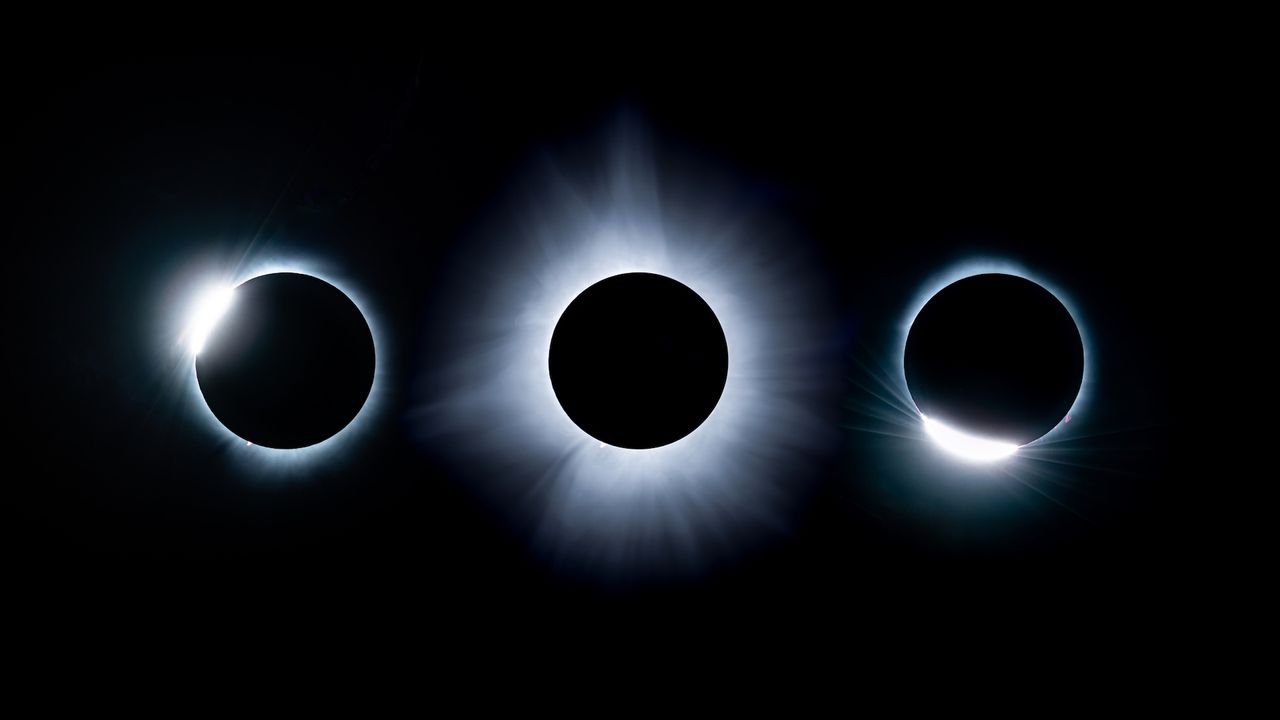
The total solar eclipse on Aug. 12, 2026, will bring thousands of photographers to a narrow path of totality through eastern Greenland, western Iceland and northern Spain. For many, it will be their first opportunity to witness totality, the brief period when the moon completely covers the sun and reveals its delicate corona, a wonder of nature that normally remains hidden by sunlight.Some first-time eclipse chasers heading to the path of totality pack expensive gear they've never used before, hoping to capture expert-level images without any preparation. Others just take a smartphone. Guess who usually comes back with the best images? Practice and rehearsal or simplicity are key. Remember, you should never look at the sun directly without specialist solar equipment (unless you are in totality), or you risk permanent damage to your sight.Preparing for totalityPhotographing a solar eclipse is unlike photographing anything else. Solar safety matters, exposure changes dramatically, and totality lasts only a few precious minutes. Despite that, memorable eclipse photographs can be taken with almost any camera. The best approach depends on your equipment, your experience and what kind of memory you want to bring home.However, you don't need to stand in the path of totality to photograph some of the event. Across much of Europe, a deep partial eclipse will occur near sunset, with more than 90% of the sun obscured in many locations. In northeastern North America, observers will see a smaller partial eclipse during the afternoon. While neither experience matches the drama of totality, both offer opportunities for striking photography.1. Take a souvenir shot through eclipse glassesA souvenir shot of the partial phase can be taken through eclipse glasses or solar viewers. (Image credit: Jamie Carter)To watch any partial solar eclipse, you'll need a pair of eclipse glasses or solar viewers; the former you wear and the latter you look through. Either works well as a solar filter for a smartphone. Simply wrap some eclipse glasses around your phone's camera lens or hold a solar viewer in front, and you can take basic images of a partial eclipse. The way to get more than just a rough souvenir shot is to put your smartphone on a tripod or purchase a Solar Snap, which not only provides a solar filter that attaches to your phone with Velcro but also includes an app that zooms in on the eclipse. If you want pinpoint sharpness without having to spend too much or travel with much gear, get yourself a smart telescope like the ZWO SeeStar S30 Pro, DwarfLab Dwarf Mini or Vanois Vespera Pro.2. Use a smartphone during totalityYou can get a great image of totality using just a smartphone. (Image credit: Getty Images)If you're traveling to Greenland, Iceland or Spain to see the total solar eclipse, take a simple smartphone photograph during totality. A smartphone cannot compete with a camera's zoom lens for close-up detail, but it's perfect for recording a wide view of the landscape you're in. In Greenland and Iceland, the eclipsed sun will hang about 25 degrees above the western horizon, making it possible to include fjords, volcanic landscapes or distant mountains in the frame. In Spain, where totality occurs late in the day, the low altitude of the sun offers opportunities to photograph the eclipse above villages, church towers, castles and mountain ridges. Before the eclipse, switch off auto-flash and enable RAW images if your phone offers them. Burst mode works well as does filming the event in 4K from a tripod and extracting stills later. 3. Take a wide-angle shot during totalityA manual camera and a wide-angle lens work well during totality. (Image credit: Getty Images)Many photographers using a manual mirrorless or DSLR camera become obsessed with the corona and forget that the eclipse affects the entire environment. The resulting images often feel disconnected from the actual experience. A well-composed landscape photograph can communicate the atmosphere of totality far more effectively. The image above was shot by expert eclipse photographer Alan Dyer, author of How to Capture the Coming Solar Eclipses, in Teton Valley, Wyoming, during the Aug. 21, 2017, total solar eclipse. It was shot with a Canon 6D and a 14mm SP Rokinon lens at f/25 for 1/10 second at ISO 100. It's one shot from a 700-frame time-lapse and was taken just as totality began, moments after the diamond ring ended, and the dark shadow of the moon is approaching from the west.4. Capture crescent sunsShadows showing crescent suns can be imaged on people's faces during a partial solar eclipse. (Image credit: Jamie Carter)When a partial solar eclipse reaches about 50% something it will only do in extreme northeast Canada and Europe on Aug. 12, 2026 it's possible to project crescent suns through anything with defined holes. It works really well through a colander or spaghetti spoon. By projecting crescent suns onto the floor, the walls and people around you, unique portrait images of eclipse chasers can be created. Unlike photographs of the corona, which thousands of people will capture, photographs like this, which document the human experience of an eclipse, can be really special.Read: Astrotourism, dark-sky and Northern Lights travel essentials5. Take a close-up of the solar coronaA close-up of the solar corona is the aim of many eclipse chasers. (Image credit: Getty Images)This is the classic eclipse photography setup and the one most commonly used by experienced eclipse chasers though it demands some serious equipment, commitment and practice. A camera fitted with a telephoto lens between 200mm and 600mm provides enough magnification to reveal detail in the corona while remaining portable enough for travel. At 400mm, the eclipsed sun fills a useful portion of the frame. At 600mm, the corona becomes significantly more prominent and fine detail begins to emerge. Lenses like the Canon RF 200-800mm f/6.3-9 IS USM, Sony FE 200-600mm f/5.6-6.3 G OSS and SIGMA 150-600mm f/5-6.3 DG DN OS Sport would be good options.Focus carefully on the partially eclipsed sun through a solar filter, and leave the focus untouched thereafter. With a camera set to ISO 100 and f/5-f/8 aperture, exposure bracketing is essential because the corona spans an enormous range of brightness. Automated exposure sequences, or bracketing, allow photographers to capture multiple exposure levels to combine later, if desired. It's always best to rehearse in advance; the excitement of totality very often leads to basic errors the classic being leaving the solar filter on during totality.6. Shoot a close-up sequence of the eclipseA composite view of various stages of a total solar eclipse. (Image credit: Getty Images)If you want to shoot a sequence throughout the entire solar eclipse that shows all of the various stages, you need to be in position, ready to take images as soon as first contact occurs, and stay there until fourth contact. Since the size of the sun won't be huge in your finished image, you don't need a huge telephoto lens. Instead, concentrate on imaging the partial eclipse at very specific times before and after totality, so that you can produce a mirror image on either side of an image of the solar corona.7. Shoot a wide-angle sequence of the eclipseA sequence of a total solar eclipse over Lac Brome, in the Eastern Townships of Quebec, Canada, on April 8, 2024. (Image credit: Getty Images)A wide-angle eclipse sequence is a different kind of image, showing not just the changing shape of the sun, but the landscape. Start with a base exposure taken during totality, when the eclipsed sun sits in a darkened twilight sky, then layer in the partial phases at regular intervals from first contact to fourth contact. The result can show the sun's path across the sky, the moon appearing to bite across it in the opposite direction, and even bright planets nearby. It's a powerful way to tell the whole story of an eclipse in one frame, especially if you include water, mountains, people or a dramatic horizon. Dyer's image above is a single exposure taken with a Canon EOS Ra and a Canon RF15-35mm lens at ISO 125, f/2.8 and 1/6s. The partial phases were photographed every five minutes from start to finish of the eclipse.Read: Best lenses for astrophotography 2026
0 Reacties
0 aandelen
26 Views




 English
 Arabic
 French
 Spanish
 Portuguese
 Deutsch
 Turkish
 Italiano
 Russian
 Romaian
 Portuguese (Brazil)
 Greek
Greek