8 Innovations From the Soviet Union
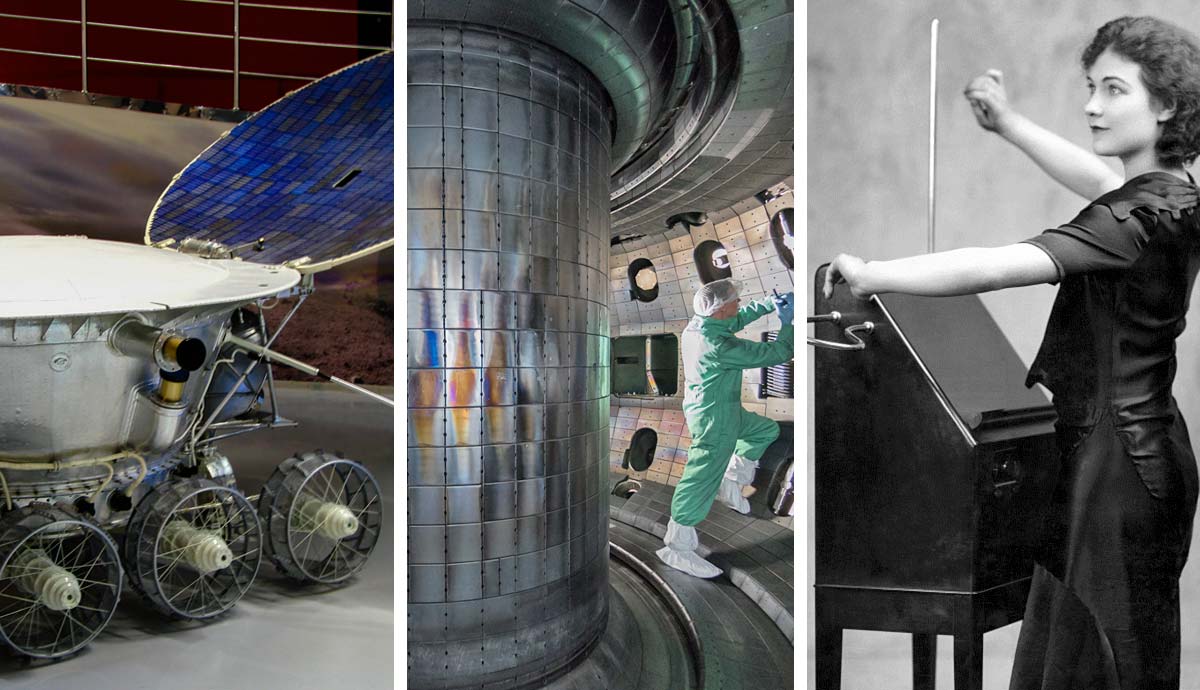
After it was founded, the USSR competed with the West in terms of political ideology, but also technological innovation. As capitalist nations began to modernize, the USSR sought to catch up through a series of Soviet inventions that would allow communism to flourish. From groundbreaking advances in human space exploration to legendary weaponry and scientific instruments, Soviet scientists and engineers developed technologies that still impact our lives today. Here are eight examples of Soviet innovation.1. Kirza: A Soviet Innovation in Synthetic LeatherA pair of Kirza leather boots. Source: Wikimedia CommonsKirza is a type of artificial leather that was invented in the Soviet Union. The material was primarily used for military boots, providing the Red Army with a cheaper alternative to costly animal leather. It is a fabric derived from cotton that combines synthetic materials such as latex and resin to create a waterproof and flexible cloth that mimics pigskin. Kirza was also used by the Soviet military to produce weapon holsters, machinery belts, and as a general replacement for animal leather.The origin of Kirza can be traced to the historical English cloth kersey, which is a traditional type of woven woolen fabric. However, while early types of Kirza did incorporate kersey in its manufacture, the name Kirza actually derived from the factory in the city of Kirov, which initially produced it. The concept of Kirza dates back to the pre-Soviet Russian Empire when, in 1904, Mikhail Pomortsev created a kersey-based leather imitation. His initial design incorporated egg yolk, resin, and wax. However, due to its complex manufacturing techniques, Pomortsevs invention had little benefit over real leather.It wasnt until the 1930s that Soviet engineers Aleksandr Khomutov and Ivan Plotnikov refined the concept of Kirza using a vacuum manufacturing process that made the material much more durable and water-resistant. During World War II, the production of Kirza increased dramatically as it was an essential component of Red Army uniforms. Kirza is still used in military boots today, with the demand for artificial leather only increasing over time.2. Sambo: Soviet Martial Art and Modern Combat SportSambo during the European Games, 2015. Source: The President of Azerbaijan / Wikimedia CommonsSambo is a popular martial art that gained prominence within the Soviet Union. It is a unique combination of traditional wrestling, judo, and self-defense techniques that was created for hand-to-hand combat. Today, sambo is recognized worldwide as a combat sport and is included in the United World Wrestling World Championships alongside Greco-Roman and freestyle wrestling.The term sambo is a combination of Russian words that means self-defense without weapons. It was first developed in the Soviet Red Army during the 1920s when it was intended to improve the combat skills and fitness of soldiers by incorporating techniques from various schools of martial arts and wrestling. Vasili Oschchepkov, a martial arts expert who trained at Japans prestigious Kodokan Institute, is considered by many to be the founding father of Sambo. Oschchepkov used the extensive training he received in Japan to create the techniques of sambo, which could be learned by Soviet Red Army soldiers. Despite his influence, Oschchepkov was persecuted by the state throughout much of the 1930s and eventually died during Stalins great purge.Another key figure in the creation of Sambo was Viktor Spiridonov. He took Oschchepkovs innovations and created a softer style of the sport, which allowed him to participate as he had been injured in battle during World War I. Spiridonovs method focused on technique over brute physical force, and eventually, the two forms of sambo merged, making the sport what it is today. The recognition of sambo as a sport in its own right was spearheaded by Anatoly Kharlampiev, one of Oschchepkovs original students. He helped to formalize sambo as a Soviet sport, and in 1938, it was officially recognized by the USSRs Sports Committee.3. Sputnik: The Worlds First SatelliteA model of the Sputnik 1 satellite, 2008. Source: Andrew Butko / Wikimedia CommonsOne of the Soviet Unions greatest inventions was the Sputnik 1 satellite. Sputnik was launched on October 4, 1957, making it the first-ever artificial satellite to enter Earths orbit. The launch was a historic achievement in space exploration and a major victory for the USSR in the space race. The Sputnik satellite was a polished metal sphere approximately half a meter across with four radio antennas attached. These antennas transmitted radio pulses detectable around the world. Sputniks elliptical trajectory allowed it to orbit the Earths most densely populated areas as well as some remote regions of the globe.The radio transmitters on board the satellite transmitted a continual signal for three weeks until the onboard batteries were depleted. During its lifespan, Sputnik 1 orbited the Earth approximately 1,440 times and traveled a distance of 70 million kilometers (43.5 million miles). However, without any onboard propulsion system, the satellite steadily fell victim to Earths gravity, and on January 4, 1958, Sputnik burned up in the atmosphere.4. The Tokamak Nuclear Fusion ReactorA Tokamak reactor, 2017. Source: Rswilcox / Wikimedia CommonsThe Tokamak nuclear fusion reactor design created by Soviet physicists Igor Tamm and Andrei Sakharov remains one of the most promising avenues for achieving controlled nuclear fusion here on Earth. The term Tokamak is derived from a combination of Russian words that refers to the reactors magnetic coil design. In contrast to nuclear fission reactors that split atomic fields to generate heat energy, the Tokamak was designed to achieve unlimited energy through nuclear fusion, the same chemical process that powers our sun, by fusing atomic material at extremely high pressures.By controlling the boiling hot plasma created by nuclear fusion within incredibly powerful magnetic fields, the Tokamak was the first design to achieve the high-energy reactions required for nuclear fusion. During extensive testing in the 1960s, a Soviet-built Tokamak reactor achieved previously unheard-of temperatures while attempting to create a nuclear fusion reaction. The success of the Soviet Tokamak design led to increased global interest in nuclear fusion, which eventually led to the ITER project in France, a multinational scientific endeavor that hopes to build the worlds largest nuclear fusion reactor, which uses the same Soviet design.5. The AK-47 Assault Rifle: Soviet Innovation on the BattlefieldIraqi soldiers using AK-47s, 2011. Source: US Air Force / Wikimedia CommonsCreated by the legendary figure Mikhail Kalashnikov during the years following World War II, the AK-47 has become one of the worlds most widely used assault rifles due to its reliability, simplicity, and affordability. Kalashnikov designed the AK-47 to answer the call that Red Army soldiers needed a weapon that could withstand the harsh conditions of the modern battlefield while still functioning normally. The AK-47 is made of inexpensive and easily available materials and is simple to repair and maintain. The core of the weapon is a gas-powered mechanism that quickly made the AK-47 a favorite of militaries worldwide.The AK-47 was mass-produced by the Soviet Union throughout the latter half of the 20th century and became a standard-issue weapon for soldiers in the Soviet and Warsaw Pact militaries. The AK-47s cultural impact is widespread, and it has become a symbol of revolution and resistance worldwide. Due to its simplicity and affordability, the rifle was used extensively by smaller guerilla forces and has been hailed as a pinnacle of Soviet ingenuity and creativity.6. The Lunokhod 1 Moon Rover: Exploring the MoonA model of the Lunokhod 1, 2009. Source: Petar Miloevi / Wikimedia CommonsOne of the Soviet Unions most ingenious inventions was the worlds first moon rover. After NASA successfully put American astronauts on the surface of the Moon and returned them to Earth, the Soviet space program was eager to repeat its early successes and put a cosmonaut on the moon. Launched in 1970 as part of the Lunar program, the Lunokhod 1 mission was the first robotic rover to ever move freely across the surface of another celestial object outside of Earth.The Lunokhod rover was originally designed by the Soviets to function for three months, but the craft surpassed all expectations and continued to function for nearly one year. During its time on the Moon, the rover traveled almost ten kilometers (6.2 miles) and gathered valuable data on the lunar surface. The success of the Lunokhod 1 mission was a major milestone for Soviet space exploration and provided the USSR with valuable data on the lunar soil, which was used to plan further missions to the Moon. However, following considerable political and economic challenges during the 1970s, Soviet cosmonauts never followed their American rivals to the Moon.7. Electron Paramagnetic Resonance SpectroscopyAn EPR detector in the lab, 2019. Source: Rickinasia / Wikimedia CommonsElectron Paramagnetic Resonance Spectroscopy (EPR) is a powerful tool that was developed by Soviet physicist Yevgeny Zavoisky in 1944. EPR allows scientists to detect the particular magnetic properties of electrons as they spin within paramagnetic materials. The tool has become an invaluable aid for scientists as it allows them to investigate molecular structures on a deep level and analyze the chemical processes that govern certain reactions.When Zavoisky discovered the techniques behind EPR, the scientific world hailed his groundbreaking discovery as he provided them with a non-invasive method of studying changes at the molecular level. Today, Zavoiskys techniques are used to study the behavior of free radicals within cells and to explore the complex biological processes that determine the structure of proteins.8. The Theremin: Inventing Electronic MusicMusician Alexandra Stepanoff playing the Theremin, 1930. Source: Wikimedia CommonsThe theremin was invented by Soviet scientist Leon Theremin and is one of the earliest examples of an electronic musical instrument. It is unique in that it uses two metal radio antennas to create an electromagnetic field that the user can manipulate in real-time to change the sound frequency and volume. The player does this by moving their hands near the antennas without physically touching them. This hands-free way of creating music produces an otherworldly and ethereal sound that has become an iconic staple of science fiction film scores. The theremin has had a huge impact on the electronic music genre and inspired an entire generation of experimental musicians.









 Arabic
 French
 Spanish
 Portuguese
 Deutsch
 Turkish
 Dutch
Dutch
 Italiano
 Russian
 Romaian
 Portuguese (Brazil)
 Greek
Greek