Why Did the United States Bomb Hiroshima and Nagasaki?
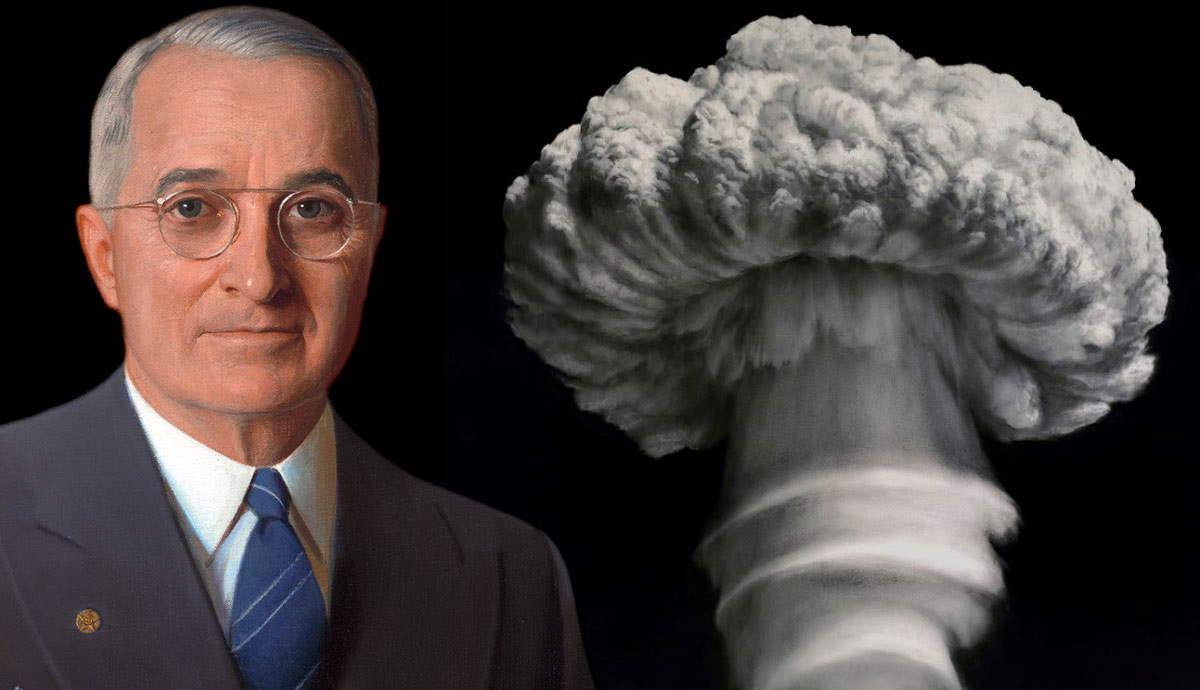
The decision to drop atomic bombs on Hiroshima and Nagasaki was one of the most consequential actions of modern history. American political and military leaders faced a series of challenges when considering how to force the surrender of the ruthless and resilient Japanese enemy. Mindful of the devastating Pearl Harbor attacks, President Harry Truman recognized that an amphibious invasion of Japan would result in the loss of countless American and Japanese lives. Truman, however, had a second option available to him: the recently tested atomic bombs. Was deploying the weapons worth their lasting consequences?Historical ContextBritish World War II propaganda poster, 1942. Source: Smithsonian InstitutionThe United States decision to drop atomic bombs on the Japanese cities of Hiroshima and Nagasaki came at the end of six years of the deadliest fighting in human history. In 1939, Germany invaded Poland, officially marking the outbreak of the Second World War. The following year, German Blitzkrieg tactics enabled the Third Reich to expand its control of Europe to Norway, Denmark, the Low Countries, and France. Meanwhile, Japan expanded its existing war against China by invading modern-day Vietnam, Laos, and Cambodia.Despite counteroffensives and organized resistance, the Allied Powers struggled to resist Axis takeovers early in the war. By late 1941, however, the balance of power changed. Following the surprise attacks on American military bases on the island of Oahu, Hawaii, the United States swift entrance into World War II strengthened the Allied cause. Within a year, the Allies drove German General Erwin Rommel out of North Africa, leading to the successful invasion of Europe via Italy. After months of deliberate planning, the Allies executed the invasion of Normandy, commonly known as D-Day, a decisive turning point of World War II in Europe. Lengthy battles ensued, but by May 8, 1945, the Allies had achieved ultimate victory in Europe. While Nazi Germany was defeated, the war continued in the Pacific and seemed destined to continue. Even though Allied forces had a decisive strategic advantage in Asia, Japanese forces seemed determined to fight to the end. Keen to avoid major loss of life in an invasion of Japans home islands, the United States sought other viable war-ending options.Military Strategy: Avoiding a Deadly Invasion of JapanFifth Marine Division cemetery on Iwo Jima, 1945. Source: Smithsonian InstitutionThe Pacific island-hopping campaigns of World War II observed brutal engagements on land and at sea including the Battles of Midway, Guadalcanal, Coral Sea, Iwo Jima, and Okinawa, leaving thousands of Allied personnel dead after three years of warfare. With Nazi Germany defeated, Allied leaders considered options for the defeat of Japan. However, without the use of atomic weapons, achieving this objective risked catastrophic outcomes for the Allies.Had it been put into practice, the proposed invasion of Japan, codenamed Operation Downfall, was anticipated as the largest amphibious assault in history. The casualty assessments of the two-pronged invasions of Kysh and Honshu matched this historic scale. While estimates of troops expected to be killed and wounded in action during Operation Downfall varied tremendously, they were all unacceptably high. General Douglas MacArthur, for example, forecasted nearly 100,000 American casualties in the first 90 days of the campaign alone. Other estimates placed upwards of one million Allied lives at stake due to heavy resistance from a determined adversary on their own turf, a logical ceiling considering Japan intended to mobilize their own population to resist Allied advances on Tokyo. Before the decision to employ atomic bombs against Japan was finalized, the United States manufactured an additional 500,000 Purple Heart medals in anticipation of the invasion, highlighting the gravity of the fragile situation at hand. President Truman was unwilling to risk the lives of so many Americans in uniform.Political ConsiderationsPortrait of President Harry Truman by Jay Wesley Jacobs, 1945. Source: Smithsonian InstitutionWhile Truman and his advisors were considering alternatives to the invasion of Japan, he sought to end the war through political means. Most notably, the Allies presented Imperial Japan with the Potsdam Declaration. This demanded an unconditional surrender from Japan in return for peace. Seeking to maintain its emperor, Japanese political leaders paid little attention and ignored the Allies warning of imminent destruction, although it did not specifically mention atomic bombs.Outside of peaceful surrender, one alternative strategy involved fighting a war of attrition through sustained bombing and naval blockade campaigns. This option, however, would have prolonged the end of the war after Germanys surrender, and if the Japanese continued to resist, boots on the ground would still be required.President Truman had only recently been compelled to consider such consequential matters. From the beginning of World War II, especially after Pearl Harbor, President Franklin Roosevelt and British Prime Minister Winston Churchill had enjoyed a very close relationship and worked together effectively. After Roosevelts death in April 1945, Truman inherited Americas seat at the top table alongside Churchill and Soviet leader Joseph Stalin. While he had limited experience in foreign affairs, as a combat veteran of World War I, Truman was well-equipped to handle this sudden increase in responsibility.The Manhattan ProjectPhotograph of J. Robert Oppenheimer by Ed Wescott, 1946. Source: US Department of Energy Archive via Wikimedia CommonsUntil English physicists first split an atom in 1932, the world was unaware of the potential for nuclear weapons. In the United States, this potential became clear one month before Germanys invasion of Poland when President Roosevelt received the EinsteinSzilard letter. Written by leading Hungarian physicists and signed by Albert Einstein, the letter warned Americas political leaders of Germanys intentions to create the worlds first atomic bomb. Fearing the worst as World War II began, the United States, with support from Britain and Canada, launched the Manhattan Project to design, develop, and test Allied nuclear capabilities before the Axis Powers could develop a nuclear weapon.The Manhattan Project quickly and discreetly ramped up across the United States after its official inception in 1942. Under the leadership of Major General Leslie Groves of the United States Army Corps of Engineers and physicist J. Robert Oppenheimer, the programs scientific director, the initiative quickly made substantial progress. Although the weapons assembly and testing site lay in the deserts of New Mexico, plutonium production and uranium enrichment were well underway behind-the-scenes in Washington and Tennessee. Leaders, however, were rushed to compete against world-renowned German physicist Werner Heisenberg, who led the German nuclear weapons program.By July 16, 1945, just two months after Germanys unconditional surrender, the Manhattan Project proved successful; the Trinity Test confirmed the worlds first workable nuclear bomb. With two weaponized payloads, named Little Boy and Fat Man, ready to be dropped on Japan, American political and military leaders debated whether it was ethical to use them.Ethical and Moral DebatesAtomic bomb mushroom cloud by Robert Longo, 2008. Source: Smithsonian InstitutionWhile many believed that dropping atomic bombs on strategic targets in Japan was the only way to definitively end World War II aside from a costly amphibious assault and invasion, internal critics of the decision suggested that there were plausible alternatives. With Germany defeated, Japan likely knew that it would be impossible to win the war. However, when given the chance for peaceful surrender, albeit unconditional, Japan refused. This reflected their ruthless resistance on Pacific battlefields where death was often preferred over surrender. As such, political leaders justified the deployment of atomic weapons despite the civilian casualties because an Allied assault against the Japanese home islands would claim far more Japanese military and civilian lives.From the American perspective, if a high death toll was inevitable, it was wise to adopt a solution that saved lives. Moreover, the United States entered World War II after Japans surprise attack on Pearl Harbor that killed nearly 2,500 troops and civilians. For some contributors to the debate, ending the conflict via a devastating bombing attack seemed a reasonable approach.With these justifications in mind, the United States dropped Little Boy and Fat Man on the cities of Hiroshima and Nagasaki in August 1945. The two sites were chosen for their industrial and military significance to the Japanese war effort. Alongside the Soviet invasion of occupied Manchuria, the decision to drop the bombs contributed to the surrender of Japan and the end of the Second World War. Regardless of ethical justifications, the bombs proved crippling to targeted populations, with resulting death estimates in the six figures, not counting those whose lives were cut short by radiation exposure in the following months and years. While this death toll may have been less than that of an Allied invasion, the legacy of the bombings is controversial due to the unprecedented devastation.Aftermath and LegacyHow to Survive an Atomic Bomb book by Richard Gerstell, 1952. Source: Smithsonian InstitutionJust like the decision itself, the legacy of the bombings of Hiroshima and Nagasaki has been subject to considerable debate. The decision may have helped to end the war, but the weapons had long-term effects on those who survived. Over time, radiation sickness gave way to significant health complications for Japanese citizens. Chronic illness, cancer, and birth defects posed serious short- and long-term consequences of deploying the atomic bombs. Survivors faced further psychological and social consequences that ostracized them from society.Overall, the atomic bombs succeeded in their objective to bring an end to World War II with as few Allied casualties as possible. While some believed that witnessing the deployment of nuclear weapons and their devastating capabilities would reduce their manufacture, the opposite ensued. After the end of World War II, the development and proliferation of nuclear weapons increased rapidly during the Cold War. The second half of the 20th century was defined by global fear of nuclear war, most notably during the Cuban Missile Crisis of 1962.While the positive and negative consequences of Trumans decision to drop atomic weapons against Japan can be endlessly debated, one overarching lesson sums up their utilization: there are no winners in war. Today, the cities of Hiroshima and Nagasaki seek to promote this message as international symbols of peace and reminders of the terrible devastation of the Second World War.









 English
 Arabic
 French
 Spanish
 Deutsch
 Turkish
 Dutch
Dutch
 Italiano
 Russian
 Romaian
 Portuguese (Brazil)
 Greek
Greek