Who Were the 4 Major Loyalist Paramilitary Groups During the Troubles?
While many tend to see the Irish Republican Army (IRA) as the undisputed protagonist of the Troubles in Northern Ireland, there were also several Loyalist paramilitary forces active between the late 1960s and the late 1990s. Groups such as the Ulster Volunteer Force (UVF), Ulster Defence Association (UDA), the Loyalist Volunteer Force (LVF), and the Red Hand Commando (RHC) were determined to defend Ulsters place within the United Kingdom and they did so by carrying out bloody attacks against Irish Republican paramilitaries as well as Catholic civilians. Statistically, from the early 1990s until the Good Friday Agreement in 1998, most paramilitary violence was carried out by Loyalist groups rather than Republicans.Unionist or Loyalist?Young men waving the British flag, photograph by Les Levine, 1972. Source: Irish Museum of Modern ArtTo understand the history of Northern Ireland and the Troubles, the bloody conflict that marred the streets of Belfast and Derry/Londonderry for three decades, it is necessary to know and understand the differences between these four terms: Unionist, Loyalist, Republican, and Nationalist. The term Unionist tends to be used interchangeably with Loyalist, just as the term Republican is often used as a synonym with Nationalist, but this is not accurate. A Unionist is someone, usually a Protestant, who believes that Northern Ireland should remain part of the United Kingdom and who is prepared to share and uphold their beliefs in a moderate and above all peaceful way, without resorting to armed struggle.Protestant paramilitary groups such as the UVF, UDA, and LVF, describe themselves as Loyalists, while political parties determined to maintain Northern Irelands status within the United Kingdom, such as the Democratic Unionist Party (DUP) and the Ulster Unionist Party (UUP), identify as Unionists.SDLP leader John Hume with Bill Clinton, 1995. Source: Wikimedia CommonsNot all Unionists are Loyalists, just as not all Republicans are Nationalists. A Nationalist is someone, usually a Catholic, who supports a united Ireland. A Republican is a Nationalist who is determined to accept, support, and embrace violence to achieve the goal of a united Ireland. Organizations such as the Irish Republican Army (IRA), the Provisional Irish Republican Army (PIRA), the Irish National Liberation Army (INLA), and the Continuity Irish Republican Army (CIRA) are armed Irish Republican paramilitary organizations. On the other hand, parties such as the Social Democratic and Labour Party (SDLP), whose leader John Hume (1937-2020) played a major role in the peace process, are nationalist political forces that ideally reject violence in pursuit of the goal of a united Ireland.1. The Ulster Volunteer Force (UVF)Loyalist Mural in Derry/Londonderry, 2004. Source: Wikimedia CommonsThe two main bodies responsible for most of the victims of the Troubles were Republican paramilitary groups (particularly the IRA) and Loyalist forces, with the Ulster Volunteer Force (UVF) alone being responsible for more than 500 deaths. Overall, it is estimated that Loyalist paramilitary groups were responsible for 29 % of the total casualties, or 1,073 deaths.The UVF was the most active loyalist group throughout the Troubles. It was formed between 1965 and 1966, a few years before the official outbreak of the Troubles in 1969, in response to the increasing (peaceful) activities of the civil rights movement inspired by the American Civil Rights Movement. The UVF took its name from the Ulster Volunteers, a Protestant Unionist and Loyalist paramilitary force founded in 1912 and based in Belfast, which was determined to resist any attempts by the British government to grant internal self-government, also known as Home Rule, to all of Ireland.The UVF was founded as a response to the growing civil rights movement in Northern Ireland, 1969. Source: Museum of Free DerryOn May 21, 1965, the UVF, led by Gusty Spence (1933-2011), issued a statement summarizing its aims and strategy: From this day, we declare war against the Irish Republican Army and its splinter groups. Known IRA men will be executed mercilessly and without hesitation. Less extreme measures will be taken against anyone sheltering or helping them, but if they persist in giving them aid, then more extreme methods will be adoptedwe solemnly warn the authorities to make no more speeches of appeasement. We are heavily armed Protestants dedicated to this cause.Over the next few days, they killed two Catholic civilians in Belfast when they couldnt find their real target, IRA volunteer Leo Martin. In the months leading up to the Battle of the Bogside and the deployment of British troops in Northern Ireland in August 1969, the UVF deliberately escalated its violence.The Free Derry Corner in late 1969. Source: Museum of Free DerryIts members planted bombs and bombed water and electricity installations across the country and publicly blamed both the (still dormant) IRA and the civil rights movement. In the early 1970s, the most violent decade of the conflict, the UVF committed itself to translate their stated objectivesto ensure that Northern Ireland remained part of the United Kingdom and to kill as many members of the IRA as possibleinto action.In addition to the indiscriminate shooting of random Catholic civilians, the UVF launched a series of car-bombing attacks on Catholic churches and Catholic-owned pubs in Protestant areas of Belfast. On December 4, 1971, they bombed McGurks Bar, a two-story pub on the corner of North Queen Street and Great Georges Street in Belfast, in a predominantly Irish Catholic area. 15 people were killed and 17 were wounded. They were all Catholics. Two of the victims, James Cromie and Maria McGurk, were aged 13 and 14 respectively.2. The Red Hand Commando (RHC)Mural showing King William III first painted in 1934 in Belfast. Source: Imperial War MuseumsThe Red Hand Commandos, a small, highly selective, and secretive Loyalist paramilitary group with close links to the UVF, was named after the Red Hand of Ulster, a controversial symbol in Northern Ireland, now mostly associated with the Protestant community, and a badge of Northern Irish Protestant identity.The RHC was formed in June 1970 in the Shankill area of West Belfast. Two years later it agreed to become part of the Ulster Volunteer Force, although it retained its own structure and commitment to secrecy. A year later, on November 12, 1973, William Whitelaw (1918-1999), Secretary of State for Northern Ireland, proscribed the organization. Most of its members were based in East Belfast, Sandy Row, Newtownabbey, north of Belfast, and parts of County Down and County Tyrone, near Castlederg, close to the border with County Donegal in the Republic of Ireland.Donegal, Ireland, photograph by Uta Scholl. Source: UnsplashAlthough the RHCs stated aim was to counter Irish Republicanism and maintain Northern Irelands status as part of the United Kingdom, the men of the RHC mainly targeted Catholic civilians and business owners through drive-by shootings and bombings.On March 13, 1972, for example, the RHC shot dead Patrick McCrory, a Catholic civilian at his home on Ravenhill Avenue in Belfast. A month later, they shot dead another Catholic civilian, Sean McConville, as he walked along Crumlin Road in Belfast. On February 18, 1973, a gunman got out of his car on Divis Street and opened fire on two Catholic postmen, Anthony Coleman and Joseph McAleese. In July 1974, the RHC bombed 14 Catholic-owned pubs in 14 days, killing one man and wounding 100 others. The majority of their attacks in the early 1970s were against Catholic civilians in Belfast and on the outskirts of Belfast.Children playing in Falls Road, Belfast, 1981. Source: Wikimedia CommonsFrom 1975 onwards, they extended their reach and began planting bombs in other counties, mainly in County Down and across the border, in County Donegal, Louth, and then, in the 1980s, also in County Kerry. They typically used cover names such as the Red Branch Knights and the more bombastic Loyalist Retaliation and Defence Group. Along with all the other major Loyalist groups, they supported the signing of the Good Friday Agreement in April 1998.3. The Ulster Defence Association (UDA)Ulster Defence Association (UDA) mural, 2013. Source: Wikimedia CommonsOn January 16, 1981, three gunmen cut the telephone wires to the home of civil rights campaigner Bernadette Devlin McAliskey in Coalisland in County Tyrone. They broke in after smashing down the front door with a sledgehammer and shot her in the chest, arm, and thigh in front of her children. She was about to wake them up. Her husband Michael was also shot twice. The British soldiers guarding their house failed to intervene. Both survived.Three years later, on March 14, 1984, Sinn Fin President Gerry Adams was driving on a lunch break in his car when several gunmen approached the car and riddled it with some 20 bullets. Hit in the arm, shoulder, and neck, Adams was rushed to the Royal Victoria Hospital. Both assassination attempts were carried out by Ulster Defence Association (UDA) men.Gerry Adams with Caomihghn Caolin and Martin McGuinness at Wolfe Tones grave, 1997. Source: Wikimedia CommonsA few months before the UVF planted the bomb that killed 15 Catholics in McGurks Bar, the Ulster Defence Association (UDA) was formed in Belfast as an umbrella group for a number of Loyalist vigilante organizations and neighborhood watch groups. Its stated purpose was to protect Protestant communities and properties from Republican attacks, but in reality, it often carried out sectarian killings against unarmed civilians under the cover name of Ulster Freedom Fighters (UFF).At its height, the group claimed to have between 15,000 and 40,000 members. CAIN estimates that At its peak in the mid-1970s, the UDA could organise 30,000 members on the streets of Belfast. The Loyalist political party Ulster Democratic Party (UDP), which was involved in the early peace talks that led to the Good Friday Agreement, emerged from the ranks of the UDA in June 1981.4. The Loyalist Volunteer Force (LVF)South County Armagh, near the border with the Republic of Ireland, 2016, photograph by Eric Jones. Source: Wikimedia CommonsOn January 5, 1976, armed men in combat uniforms and blackened faces stopped a red Ford Transit minibus near the village of Whitecross in South County Armagh. On board were eleven Protestant textile workers and one Catholic. The gunmen lined them up alongside the vehicle, facing it with their hands on the roof. One of the gunmen asked the workers to identify themselves. Were they Catholic or Protestant? The only Catholic was Richard Hughes. His colleagues tried to stop him from identifying himself, fearing the gunmen were members of a Loyalist paramilitary group and they would kill him. They were not.When Hughes identified himself as a Catholic, the gunmen let him go. Get down the road and dont look back, one of them told him. His workmates were shot dead in less than a minute. One of the gunmen shot each of them in the head to make sure there were no survivors.Rev. Mervyin Gibson, Grand Secretary of the Orange Order during the Newcastle Demonstration on July 12, 2018. Source: Wikimedia CommonsOne of the victims was a former Ulster Defence Regiment (UDR) soldier. Four were members of the Orange Order. There was only one survivor, Alan Black, aged 32. The mass shooting, now known as the Kingsmill Massacre, came as a shock, particularly as the Provisional IRA and the British government had agreed on a ceasefire on February 10, 1975. But as the Kingsmill Massacre proved, the ceasefire was fragile. It would officially end a month later.Billy Wright (1960-1997), the founder of the Loyalist Volunteer Force, nicknamed King Rat by his fellow Loyalists, was 15 years old when the massacre took place. During this time his uncle, cousin, father-in-law, and brother-in-law were all killed by the IRA. Wright later claimed to have joined the UVF spurred on by the bloodshed at Whitecross. He was arrested in 1977 and spent five years in the Maze Prison, turning away from paramilitary activity and nursing a deep anger and sense of betrayal toward the British and the UVF leadership.In 1985, British Prime Minister Margaret Thatcher and Irish Prime Minister Garret FitzGerald (pictured 3rd and 4th from left, 1st row) signed the Anglo-Irish Agreement, 1983. Source: Wikimedia CommonsWright returned to the UVF in 1985 after the signing of the Anglo-Irish Agreement and quickly took over the leadership of the unit based in Portadown; the town was nicknamed the Orange Citadel because of its predominantly Protestant population. It was short-lived. Wright was expelled from the UVF after the murder of Michael McGoldrick, during protests against attempts to reroute an Orange parade in 1996. The Combined Loyalist Military Command (CLMC) ordered him to leave Northern Ireland within two days or face execution. He defied the order and ignored the threat.At this point, dissatisfied with the UVF and angry at both the British Government and the IRA, he formed the Loyalist Volunteer Force (LVF). The IRA tried to kill him five times in the late 1980s and early 1990s. All to no avail. On the morning of December 27, 1997, three INLA prisoners shot him dead in the forecourt outside H Block 6 of the Maze Prison as he was on his way to an arranged visit with his girlfriend.Deaths and DecommissioningBritish soldiers in Northern Ireland. Source: National Army MuseumListed as a terrorist group by both the United States and the United Kingdom, the LVF ceased to operate in October 2005, less than a decade after it was formed. In the two years between 1996 and May 1998, when it declared a ceasefire, LVF men killed at least 19 people according to the CAIN: three UVF members, one former Provisional IRA member, and one LVF member.However, the majority of the victims were civilians. Two were Protestants and twelve were Catholics. Some were kicked to death on their way home, like 25-year-old Robert Hamill from Portadown, others were abducted, beaten, and finally shot, like 61-year-old Sen Brown and 16-year-old James Morgan. Others were shot in their beds, like 18-year-old Bernadette Martin killed as she slept in her Protestant boyfriends house in Aghalee. The first victim of the LVF was Michael McGoldrick, a 31-year-old Catholic taxi driver and graduate of Queens University, who was shot dead in his car in Aghagallon.UDA mural in Lower Shankill, Belfast, 2006. Source: Wikimedia CommonsThe LVF was also responsible for the kneecapping of several UDA members in 1997. The British government only listed the UDA as a proscribed organization in 1992. Following the IRAs complete cessation of all military activities in October 1994, the UDA, along with other Loyalist paramilitary organizations, declared a ceasefire. However, sporadic violence by UDA gunmen continued well into the early 21st century and long after the Good Friday Agreement. Estimates of the number of people killed by the UDA during the Troubles range from 113 (according to Suttons Index of Deaths on CAIN) to 260. The vast majority were civilians.Members of the UVF killed between 428 and 569 people during the Troubles; more than two-thirds of them were Catholic civilians targeted indiscriminately. The RHC is officially responsible for 13 deaths.Loyalist Shankill Road, Belfast, photograph by Gilles Peress, 1981. Source: Kemper Art MuseumHowever, Malcolm Suttons index lists 256 killings carried out by Loyalist groups that have not yet been attributed to a specific group. The UDA and the UVF officially renounced violence and began disarming in 2008. On May 3, 2007, the RHC issued a statement declaring that they would assume a non-military, civilianised, role, end any form of recruitment and military training, reaffirm their opposition to all criminality, call on all violent dissidents to desist immediately, and state unequivocally that any volunteer engaged in criminality does so in direct contravention of brigade command.In June 2009, the RHC and UVF completed the decommissioning of their weapons. A year later, in 2010, it was announced that the UDAs decommissioning process was complete. Their Uzi machine guns, machine pistols, and AK-47 rifles had finally been handed over.The UVF was formed in response to the increased activism of peaceful organizations such as the Civil Rights Association, 1972, photograph by Robert White. Source: The Museum of Free DerrySince the mid-1960s, Loyalist paramilitary groups such as the UVF, UDA, RHC, and LVF have been determined to maintain Northern Irelands status within the United Kingdom through armed struggle. While their stated aim was to protect Protestant communities from Republican violence, these groups mostly targeted unarmed Catholic civilians in indiscriminate bombings, drive-by shootings, and kidnappings.




 0 Kommentare 0 Geteilt 27 Ansichten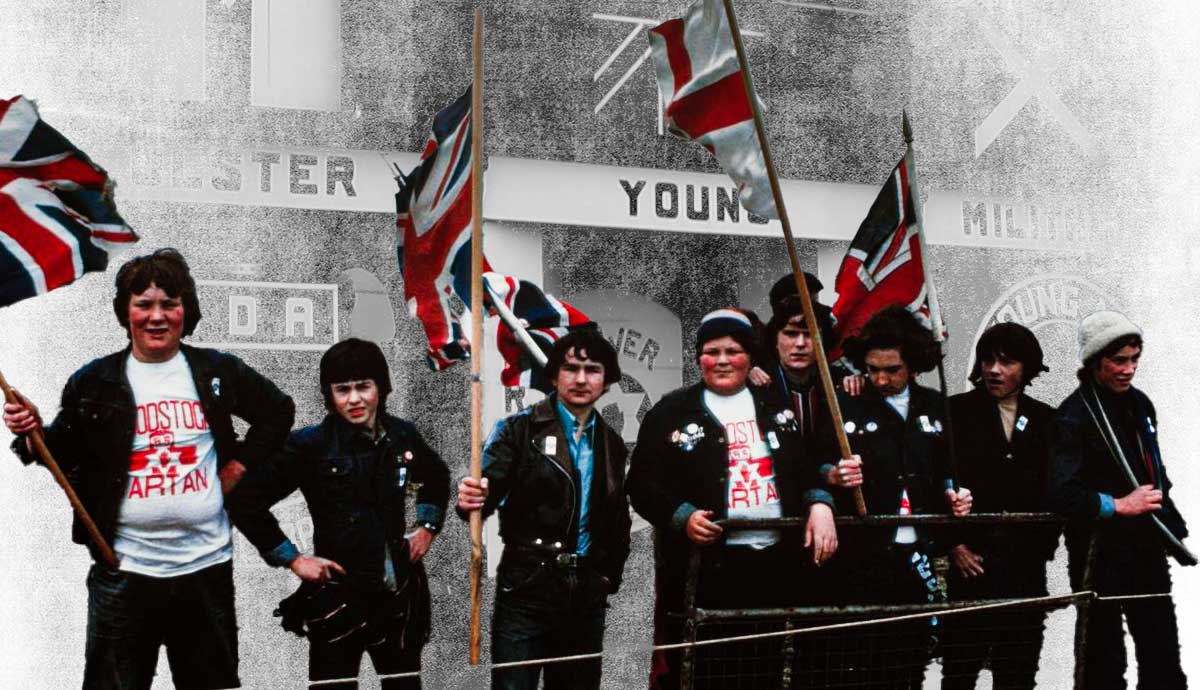



 English
 Arabic
 French
 Spanish
 Portuguese
 Turkish
 Dutch
Dutch
 Italiano
 Russian
 Romaian
 Portuguese (Brazil)
 Greek
Greek