The Hungarian Revolution of 1956 and Its Freedom Fighters
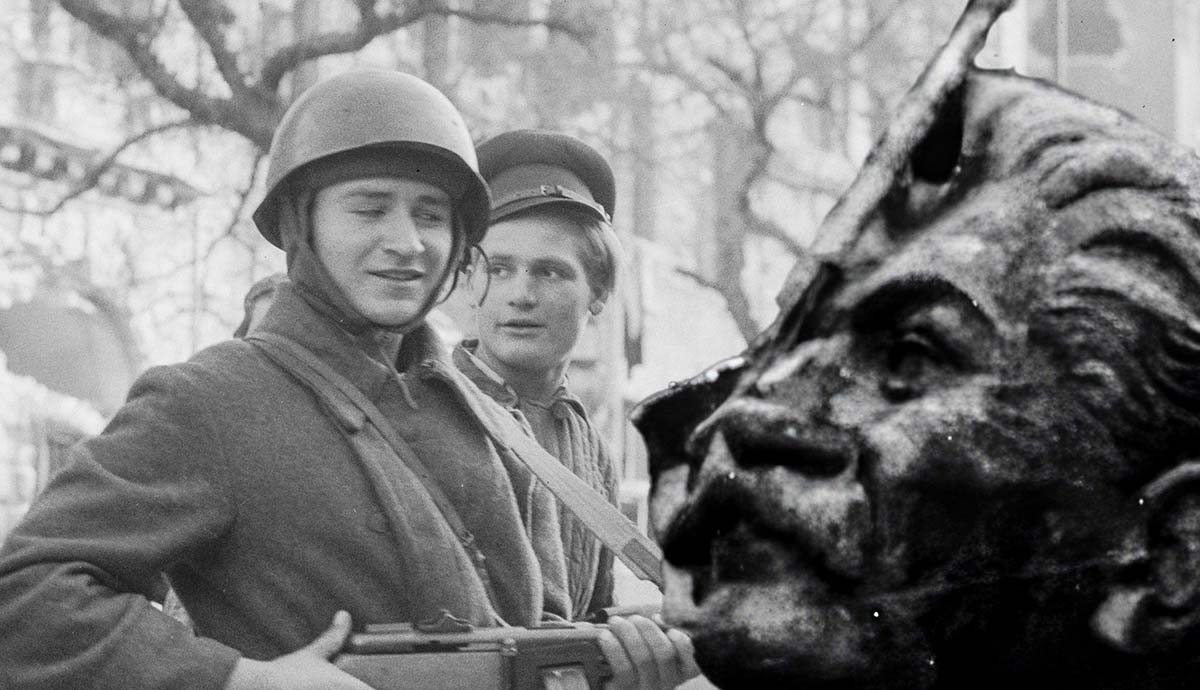
When university students of the Technical University of Budapest convened on October 22, 1956 to plan a protest the following day, they did not expect to become Freedom Fighters waging guerrilla warfare against the Soviets 24 hours later. But, when the secret police began shooting the unarmed protesters, they quickly gathered weapons and returned to the fight. The Freedom Fighters were primarily in their teens and early twenties, and they fought fiercely, even when they knew they did not have a chance.How It BeganLajos Kossuth Square, the building of the Labor Movement Institute (once a mansion, now an Ethnographic Museum) by Nagy Gyula, 1956. Source: Wikimedia CommonsOn October 22, 1956, University students in Budapest convened to plan a protest. They created the Sixteen Points, which demanded social, economic, and political reform in Hungary. The demands included the withdrawal of Soviet troops, free elections, a livable wage, readjustment of production quotas, and freedom of speech. Hungary had been occupied and oppressed by the Soviet Union since 1945 when the Soviets took advantage of a post-WWII Hungary while its government was in ruins and turned it into a satellite state, as they did with much of Eastern Europe.Their regime consisted of economic repression, poverty, weaponized food insecurity, mass deportations, murder, forced labor in gulags, political purges and show trials, religious suppression, propagandized education, and the Iron Wall from which people could not escape. They installed a puppet government that served the USSR and a secret police that was an offshoot of the KGB, and they were among the most brutal and oppressive in all of the USSR or their satellite states.Map of the Eastern Bloc after the annexations and installations by Mosedschurte, 2009. Source: Wikimedia CommonsThe youth were tired of the extremist regime and the secret police terrorizing the population. After a series of events in Eastern Europe, including other anti-communist resistances and protests, Hungarian students decided it was time to demand change. On October 23, 1956, about 20,000 students began marching in the afternoon, and by the end of the night, roughly 200,000 people had joined the demonstrations in Budapest; people would see the protesters marching by and join impulsively, driven by Hungarian pride. They gathered around a statue of Jzef Bem, a revolutionary hero of the 1848 Hungarian Revolution. One student read the Sixteen Points aloud to the crowd.Ern Ger, one of Hungarys most hated communist politicians, broadcast a condemnation of the protest and the demands. Imre Nagy, a moderate communist politician, addressed the crowd and promised reforms; he was the man the students wished to lead the country. He was elected as prime minister (for his second term) that night, but his term only lasted for the duration of the Revolution, after which he was exiled and later hanged.1956 Hungarian Revolution by Gabor B. Racz, 1956. Source: Wikimedia CommonsSome of the 200,000 protesters began ripping down the Hungarian flags around the city and tearing out the Soviet symbol of the sickle and hammer. Later, when the army arrived to control the ensuing riot, they ripped the symbols from their clothes, threw their hats, and joined the revolutionaries. Protesters also toppled over an 18-meter statue of Stalin. First, they tried pulling it down with ropes attached to trucks, but then welders arrived to torch the statues knees enough to pull it down. When it fell, Stalins head rolled, and the crowd surged.Stalins statue was purposefully put on the site of a church that the Soviets had torn down as an anti-religious stab at the (primarily Catholic) Hungarians. The Regnum Marianum had been erected in 1931 to symbolize their appreciation for the collapse of the short-lived Soviet Republic of 1919. One can imagine the deep-seated loathing for the Soviets; it was not just one event or one person who caused the 1956 Hungarian Revolution; it was a long series of intentional jabs at an oppressed population.Violence and riots are the languages of the oppressed. Even if the majority of a protest is peaceful, when a few people resort to violence, it distorts the image of the resistance, even when the violence is justified and retaliatory.The First Battle of the RevolutionMagyar Radio, 2013. Source: Wikimedia CommonsValria Benke, a politician and the head of Kossuth Radio in Budapest, tricked the student protesters. She promised the students time on the radio to tell the country about the protest and their Sixteen Points, but when the students were given a microphone and began speaking during the demonstration, they realized they were not live on the radio.After nightfall, protesters gathered outside of Kossuth Radio, demanding they be allowed to go on the air. The secret police had locked them out and were stationed in the building, and a group of students managed to get inside the building and were detained by the secret police. The protestors outside demanded their release, but the secret police would not budge, so several protestors broke the windows and barged through the door of the Radio. Because of that, the secret police used tear gas and fired at the crowd of unarmed protesters, immediately killing several people as they tried to flee.Many protesters left and did not return, but many thousands became Freedom Fighters at that moment. They went to gather weapons and returned for the fight with the secret police, and the Battle for the Budapest Radio raged until the next morning. At some point, the building caught fire. While the first battle of the revolution took place, the Soviets convened and decided to make Imre Nagy the Prime Minister again to appease the protestors. However, it was too late for peace, and the Freedom Fighters success at the Radio gave them hope and fueled their fire.Jzsef Boulevard, dead bodies in front of Pl street by Nagy Gyula, 1956. Source: Wikimedia CommonsHungarian soldiers were ordered to the scene to contain the violence, but when Colonel Lszl Zlomys company first arrived and saw dead teenagers on the street, they realized that the protesters were unarmed and being shot at by the secret police. Zlomy ordered his men to do nothing unless the protesters tried entering the radio building after it had already been vandalized. As military members, they were supposed to be loyal to the communist regime and the Soviet leaders, but their Hungarian nationalism was stronger, and many of them were the same age and shared the same values as the Freedom Fighters.Next to arrive on the scene was Lieutenant-Colonel Jnos Solymosi. He brought 14 tanks and 17 trucks of troops, and he also declared that his men would not fire upon the protesters. Many soldiers essentially defected from the military and joined the Freedom Fighters, including the colonels, which helped the resistance immensely. The soldiers had access to storesalbeit modest storesof weapons, tanks, and military barracks that the Freedom Fighters used as strongholds during the Revolution.Ern Ger requested Soviet military intervention when he realized the Revolution would not be easily quashed, even though the Soviets and secret police outnumbered them. The Freedom Fighters had the upper hand in the beginning because they knew Budapests streets, alleys, and underground passageways better than the Soviets. An estimated 26,000 civilians, mostly teenagers and young-twenty-year-olds, and nearly 2,000 soldiers fought against a growing Soviet army as more troops were continuously called in.Hungarian Freedom Fighters by Jack Metzger, 1956. Source: Wikimedia CommonsEven the Chief of Police, Sndor Kopcsi, joined the Revolution with his men, and he had access to weapons, as well. There were two military academies in Budapest, and they also emptied out their weapons stores for the Freedom Fighters.The kicker was that industrial laborers in Budapest, who were supposed to be the backbone of communism, took control of one of the factories in the middle of the first night and handed out at least 1,000 rifles to the Freedom Fighters. It was called the United Lamp Factory, an undercover arms factory. Nearly 15,000 industrial employees joined the Revolution; some even went to work in the factories to manufacture more weapons and ammunition. They were the last to be defeated on November 11, as well.The Revolution SpreadsAn aerial view of the Corvin Cinema by Civertan, 2008. Source: Wikimedia CommonsThere were several strongholds throughout Budapest. They made bastions in train stations, military barracks, abandoned buildings, and even a cinema. If they had to make a fortress in an alleyway, even young children pitched in to help build a barricade with random things. Kids as young as 12 were joining the revolution (much to the dismay of their parents), and if they could not hold up a gun, they could make Molotov cocktails and run messages to other groups.An agricultural engineer named Gergely Pongrcz heard about the Revolution and drove 80 kilometers on his tractor to join. He became the leader of the Corvin Group, which was stationed in the Corvin Cinema, the adjoining passageway, and the tunnels underneath the cinema. They could use these tunnels to travel to another part of the city unseen, throw an incendiary bomb, or shoot at the Soviets, and then disappear as quickly as they came.Police Chief Kopcsi wanted a man named Bla Kirly to be the new National Guard commander during the Revolution. He was actually in the hospital recovering from a surgery, but his former students from the military academy found him to tell him of the Revolution and Kopcsis plan for him. Kirly snuck out of the hospital on October 29 and joined the Revolution.The Soviets were quite alarmed at the soldiers for joining the resistance, so they sent in Colonel Pl Malter to take control of the military barracks. This, however, backfired because he joined the fight, too. Imre Nagy, Revolutionary Prime Minister, promoted Malter to Major-General and Defense Minister for the duration of the Revolution. He led the defense of the Kilian Military Barracks and the Corvin Cinema directly across the street. He was later hanged alongside Nagy for his participation in the Revolution.They Had Nothing to Live For, So They Had Everything to Fight ForFreedom Fighters atop a tank where Lajos Kossuth Street and Magyar Street cross by Nagy Gyula, 1956. Source: Wikimedia CommonsThe Freedom Fighters did what they could with what little supplies they had from October 23 to November 11. They occupied buildings as a form of protest, they continued demonstrating in the streets, protests sparked in several cities around the country, and some were literally shot down by fighter jets for it. Nurses tended to the wounded, truck drivers made food deliveries to them, they tapped into phone lines to communicate with each other and disrupt the Soviets communications to Moscow, they destroyed or captured Soviet tanks, and children faced off with tanks.Initially, the Freedom Fighters thought they were in the lead; they had won several battles, killed hundreds (if not thousands) of Soviets, destroyed and captured Soviet military equipment and tanks, and inspired millions across the country.The Soviets agreed to a ceasefire, and the fighting stopped. The Soviets faked a retreat and evacuated Budapest on November 3. Then, around 4 AM on November 4, the Soviets attacked Budapest with 150,000 troops and tens of thousands more in other cities of Hungary.The Freedom Fighters held out for as long as possible with bare-bones supplies and rapidly dwindling manpower during the final week, even when it was clear that they did not stand a chance. The Soviets succeeded in killing the revolution, and they remained in control of Hungary until the USSR collapsed 35 years later.References:Gati, Charles. (2006). Failed Illusions: Moscow, Washington, Budapest, and the 1956 Hungarian Revolt. Stanford University Press.Korda, Michael. (2006). Journey to a Revolution: A Personal Memoir and History of the Hungarian Revolution of 1956. HarperCollins Publishers.Mertz, Dawn-Eve. (2024). Young Men Go West: The Hungarian Revolution of 1956 and One Teenagers Risky Escape. Kleo Press.Michener, James. (1957). The Bridge At Andau. Random House, Inc.Molnr, Mikls. (2001). A Concise History of Hungary. Cambridge University Press.Sebestyen, Victor. (2006). Twelve Days: The Story of the 1956 Hungarian Revolution. Pantheon Books.









 English
 Arabic
 French
 Spanish
 Portuguese
 Turkish
 Dutch
Dutch
 Italiano
 Russian
 Romaian
 Portuguese (Brazil)
 Greek
Greek