The Masterless Samurai Who Traded Their Swords for Bamboo Flutes
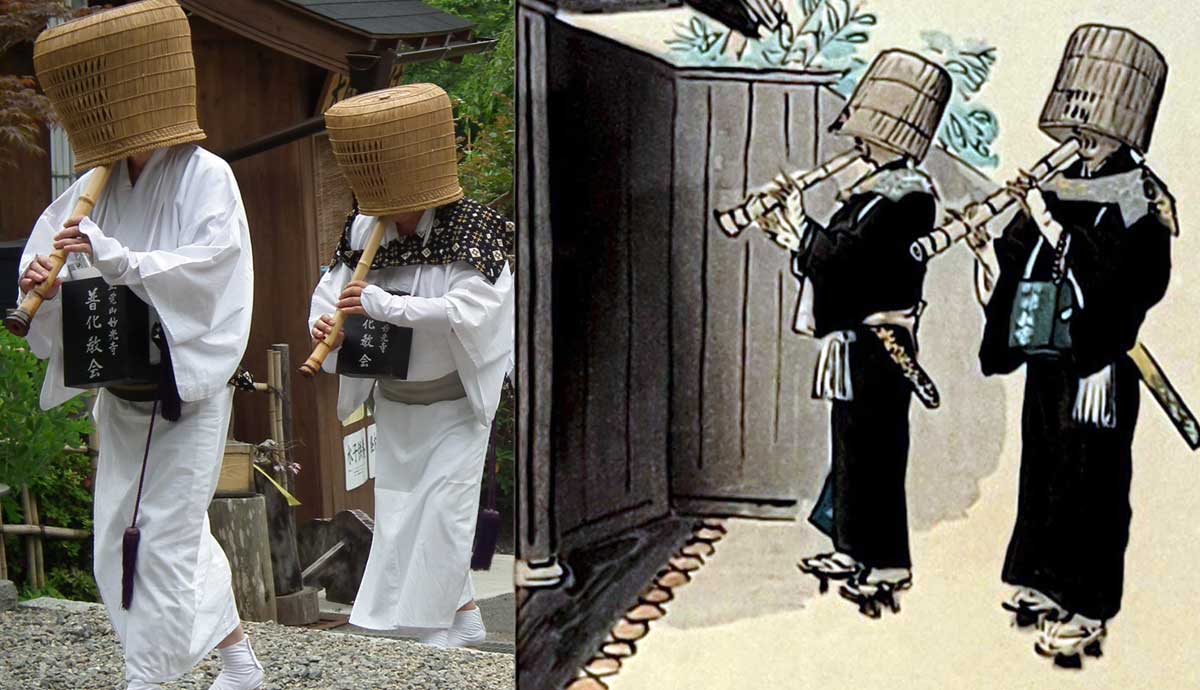
Counted among Japans most enigmatic religious figures, the komuso monks walked feudal Japan with faces hidden underneath woven-basket hats, choosing to use their breath not for religious sermons but for playing the flute. Emerging around the Edo Period (16031868), they transformed woodwind music into melodious meditation, and wandering into spiritual discipline. Rooted in the Fuke school of Zen, they are called monks by tradition but not by strict definition. In reality they were neither full Buddhist clergy nor laymen, occupying a kind of religious liminal space. This is their story.From Grand Temples to Dirt Roads: The Many Paths of Japanese BuddhismThe Great Hall of Todai-ji Temple in Nara City, by Hyppolyte de Saint-Rambert, 2020. Source: Wikimedia CommonsBuddhism first arrived in Japan in the 6th century from India via China and Korea, and immediately began transforming the country. Instead of following a single doctrine, Japanese Buddhism evolved into a vast branching tree of schools, traditions, and lifestyles.Early Buddhism mainly found support among the elites, the only ones who had the time and classical education to read and understand the sutras. But this severely limited the religions reach. Between the 8th and 14th centuries, new schools of Buddhism emerged around the country, each one taking radically different approaches to fulfilling Japans spiritual needs.Tendai and Shingon Buddhism, for example, emphasized esoteric rituals, studies, and a grand cosmology. Pure Land Buddhism, on the other hand, attracted millions by simplifying spiritual salvation to one simple mantra and faith in the Amida Buddha. Nichiren Buddhism confined devotion to the Lotus Sutra. Zen Buddhism, introduced in the late 12th century, appealed strongly to the warrior class by emphasizing discipline, introspection, and simplicity.But even distinctive schools were not safe from fracturing, which is what happened with Zen. Some practitioners pursued enlightenment through seated meditation in grand temples, while others embraced unconventional paths, taking their faith on the road. This spiritual diversity made Japanese Buddhism less of a single religion and more of a living, constantly evolving ecosystem. And this fertile holy ground eventually gave rise to the mysterious komuso monks, who considered music sacred.Monks of Straw Mats and Emptiness: The Birth of the KomusoShakuhachi Performance During the Himeji Castle Festival, by Corpse Reviver, 2009. Source: Wikimedia CommonsThe word komuso literally translates to monk/priest of emptiness, which is, in proper academic terms, very cool. But the name was not meant to be poetic. It was actually an accurate expression of their beliefs. Emptiness (mu), in the Japanese Zen sense, refers to the dissolution of ego, attachment, and fixed identity, a.k.a. the proverbial becoming one with everything. This was signaled by the monks woven-basket hats known as tengai, which obscured the face, thus suppressing the self.With these obstacles removed, the monks believed that they could seek out enlightenment more easily through real-world experiences rather than purely theoretical studies. Though commonly referred to as monks, with the character for priest even appearing in their name, the komuso were not recognized as such by many of their Buddhist brethren. They existed somewhere between clergy and lay practitioners, both religious devotees and secular wanderers.The komuso trace their origin to 15th-century beggar-monks known as komoso, or straw-mat monks. These figures wandered the countryside playing simple flutes while begging for alms (the only way they were allowed to make money) and carrying rolled straw mats that allowed them to sleep wherever they found themselves. Socially marginal and often viewed with suspicion (feudal Japanese authorities were extremely distrustful of people who did not stay in one place), the komoso originally had no formal religious identity. But, with time, they started to absorb Zen traditions as the school spread beyond temple walls.Daikoku-ji Temples Komuso Procession, by Akiyoshi Matsuoka, 2011. Source: Wikimedia CommonsThe transformation of these individuals into the komuso during the Edo Period was primarily the result of a shifting political landscape. After the end of the tumultuous Warring States period, the Tokugawa shogunate unified a fractured country and ushered in an era of peace that also put vast numbers of samurai out of work. This sudden surplus of trained warriors posed a serious threat to the nascent stability of the realm. The komuso system was the solution: a controlled outlet that absorbed masterless warriors into a disciplined, supervised way of life. For many former samurai, joining the komuso meant exchanging the sword for the flute while retaining a sense of honor, structure, and purpose.Membership of the komuso was eventually restricted to those of samurai lineage after the group was incorporated into the Fuke school, a branch of Rinzai Zen Buddhism. Although never fully recognized as an orthodox Zen school by the Buddhist establishment, Fuke Buddhism did receive official sanction from the Tokugawa government, granting them rare privileges like the right to travel freely across Japan at a time when movement was strictly controlled.In return, the komuso were strictly regulated and, according to rumors, sometimes expected to report on conditions in the provinces, which has occasionally gotten them accused of being ninjas. But the komusos main weapon was not the shuriken. It was the flute.When Breath Became PrayerA Shakuhachi Flute, Gift of Mrs. Howard Mansfield, 18th century. Source: Metropolitan Museum of Art, New YorkWhat truly distinguished the komuso was their practice of suizen or blowing Zen. Unlike other monks, they did not chant sutras, study scriptures, or conduct any sanctified rites. Instead, they sought enlightenment through the shakuhachi flute. Playing a single note with absolute concentration was believed to be a sufficient path to achieving enlightenment. For the komuso, sound itself was meditation.Therefore, to understand the komuso, we must first understand the shakuhachi. This intriguing bamboo flute is named for its standard length: one shaku and eight (hachi in Japanese) sun, for a total of about 54.5 cm or 21.4 inches. The shakuhachi was a very simple and impermanent instrument (its most basic form could be made in minutes), which both suited the austere monks perfectly and also neatly encapsulated their philosophy. For the komuso, the characteristics of the shakuhachi mirrored the human condition. Because of this, the flutes were treated as sacred tools capable of guiding their players towards enlightenment.The core musical practice of the komuso consisted of honkyoku solo compositions passed down within the Fuke tradition. These pieces were not meant for entertainment or public display. They were exercises in concentrated awareness, intended to unify breath, body, and mind. Control of breathing was paramount, with long, unbroken exhalations during the honkyoku demanding both physical discipline and mental fortitude.Shakuhachi Players, by Wada Sanzo, early 20th century. Source: Ukiyo-e.orgThe outward appearance of the komuso reinforced their inner discipline. To onlookers, the monks tengai hats appeared mysterious and otherworldly and there were many stories about them, like how they were supposed to shield the komusos magical flute techniques from the general public. But to the wearers, the tengai was simply a constant reminder to leave their ego behind, to not fall for the trappings of vanity, and to forget about their previous high social position as samurai.Komuso lived as wanderers. Without the hat, there would be no outward difference between them and common vagrants. But samurai honor is a powerful, hard-to-let-go, mostly made-up thing, so any tool that helped a former warrior get in a monks headspace was very useful indeed.The komuso monks traveled alone or in pairs, never in groups, and were forbidden from remaining in one place for more than a single day. Moving through towns and villages, they, like their komoso predecessors, could only earn money from receiving alms and other forms of charity by playing the non-meditation notes on their shakuchachi.Their priestly robes, basket hats, and flutes together made up their three tools, everything a person needed to be a komuso monk. It complemented their three seals, which were official travel documents that also verified a persons membership in the ranks of komuso. Buddhist schools tried not to antagonize the shogunate but often insisted they were above their laws, so it is fascinating just how much government control the komuso had to live with.The Lingering SoundShawnee Schroeder Playing a Japanese Shakuhachi Flute, by Shawnee Schroeder, 2022. Source: Wikimedia CommonsThe komuso were paradoxical figures. Most embodied discipline and austerity but there are records of some abusing their privileges and behaving disruptively. This tension between spiritual ideals and human reality is another thing that makes them so unique and adds to their mystique. It is a shame that they are not around anymore. At their height, there were more than one hundred komuso temples across Japan, but during the Meiji Period (18681912), feudalism, the samurai class, and the Fuke school were all abolished, and with them so were the basket-hat-wearing wandering monks.However, some modern monks still try to keep the traditions of the komuso alive, albeit outside of any official religious structure. The emptiness monks also survive through their shakuhachi traditions, with the honkyoku repertoire serving both flutists and practitioners of alternative forms of meditation, reminding us that enlightenment is not always found in silence.














 English
 Arabic
 French
 Spanish
 Portuguese
 Deutsch
 Turkish
 Dutch
Dutch
 Russian
 Romaian
 Portuguese (Brazil)
 Greek
Greek