



ALLTHATSINTERESTING.COM
Why Braveheart Has Been Called One Of Hollywoods Most Historically Inaccurate Films
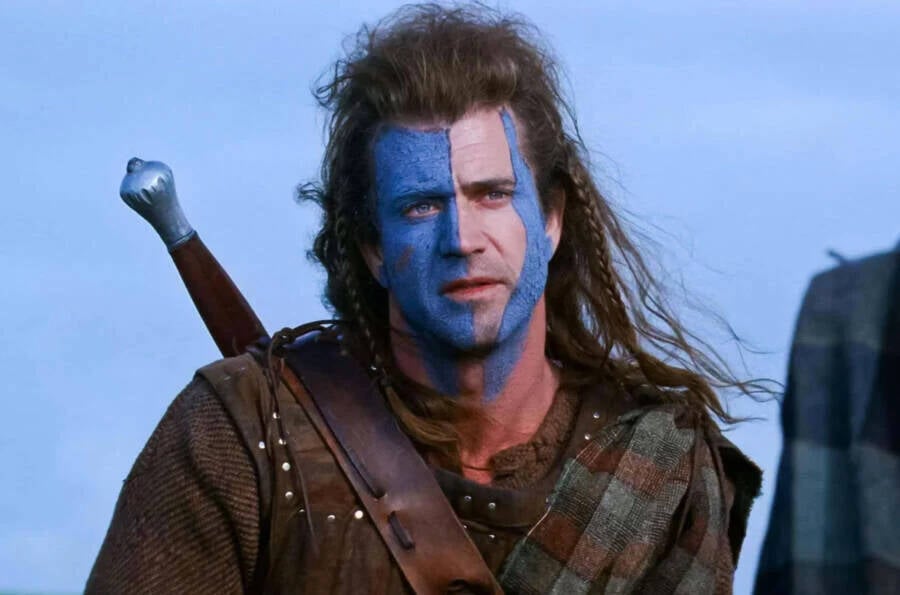
Icon ProductionsMel Gibson portrayed William Wallace in Braveheart (1995).The 1995 film Braveheart stars Mel Gibson as William Wallace, a Scottish warrior who fights for his countrys independence before facing a grisly death at the hands of English executioners. The movie is certainly based on actual historical events, but is Braveheart a true story?The answer is complicated. William Wallace was a real person who fought for Scotland, and he was executed for high treason in 1305. And the conflict portrayed in the film, the First Scottish War of Independence, did rage for more than 30 years in the late 13th and early 14th centuries. However, Mel Gibson and his fellow producers took great liberties with Wallaces story. Indeed, Braveheart has been called one of Hollywoods most historically inaccurate movies.So, what is the true story behind Braveheart?The True Story Of Braveheart And William WallaceThe real William Wallace was born in Scotland around 1270. His family was part of the lesser nobility, and while little is known of Wallaces early life, he likely joined the military as a young man. By 1297, the year after Englands King Edward I invaded Scotland, Wallace had taken up arms to join an uprising against William Heselrig, an Englishman who was acting as the sheriff of the Scottish county of Lanarkshire. Later that year, Wallace joined forces with Andrew Moray to lead a Scottish army in the Battle of Stirling Bridge. The men used a narrow bridge to their advantage, attacking English troops as they crossed and then charging, causing the bridge to collapse and trapping half of the opposing army on the other side of the River Forth.Public DomainA 19th-century illustration of the Battle of Stirling Bridge.This victory earned Wallace the title Guardian of the Kingdom of Scotland, a regency that gave him some governing privileges. He continued commanding troops for at least the next year, but he suffered a defeat at the Battle of Falkirk in the spring of 1298 that damaged his reputation. That September, he resigned his position to Robert the Bruce the man who would go on to become Scotlands king.For the next several years, the historical record of the true story behind Braveheart is murky. Wallace may have traveled to France to ask for assistance in Scotlands fight for independence, and he seemingly didnt return to his homeland until 1304. The following year, he fell into the hands of the English.He was betrayed by John de Menteith, a former Scottish soldier who had pledged allegiance to Edward I to secure his release from prison after he was captured during the Battle of Dunbar in 1296. William Wallace was taken to London, where he was found guilty of treason. Guildhall Library & Art Gallery/Heritage Images/Getty ImagesA 19th-century depiction of William Wallaces trial at Westminster Hall in London.On August 23, 1305, Wallace was executed in a gruesome fashion. He was stripped naked, dragged through the streets of London, and hanged until he was on the brink of consciousness. Then, his executioners cut him down, sliced off his penis and testicles, disemboweled him, and burned his genitals and intestines in front of him. Afterwards, they beheaded Wallace and quartered his corpse, sending each of his four limbs to different cities for display. His head was dipped in tar and placed on a spike on London Bridge.With that, Wallaces life came to an end. But the real story of Braveheart continued to inspire patriots for centuries to come.How William Wallaces Legacy Has Endured For 700 YearsIn the mid-15th century, more than 150 years after Wallaces death, a medieval minstrel known as Blind Harry wrote The Actes and Deidis of the Illustre and Vallyeant Campioun Schir William Wallace. The poem was based on oral histories of Wallaces heroism that had been passed down through the generations. The narrative follows William Wallaces life from childhood until his execution, but much of the story is fictionalized. At one point, Wallace even kills a lion. It was Blind Harrys poem that later inspired filmmaker Randall Wallace to write the screenplay for Braveheart. Of course, many of the historical inaccuracies in the text eventually made it to the big screen, too.Kjetil Bjrnsrud/Wikimedia CommonsA statue of William Wallace at Edinburgh Castle.Mel Gibson saw the screenplay and decided to take on the project, and the movie was released in 1995, with Gibson playing the role of William Wallace. Braveheart ultimately won six Academy Awards, including Best Picture, Best Director, and Best Cinematography. Gibson was lauded for his performance, and William Wallaces story was introduced to a new generation.But while viewers experienced an action-packed film based on an actual medieval war, they didnt see the real story behind Braveheart.Is Braveheart A True Story?The historical inaccuracies in Braveheart start with the title itself. The nickname Braveheart was associated with Robert the Bruce, not William Wallace. The opening scenes of the film also contain elements of fiction. Wallaces father wasnt a poor farmer, and the future war hero wasnt raised by an uncle named Argyle. Whats more, the movie implies that Wallace joined the fight for independence because his wife, Murron, was killed by English soldiers but theres no evidence that this happened.A later edition of Blind Harrys poem introduces a woman named Marion Braidfute, the lover of William Wallace who is murdered by the Sheriff of Lanarkshire. Its unclear where this story originated. In fact, no records exist to suggest that Wallace was ever married at all. The inconsistencies dont end there. Perhaps the most egregious inaccuracy is the clothing in the film. Belted kilts, like the ones Wallace and his fellow soldiers wear into battle, didnt appear until several centuries after Wallaces death. And the heros blue face paint was fashionable during the time of the Picts, who lived long before Wallaces time.Scott Neeson/Wikimedia CommonsMel Gibson in historically inaccurate attire speaks with 20th Century Fox executive Scott Neeson on the set of Braveheart.The scene depicting the famous Battle of Stirling Bridge is also much different from the actual conflict. For one, theres no bridge in the movie at all. And Andrew Moray, who led the battle alongside Wallace, doesnt appear in the film.John de Menteith, the man who betrayed the real-life William Wallace, is also missing from the movie. Instead, the filmmakers have Robert the Bruce deceive Wallace during the Battle of Falkirk which never happened and Roberts father is the one who plays a role in Wallaces arrest.The execution scene is perhaps the most historically accurate, but it leaves out some of the more grisly aspects of the event, such as the burning of Wallaces bowels. Even the most famous scene in the film never really took place. There is no evidence that William Wallace ever said, They may take our lives, but theyll never take our freedom!In the end, the essence of the real story behind Braveheart is captured on the big screen. But the film conflates different time periods, historical figures, and semi-fictional accounts to create its own cinematic version of the truth.After learning the true story behind Braveheart, go inside nine historically inaccurate TV shows. Then, discover the real facts behind 11 historical movies based on true stories.The post Why <em>Braveheart</em> Has Been Called One Of Hollywoods Most Historically Inaccurate Films appeared first on All That's Interesting.
0 Σχόλια
0 Μοιράστηκε
162 Views





 English
 Arabic
 French
 Spanish
 Portuguese
 Deutsch
 Turkish
 Dutch
Dutch
 Italiano
 Russian
 Romaian
 Portuguese (Brazil)