Why Voltaire Said the Holy Roman Empire Was Neither Holy Nor Roman Nor an Empire
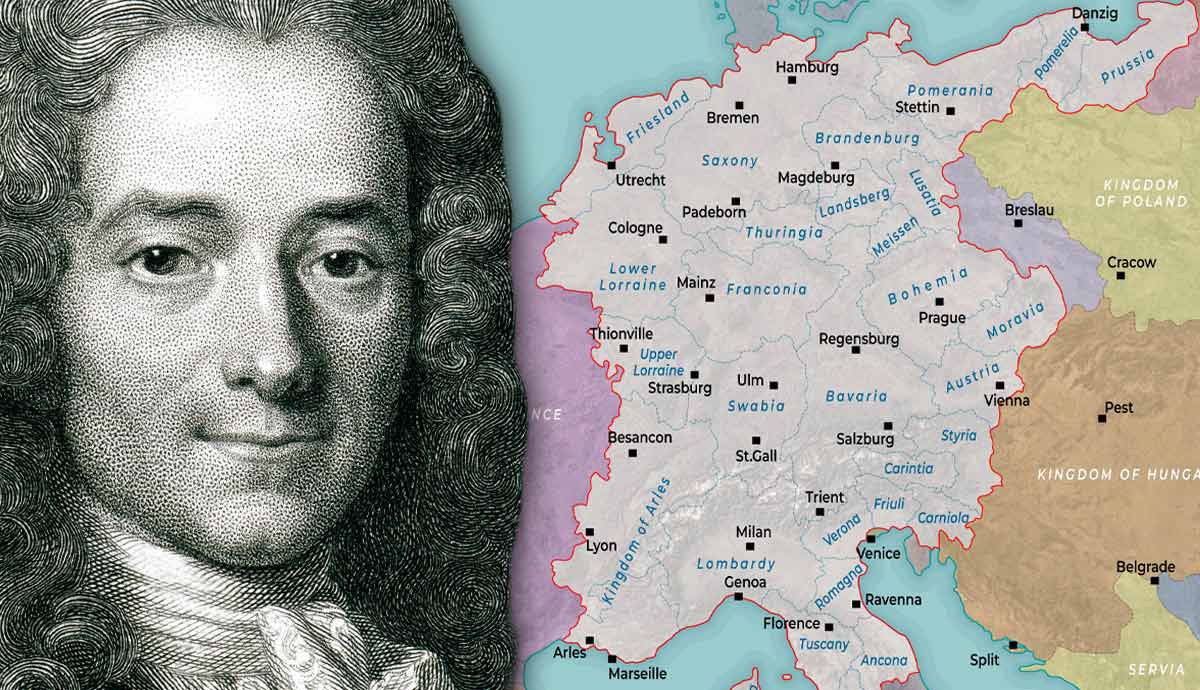
The 18th-century French philosopher Franois-Marie Arouet, better known by his pen name Voltaire, had a reputation for making ironic and pithy comments about the world around him. In his 1756 book An Essay on Universal History, the Manners, and Spirit of Nations, Voltaire famously quipped that the Holy Roman Empire was neither Holy, nor Roman, nor an Empire. To what extent was Voltaires observation a truthful description of the Holy Roman Empire?Defining the Holy Roman EmpireCharlemagnes Empire. Source: TheCollectorThe Holy Roman Empire spanned over 1,000 years and is one of the most important realms in European history, but its name, the territory it controlled, and its institutional arrangements changed over time. Before assessing whether the Holy Roman Empire was worthy of the three attributes in its name, it is worth defining what it is and how long it lasted.The establishment of the Holy Roman Empire is traditionally dated to Charlemagnes coronation as emperor by Pope Leo III in Rome on Christmas Day 800 AD. While Charlemagne claimed to have revived the Roman Empire, his empire quickly fragmented under his descendants. In 843 AD, the Carolingian Empire was partitioned into West Francia, Middle Francia, and East Francia. The kingdom of West Francia evolved into France, East Francia into Germany, while Middle Francia or Lotharingia would become a contested zone.Following the death of Emperor Berengar I in 924, the office of emperor remained vacant until 962, when German king Otto of Saxony was crowned emperor in Rome. Otto is now widely regarded as the true founder of the Holy Roman Empire, which maintained a German character for the rest of its history.The epithet holy only became associated with the empire in the 12th century, when the emperor claimed to derive his authority directly from God rather than via the Pope. By the late 15th century the formula Holy Roman Empire of the German Nation began to be used. The Holy Roman Emperors are known in Germany as Roman-German Emperors to distinguish them from the Roman emperors of antiquity and the emperors of the German Empire (1871-1918).Holy?The Coronation of Charlemagne by Friedrich Kaulbach, 1903. Source: Wikimedia CommonsAlthough it took several centuries for the polity to be known as the Holy Roman Empire, its religious aspect was clear from the very beginning with Charlemagnes coronation in Rome. This pivotal event was a pragmatic event that worked to the advantage of both parties.In response to an appeal from Pope Adrian I, Charlemagne vanquished the kingdom of Lombardy in northern Italy in 774 and incorporated the territory into his Frankish empire. After Adrians death in 795, his relatives challenged the authority of his successor Leo III, who received military support from the Frankish troops. In return, Leo crowned Charlemagne emperor, making him the first emperor in Western Europe for over three centuries.Although the emperor owed his imperial title to a Papal coronation in Rome, the late 11th century witnessed a major power struggle between Pope and emperor as the boundaries between spiritual and temporal power became increasingly blurred. The dispute over the right to appoint bishops came to be known as the Investiture Controversy. One of the most dramatic events was Emperor Henry IVs journey to the castle of Matilda of Tuscany in 1077 to beg for forgiveness from Pope Gregory VII following his excommunication.The Crown of the Holy Roman Emperor, 10th century AD. Source: themedievalmagazine.comDespite Henrys apparent penance, the conflict continued for half a century as emperors created antipopes and popes crowned anti-emperors. Pope Urban IIs preaching of the First Crusade in 1095 was a demonstration of the Papacys secular power. The Investiture Controversy finally came to an end in 1122 with the Concordat of Worms. The Pope retained the right to appoint bishops and abbots in the presence of imperial officials, while the bishops and abbots who wielded temporal power would swear fealty to the emperor in a separate ceremony.Even after the agreement, Papal-Imperial relations remained fraught. While the emperor sought to assert his feudal rights as king of Italy, independently minded Italian princes often rallied around the Pope to resist German influence. In the 12th and 13th centuries, Italy was engulfed by conflict between pro-Papal Guelphs and pro-Imperial Ghibellines.While German kings continued to journey to Rome to be crowned emperor, this was often achieved by lengthy diplomacy or military coercion. At the turn of the 16th century, the Habsburg emperor Maximilian I assumed the imperial title without being crowned by the Pope. His grandson and successor Charles V was the last emperor to be crowned by the Pope in 1530, in Bologna rather than Rome.Roman?The Holy Roman Empire under Frederick II. Source: TheCollectorAfter his coronation in 800, Charlemagne called his realm the Roman Empire and adopted the title of Augustus. While the Roman Empire had survived in the east as the Byzantine Empire, the throne in Constantinople was then occupied by a female ruler, Irene of Athens, which facilitated Charlemagnes claim that he was the true successor of Rome through the concept of translatio imperii or the transfer of power.After the empire was revived by Otto the Great in 962, the Germans adopted the title of kaiser, derived from the Latin Caesar. Meanwhile, prior to their coronation as emperor, the king of Germany was officially known as king of the Romans. After the Habsburg dynasty gained effective control of the empire, the title was often held by the designated successor to the emperor. Even after the dissolution of the Holy Roman Empire, Napoleon alluded to this tradition in 1810 by making his newborn son the King of Rome.The Sack of Rome of 1527, by Johannes Lingelbach, 17th century. Source: Wikimedia CommonsEven though the German rulers adopted Roman titles and called themselves kings of Italy, most Italians regarded them as undesirable German outsiders who sought to trample on their rights and liberties. Accordingly, Italian princes often asserted their independence from imperial rule. These challenges to imperial authority obliged the emperor to cross the Alps to bring their wayward vassals to heel. However, the emperor could not remain in Rome indefinitely, and once he returned to Germany his authority was again eroded.From the 12th century onwards, the Republic of Venice and the Papacy began to push back against imperial forces, enabling smaller Italian city-states to enjoy unusual degrees of independence. The Florentine poet Dante Alighieri, who held political office as a Guelph, later lamented the absence of a powerful emperor who could bring peace to the warring city-states.The imperial retreat from Italy and the French conquest of Burgundy in eastern France meant that the Holy Roman Empire became increasingly German. Nevertheless, Italy remained important to the empire. Emperor Charles V spent much of his reign seeking to gain control of Milan, a crucial strategic node in his sprawling empire. In 1527, while Charles was seeking to put pressure on the Papacy, underpaid imperial troops marched into Rome and sacked the Eternal City.Empire?Frederick Barbarossa, by Christian Siedentopf, 1847. Source: DW.comThe term empire is derived from the Latin word imperium, which referred to the power of military command in Republican Rome. Successful generals were hailed as imperator, but after Augustus the title was exclusively associated with the imperial family.In medieval Europe, the concept of empire came to be associated with universal rule. When Charlemagne was crowned emperor, he was by definition the most powerful man in Christendom. While the power of the Carolingian rulers decreased significantly, the 12th and 13th century emperors Frederick I (Barbarossa) and his grandson Frederick II were some of the most powerful rulers of medieval Europe.While the emperors were never able to consolidate their authority in Italy, imperial power over Germany was also uncertain. Since the king of the Romans was elected by a German princely assembly, no single family could claim the imperial crown as a hereditary possession.The institutional arrangements of the Holy Roman Empire changed significantly in 1356, when the right to elect the king of the Romans was limited to seven powerful princes: the archbishops of Mainz, Cologne, and Trier; the king of Bohemia, the count palatine of the Rhine, the duke of Saxony, and the margrave of Brandenburg.Emperor Charles V at Mhlberg by Titian, 1548. Source: Museo del Prado, MadridThe creation of the prince-electors meant that candidates only had to bribe and influence seven people. In the 14th and 15th centuries, Charles IV and his son Sigismund I from the House of Luxembourg initiallyleveraged their status as kings of Bohemia to secure the imperial title, but their Austrian rivals from the Habsburg dynasty eventually prevailed. Several Habsburgs had won election as king of Germany, but Frederick III was the first to be crowned emperor in 1453.Fredericks great-grandson Charles V was Europes most powerful sovereign since Charlemagne, by virtue of being King of Spain and Duke of Burgundy as well as Holy Roman Emperor. Charles sought to revive the concept of universal empire but was ultimately forced to divide his inheritance between his son King Philip II of Spain and his brother Emperor Ferdinand I. A combination of bribery and marriage diplomacy ensured that the imperial crown remained with the Habsburgs almost exclusively until the dissolution of the empire in 1806.While the Habsburgs ruled over vast territories in their own right, including Austria, Bohemia, and Hungary, in Germany itself their power gradually ebbed away. Following the Protestant Reformation, Emperor Charles V was unable to defeat his Protestant enemies in Germany and was forced to compromise at the Peace of Augsburg in 1555. After Germany was ravaged by the Thirty Years War, the Peace of Westphalia in 1648 created the nation state, rendering the Holy Roman Empire an anachronism.Voltaires Holy Roman EmpirePortrait de Voltaire, Nicolas de Largillire, 1899. Source: Wikimedia CommonsBy the 18th century, the institutional link between the Holy Roman Empire and the Papacy had been broken for over two centuries. While the Habsburg emperors had been at the forefront of the Catholic Counter-Reformation, Empress Maria Theresa pursued a more moderate religious policy. Her son Emperor Joseph II would extend religious toleration even further.While the title of Holy Roman Emperor remained the most prestigious according to European diplomatic protocol in the 18th century, its importance was mostly symbolic and ceremonial. By the early 18th century, several imperial electors became kings in their own right. In 1697 the Elector of Saxony was elected Augustus II of Poland, in 1701 the Elector of Brandenburg crowned himself King Frederick I of Prussia, and in 1714 the Elector of Hanover was crowned King George I of England. In 1740 Frederick II (the Great) of Prussia opportunistically conquered the province of Silesia from Maria Theresa, Emperor Charles VIs daughter and designated successor.The Habsburg emperors continued to regard themselves as the inheritors of the Roman imperial legacy, even if their Italian possessions were limited to Milan and Tuscany. After Napoleon expelled the Habsburgs from northern Italy at the turn of the 19th century, he had himself crowned king of Italy with the Iron Crown of Lombardy in Milan in May 1805. Napoleons establishment of the Confederation of the Rhine in western Germany prompted Emperor Francis II to formally dissolve the Holy Roman Empire in August 1806.Although the Holy Roman Empire could justifiably be considered all three during the medieval period, Voltaires observation was broadly accurate in the 18th century. Despite the dissolution of the Holy Roman Empire, the Austrian (later Austro-Hungarian) empire of the Habsburgs outlasted the Napoleonic Empire and survived to 1918.










 English
 French
 Spanish
 Portuguese
 Deutsch
 Turkish
 Dutch
Dutch
 Italiano
 Russian
 Romaian
 Portuguese (Brazil)
 Greek
Greek