Archaeologists Preparing For Development In Eastern Rome Happened Upon Ancient Tombs And A Shrine To Hercules
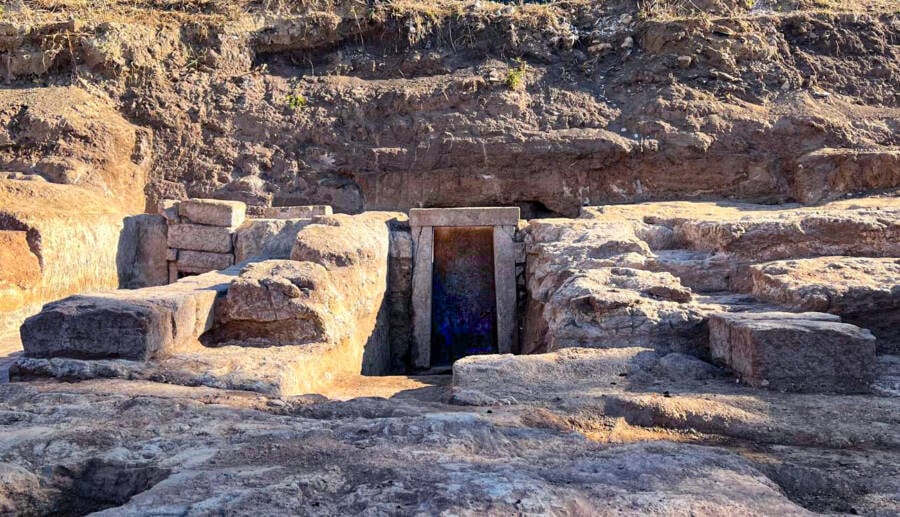
Italian Ministry of CultureOne of the elite tombs discovered at the archaeological site in Parco delle Acacie.The center of Rome is known for its rich historical sites, from the Colosseum to the Forum. But during excavations in the eastern edge of the city, archaeologists uncovered an incredible set of ruins from the Roman Republic period including a shrine, tombs, pools, and an ancient road. These new discoveries promise to add illuminating new detail to the history of the Roman Republic.The Roman Tombs And Shrine To Hercules Found At Parco Delle Acacie In Eastern RomeSpecial Superintendency of Archaeology, Fine Arts and Landscape of RomeSome of the ruins that have been uncovered at the Parco delle Acacie since excavations at the site began in 2022.According to a statement from the Italian Ministry of Culture, these ruins were discovered during a preventative excavation project at the Parco delle Acacie in the Pietralata district on the eastern side of Rome, in preparation for a development project. During the excavations, which began in 2022, archaeologists uncovered the ruins of an area covering about two-and-a-half acres that was occupied from the 5th or 4th century B.C.E until the 1st century C.E., and then periodically during the 2nd and 3rd centuries C.E.One of the most compelling discoveries at the site is the ruins of a shrine, which archaeologists suspect was once connected to the cult of Hercules. Set close to an ancient road, the shrine is a small quadrangular building, roughly 15 feet by 18 feet. In the center of the building, aligned with its entrance, archaeologists found a small white-plastered tuff (a kind of volcanic rock) that was likely once used as an altar.At the back of the building, archaeologists also found what appears to be the base of a cult statue, and further excavation of the building revealed that it was built over a votive deposit. Here, archaeologists found terracotta heads, feet, and female figurines, as well as two terracotta cattle. Ancient bronze coins found nearby furthermore suggest that the Hercules shrine was constructed between the late 3rd and 2nd centuries B.C.E.Special Superintendency of Archaeology, Fine Arts and Landscape of RomeA terracotta figurines head that was found at the site of the Roman ruins in Pietralata.Nearby, archaeologists also uncovered two impressive tombs. Dating to the 4th or 3rd century B.C.E., the two chamber tombs were carved into the tuff slope which descends down from the nearby Via di Pietralata.The first has a monumental entrance with a stone portal. Within the tomb, archaeologists found a sarcophagus and three urns, as well as two vases, two black-glazed cups, a ceramic jug, and a mirror.The other tomb, which was built slightly later, has benches on either side, and contains the remains of a man who seemingly underwent surgical trepanation.And thats not all that archaeologists found at the site.The Enormous Pools And Ancient Road Also Uncovered In PietralataIn addition to the Hercules shrine and the two Republic-era tombs, archaeologists also uncovered the remains of an ancient road and two monumental pools. The road, constructed in the mid-Republican period (around the 3rd century B.C.E.) was seemingly used up until around the dawn of the Roman Empire, in the first century C.E. By the 2nd and 3rd centuries C.E., at least 200 years before Rome fell, the road had begun to fall out of use.The two pools, meanwhile, were seemingly built in the second century B.C.E. Archaeologists arent entirely certain what the pools were used for, however. Theyve speculated that they served a religious purpose, or were perhaps used for some type of productive activity.Italian Ministry of CultureOne of the two large pools that were found amid the ruins, and which may have played a religious role of some kind.Though questions about the site remain, archaeologists are thrilled with the discovery. It proves that Romes ruins can be found far beyond the center of the city, and that theres still much left to discover in its outlying regions.It is precisely in contexts like this, said Daniela Porro, Special Superintendent of Rome, apparently distant from the most famous sites of the ancient metropolis, that elements emerge that enrich the narrative of archaeological Rome as a sprawling city and that have contributed significantly to its development. The modern suburbs thus reveal themselves to be repositories of profound memories, yet to be explored.After reading about the Roman ruins that were found in Parco delle Acacie, learn the full story of why Rome fell. Then, discover the fascinating story of the Roman catacombs that snake beneath the city.The post Archaeologists Preparing For Development In Eastern Rome Happened Upon Ancient Tombs And A Shrine To Hercules appeared first on All That's Interesting.









 English
 Arabic
 French
 Spanish
 Portuguese
 Deutsch
 Dutch
Dutch
 Italiano
 Russian
 Romaian
 Portuguese (Brazil)
 Greek
Greek