Hawaiian Pidgin: The History of a Creole Language
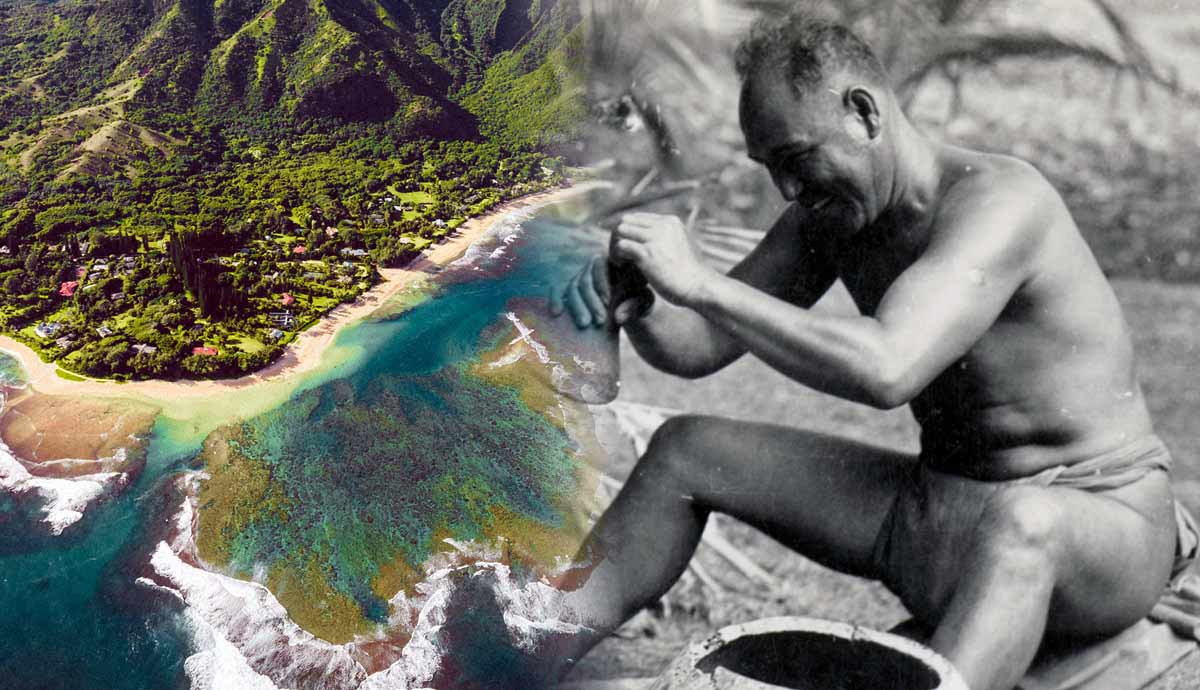
Today Hawaiian Pidgin is a marker of local identity. Spoken by thousands of people across the Hawaiian Islands as a first or second language, it is, like many pidgins and creoles, a product of colonialism. It originated in the 19th century on the sugarcane plantations of Hawaii, where American plantation owners employed workers from Japan, China, Korea, the Philippines, and Portugal, and sometimes African Americans from the United States. Hawaiian Pidgin, which despite its name is now considered a separate Creole language, emerged to bridge the communication gap between these workers and the plantation owners.What Do We Mean by Hawaii?Kauai (Garden Isle), photograph by Karsten Winegeart. Source: UnsplashIn Hawaiian, Hawaii is known as Hawaii. The term probably derives from Hawaiki, the original home of the Polynesians before they dispersed throughout Polynesia. New Zealand anthropologist Anne Salmond believes that Hawaiki (or Havaii in Tahitian) was the ancient name for Raitea (or Raiatea), the home of the Mori people who eventually settled in Aotearoa/New Zealand.The state of Hawaii is an archipelago of eight large volcanic islands in the central Pacific Ocean, plus several smaller islands, atolls, and islets. They are, from east to west, Hawaii (also known as the Big Island), Maui (Valley Isle), Kahoolawe (Target Isle), LnaI (Pineapple Isle), Molokai (Friendly Isle), Oahu (Gathering Place), Kauai (Garden Isle), and Niihau (Forbidden Isle). On January 20, 1778, Captain James Cook (1728-1779) landed in Waimea Bay, on Kauai Island, and named the archipelago the Sandwich Isles after his patron, the sixth Earl of Sandwich.Captain James Cook, painting by John Webber, 1782. Source National Portrait GalleryCook was the first European to land on Kauai Island and the first European to discover the Hawaiian Islands (Mokupuni Hawaii, in Hawaiian). He returned to the islands a year later, disembarking at Kealakekua Bay, known in Hawaiian as the Path of the God. Christina Thompson, author of Sea People, describes it in these terms: Kealakekua Bay lies on the west, or leeward, side of the Big Island of Hawaii, in the rain shadow cast by the great volcano Mauna Loa. It is a smallish bay about a mile wide, open to the southwest, with a bit of flat land at either end and a great wall of cliffs along the middle, where in ancient times the bodies of Hawaiian chiefs were hidden in secret caves. It was at Kealakekua Bay that Cook initially greeted as a royal figure, was beaten on the head and then stabbed to death on February 14, 1779.Waipio Valley, Big Island, Hawaii, photograph by Martin Zangerl. Source: UnsplashFor more than a thousand years before the arrival of European explorers, Polynesians existed, to quote Thompson again, in splendid isolation from the rest of the world. Cooks arrival changed all that. Cook introduced the West to the Hawaiian Islands and vice versa, but another important figure emerged at this time who would change the history of the islands forever. His name was Kamehameha I (ca. 1758-1819), the founder of the Kamehameha Dynasty. Wise enough to embrace and understand the power of European weapons, by 1810 he had managed to unite Hawaii under his leadership, with governors and high chiefs administering each island.In 1792, Captain George Vancouver (1757-1798), a British naval officer and explorer, was the first to introduce livestock to the islands. By the early 19th century, explorers and traders were regularly visiting the islands and putting down roots.Queen Emma of Hawaii, wife of King Kamehameha IV, and her entourage, photograph by Alexander Gardner, 1865. Source: The Metropolitan Museum of ArtIn 1820, settlers and explorers were followed by a wave of missionaries, first Protestant missionaries from New England and then Roman Catholic missionaries from Europe. The Great Mhele marked a pivotal moment in the history of land titles and the beginning of private ownership in the Hawaiian Islands. Prior to the arrival of Europeans and Americans, the concept of private property was virtually non-existent in the Hawaiian Islands. The land was divided into specific territories or divisions, with boundaries marked by geographical features such as rivers, gullies, or mountains. Each area was supervised by an alii and farmed and tended to by the kanaka, commoners who leased the land but did not own it.In 1848, the king essentially abolished the feudal system. After the Great Mhele (great land division), large sugar and coffee plantations were established throughout the Hawaiian Islands. It was in this context of trade and cultural exchange that the Hawaiian Pidgin was born.Where and WhenPineapple Fields in Hawaii, 1945. Source: The National WWII MuseumThe birth of Hawaiian Pidgin is directly linked to the vast fruit and sugar plantations that sprang up across Hawaii after the Great Mhele of 1848. In 1835 William Hooper arrived on the island of Kauai from Boston and established the first plantation. He left four years later. He was, however, the first in a long line of American businessmen to buy land in the Hawaiian Islands.Soon plantation owners were actively recruiting Japanese, Chinese, Korean, and Filipino workers, as well as Portuguese, Puerto Rican, African American, and Native Hawaiian laborers. According to Alan Takeo Moriyama, professor of International Relations at Yokohama National University, 26 government-sponsored ships brought some 29,000 Japanese to Hawaii between 1885 and 1895. By the mid-1920s, Japanese made up the largest non-Hawaiian population in the islands.Vesper Bells at Mii Temple, by Utagawa Hiroshige, 1832. Source: The Metropolitan Museum of ArtIt was around this time that Japanese workers began to organize with other workers to demand better working conditions, better wages, and an end to management abuse and the overcrowded barracks where they were forced to sleep in at night, after working from dawn to dusk. As we read in a Library of Congress article, living and working conditions on the cane plantations were rigidly stratified by national origin, with Japanese, Chinese, and Filipino laborers paid at different rates for the same work, while all positions of authority were reserved for European Americans.Japanese workers on sugarcane plantations in Hawaii, 1900. Source: The National WWII MuseumThis multicultural and multiethnic workforce forever changed the social and linguistic landscape of Hawaii. As Japanese immigrants put down deep roots, building their temples on plantations, and celebrating their traditional festivals, their language evolved too. During what is now known as the Hawaiis plantation days, Hawaiian Pidgin emerged to facilitate communication between workers who sometimes spoke completely different languages.Pidgin or Creole?Native Hawaiian man holding a poi pounder over a pounding board, 1940s. Source: The National WWII MuseumAs the name suggests, Hawaiian Pidgin is often referred to as a pidgin. However, it is a creole, a fully-fledged language currently spoken natively by around 600,000 people in Hawaii and used extensively in advertising and literature. A pidgin is a simplified language with a limited vocabulary and grammar that evolves to help two groups communicate when they do not share a common language. A creole is a pidgin that has not become obsolete, that has stabilized and developed, and that is now constantly enriched by a new generation of speakers who now consider it their mother tongue.This transition from pidgin to creole occurred with Hawaiian Pidginalso known as Hawaii Creole English (HCE)between the 19th and 20th centuries. As English is the main lexifier of Hawaiian Pidgin, most of its vocabulary comes from English.Great Wisdom Sutra (Daihannya-ky) from the Chsonji Temple Sutra Collection (Chsonji-ky), 1175. Source: The Metropolitan Museum of ArtHowever, it also includes loanwords from Japanese, such as obake (ghost), Portuguese, and Tagalog, the Austronesian language spoken by the Tagalog people in the Philippines. When Hawaiian Pidgin developed in the 19th century, Native Hawaiians were still suffering from the devastating effects of smallpox, influenza, whooping cough, and measles, to which they had no immunity. Despite this, Hawaiian terms such as lanai (verandah) or akamai (clever) survive in Hawaiian pidgin today, alongside Spanish words brought to Hawaii by Spanish-speaking Puerto Rican settlers and workers.Sentence structures borrow heavily from English, but with important differences that mimic the grammatical structures of the Hawaiian language. For example, the verb to be (e.g. the copula) is omitted in interrogative and affirmative sentences, so Are you happy? would become You happy? and The dog is cute would become The dog cute.Smallpox killed more than 5,000 Native Hawaiians in the 1850s. Source: National Museum of AustraliaThe past tense is indicated by the use of wen (from the English went) before the infinitive form of the verb, while go, gon, and gona, from the English going to, are usually used to refer to future events. The word ste (from the English stay) is placed immediately before the verb to indicate an action or event that is still in progress, and neva (from the English never) is used to express a negative past tense.Minor variations distinguish the Hawaiian Pidgin spoken in different areas across the islands, but these are not significant enough to be called dialects. Hawaiian Pidgin has its own sound system, which differs from American and British English, particularly with regard to vowels. Like other European languages, it has what are called pure vowels, or monophthongs. Merriam-Webster defines a pure vowel as a Vowel sound that throughout its duration has a single constant articulatory position.Haleakal, Maui, Hawaii, photograph by Jeff King. Source: UnsplashFor example, Haleakal, the active shield volcano on East Maui, whose name translates to House of the Sun, is pronounced Hah-leh-ah-kah-lah. In other words, pure vowels are vowels that are pronounced without any change in sound. Long vowels are usually not pronounced in Hawaiian Pidgin. Also, unlike most accents of American English, the intonation pattern in Hawaiian Pidgin tends to fall, reaching a lower pitch in the last syllable of the word.The pronunciation of Puuoina Heiau, an important fishing heiau (temple or religious site) in Kona on the south shore of Honokhau Bay, is a perfect example of this: pronounced Poo-oo-OH-ee-nah HAY-ow, the intonation drops dramatically on the last syllable. It is also worth remembering that Hawaiian Pidgin has its own spelling system.Status NowHonolulu, Hawaii, photograph by Alisa Matthews. Source: UnsplashFor decades, and especially in formal settings, Hawaiian Pidgin has been denigrated as a broken and crude, inferior form of English, as is the case with many other creole languages. Research in the early 2000s showed that such prejudices had a particularly strong impact on children. In kindergarten, for example, many children were observed speaking Hawaiian Pidgin freely and without any sort of moral constraints. As they grew up, in schools and colleges, they tended to switch to Standard English, influenced by the common misconception that speaking Hawaiian Pidgin in social or work settings was rude and inappropriate.In 2015, the US Census Bureau recognized Hawaiian Pidgin as a language in its own right, adding it to the list of official languages in the US state of Hawaii. This was a much-needed step in the decolonization process and helped to dispel the myth that creoles were inferior and less sophisticated languages than European or Indigenous languages.Hawaiian flag quilt today at the Honolulu Museum of Art, late 19th to early 20th century. Source: Wikimedia CommonsToday, Hawaiian Pidgin is used in literature, cinema, television commercials, and theater productions. American writer Lois-Ann Yamanaka and Filipino-American poet and novelist R. Zamora Linmark frequently use Hawaiian Pidgin in their works.Originally limited to sugarcane plantations and the tragic history of plantation abuse, Hawaiian Pidgin began to be used throughout the islands in the late 19th and early 20th centuries. Borrowing words and grammatical structures from such diverse languages as Japanese, Portuguese, English, and Korean, it is symbolic of Hawaiis history as a melting pot, a society that has thrived thanks to the physical and cultural contributions of people from all over the world.












 Arabic
 French
 Spanish
 Portuguese
 Deutsch
 Turkish
 Dutch
Dutch
 Italiano
 Russian
 Romaian
 Portuguese (Brazil)
 Greek
Greek