How the Mexican-American War Shaped the US-Mexico Border
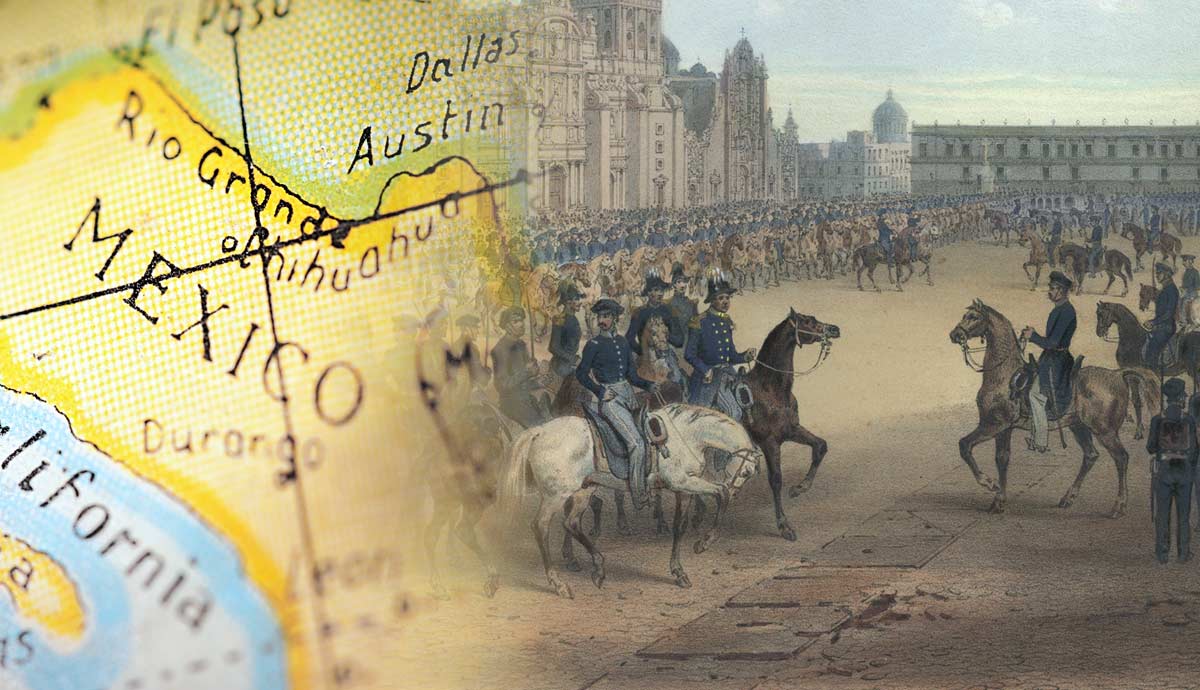
Since 1776, the borders of the United States have continued to expand outwards through land acquisitions such as the Louisiana Purchase or full-blown wars. The Mexican-American War, which took place between 1846 and 1848, was one such conflict that forever changed the US-Mexico border. Sparked by years of debate regarding the southern boundaries of the United States, the war saw US troops occupy the Mexican capital and permanently transform the boundaries of North America.The Roots of the War: Manifest Destiny and Mexican SovereigntyUS President James K. Polk. Source: Wikimedia CommonsThe motivations behind the Mexican-American War can be traced back to the expansionist belief in Manifest Destiny. This ideology became increasingly popular in the 19th century, and its proponents argued that the United States was inevitably going to expand across the entirety of the North American continent. Democrat figures such as President James K. Polk used the notion of Manifest Destiny to win elections and frame expansionist government policies as both a divine right and a national imperative.Under James Polk, the US had already begun to annex territories that Mexico regarded as a part of its own national territory. The notion of Manifest Destiny played a key role in the 1844 presidential election campaign, where Democratic candidates used it to justify bold actions such as annexing Texas, the Oregon boundary dispute, and eventually the Mexican-American war. However, Manifest Destiny was not universally supported by Americas ruling class, and a great many Whigs and Republican figures, such as Abraham Lincoln and Ulysses S. Grant, publicly opposed it.Tensions began to mount as settlers from across the United States poured into Mexican territories such as California and New Mexico, often with little regard for Mexican governance or cultural norms. While the US did offer to purchase these territories from Mexico, disputes regarding the precise border between Texas and Mexico inflamed relations. Mexico continued to insist that the Nueces River marked the true border of southern Texas, and the United States claimed that the Rio Grande was the rightful border. This disagreement proved a key flashpoint that developed into a war.The Thornton Affair and the Outbreak of the Mexican-American WarVolunteers in New Hampshire leaving to fight in the Mexican-American War, 1846. Source: Amon Carter Museum of American Art via Wikimedia CommonsIn the summer of 1845, the newly elected President Polk ordered General Zachary Taylor, along with over 3,000 soldiers, to the Nueces River. Under the guise of peacekeepers, these troops remained stationed along the Mexico-American border in readiness. Eventually, Polk ordered Taylors forces to move south to the contested point of the US-Mexico border, the Rio Grande. Mexican forces stationed nearby demanded that Taylor and his troops withdraw to the Nueces, but they refused. Instead, the American troops built a wooden fort on the banks of the Rio Grande in defiance of the Mexican demands.By the spring of 1846, it became clear to both sides that a war could break out at any moment. Despite a year of internal turmoil that saw the presidency change hands four times, the Mexican army prepared to defend its territory. On April 25, a detachment of Mexican cavalry attacked a US patrol that had been dispatched from the fort along the Rio Grande. The patrol was commanded by Captain Seth Thornton, and the incident became known as the Thornton Affair, effectively beginning the Mexican-American War.11 US soldiers were killed in the Thornton Affair, and Washington, DC, was forced to take drastic action. Polk seized the opportunity to rally Congress, declaring that because American blood had been shed on its territory, the only way to resolve the conflict was to declare war. With the support of Congress, war was formally declared by the United States on Mexico on May 13, 1846.Key Events of the WarZachary Taylor at the White House. Source: Wikimedia CommonsThe early days of the Mexican-American War brought to light the imbalances in military capability between the two nations. While Mexico had a much larger standing army, it was plagued by internal divisions. Within Mexico, two factionsthe conservative centralists and the liberal federalistswere vying for control of the country. Reportedly, troops from these factions within the Mexican army often fought each other instead of the American army.The Mexican-American War unfolded across multiple theaters, each with its own strategic objectives. In the North, General Zachary Taylors forces captured Monterrey and triumphed at Buena Vista, solidifying American control over northeastern Mexico. Meanwhile, General Stephen W. Kearny led a campaign in the west, securing Santa Fe and advancing into California with the help of local American settlers and naval forces. The California front saw the establishment of the short-lived Bear Flag Republic before US dominance was firmly established in the region.The most decisive period of the war occurred in central Mexico, where General Winfield Scott led an audacious amphibious assault against the port city of Veracruz in March 1847. From there, Scotts forces embarked on a grueling march towards Mexico City, encountering fierce resistance at Cerro Gordo and Chapultepec along the way. The Battle of Chapultepec is one of the most remarkable periods of the war. During the time of the battle, it was being used as a military school and was largely evacuated, save for six military cadets under the age of 18. Instead of surrendering to the US army, these young cadets fought bravely and even jumped from the castle to their deaths to avoid being captured.After their string of victories, by September 1847, US troops succeeded in occupying Mexico City, effectively forcing the Mexican government to negotiate a surrender.The Treaty of Guadalupe Hidalgo and the Redrawing of National BordersAmerican troops occupying Mexico City. Lithograph by Adolphe Jean-Baptiste Bayot, 1851, after a drawing by Carl Nebel. Source: Public Domain / Wikimedia CommonsAfter the defeat of its army and the capture of its capital city, Mexico was forced to enter into peace negotiations with the United States. The resulting treaty was signed on February 2, 1848, in the town of Guadalupe Hidalgo. The terms of the treaty required the Mexican government to cede more than half of its territory, including the future states of California, Nevada, Utah, New Mexico, and large parts of Colorado and Arizona. Mexico was also forced to relinquish all of its territorial claims over the state of Texas and officially recognize that the Rio Grande formed the border between the two North American nations.Territorial claims ceded by Mexico to the United States in the Treaty of Guadalupe Hidalgo. Source: US federal government via Wikimedia CommonsIn return for these sweeping land acquisitions, the US government agreed to pay Mexico $15 million and also settled the debts owed to American citizens by the Mexican treasury. Mexican citizens present in the areas newly annexed by the US were given the opportunity to relocate within Mexico or receive full American citizenship. This new border marked a dramatic expansion of US territory, effectively increasing the nations area by nearly 25 percent and solidifying its presence as a continental power. For Mexico, however, the loss represented a national tragedy. The forfeiture of over half its territory was a profound blow to its political and economic stability.However, in the United States, a debate between Democrats and Republicans regarding whether to declare the newly acquired territory as slave-owning or free states contributed to the further rise in tensions between the slave-owning Southern States and the anti-slavery North. Some historians have even argued that the ensuing debates in Congress following the treaty of Guadalupe Hidalgo contributed to the American Civil War a decade later.The Impact of the War on the US-Mexico BorderA gold prospector in Montana, 1860. Source: Nordic Museum via Wikimedia CommonsThe redrawing of the US-Mexico border after the Mexican-American War had far-reaching consequences, many of which continue to shape the region today. From a geopolitical perspective, the new border created opportunities for westward expansion and facilitated economic development through agriculture, mining, and trade. The discovery of gold in California in 1848, just months after the war ended, spurred migration that transformed the western United States into a booming economy.However, the new border also introduced profound challenges. For the Indigenous people and Mexican communities who had long inhabited these territories, the change in sovereignty often meant dispossession and marginalization. The US governments policies of forced relocation and land exploitation disrupted Indigenous ways of life, while Mexican residents who were newly classified as US citizens often faced discrimination and marginalization.In Mexico, the loss of territory remained a painful period of history for several decades. In the immediate aftermath of the treaty of Guadalupe Hidalgo, a series of internal domestic struggles plunged the country into chaos for almost 20 years. The Reform War between the rival liberal and conservative factions eventually led to the Second French Intervention in 1861, a military invasion of Mexico by the French Empire led by Napoleon III. What followed was a period known as the Second Mexican Empire, in which the country became governed by a constitutional monarchy.The War and US Domestic PoliticsAbraham Lincoln was a vocal opponent of the Mexican-American War. Source: Library of Congress / Wikimedia CommonsThe legacy of the Mexican-American War can still be seen in the contemporary politics that surround the US-Mexico border, which still serves as a literal and symbolic dividing line between the two nations. However, the border region has since evolved into a dynamic place that has become a hub of cultural exchange, economic diversity, and ingenuity. Cities such as Tijuana, San Diego, and El Paso have come to exemplify the interconnectedness of the United States and Mexico, while ongoing debates surrounding immigration and trade continue to underscore the contested nature of the border.The war was not universally supported in the United States. Opposition came from a wide range of prominent political leaders, intellectuals, and writers who criticized the moral grounds for starting such a conflict. One of the main concerns of the opponents to the war was that the conflict would help to expand the practice of slavery. Notably, Abraham Lincoln argued that the war was merely a pretext used by President James K. Polk to expand slavery into new territories. Ulysses S. Grant, who fought in the war, later reflected that the conflict was one of the most unjust in American history and claimed that it should never have been approved by the American people. Prominent writer Henry David Thoreau even went so far as to call for mass civil disobedience to prevent the war from going ahead.The war also left a lasting imprint on the culture of the American Southwest. From place names and architectural styles to cuisine and festivals, the region bears marks of its former Mexican heritage. However, the cultural richness is often accompanied by persistent inequalities between the ancestors of the American settler communities and those of the original Mexican inhabitants.The Lasting Legacy of the Mexican-American WarA Mexican memorial to those killed in the war. Source: Agencia Brasil via Wikimedia CommonsThe legacy of the Mexican-American War has been felt differently in both nations. For Mexico, the story of young military cadets who sacrificed their lives in the Battle of Chapultepec became a source of great national pride. A monument was built to honor the young cadets, and annual commemorations have become a part of Mexican national culture.In the United States, the legacy of the war was largely overshadowed by the catastrophic conflict that followed in 1861: the American Civil War. However, a number of important monuments have since been erected in Southwestern States to commemorate the soldiers who lost their lives. As relations between the United States and Mexico began to improve in the 20th century, a cemetery was built in Mexico City to house the remains of over one thousand American soldiers who died there. Nevertheless, the conflict still plays a minor role in the national culture of the United States, while the border it helped to create remains a key point in the national debate.










 English
 Arabic
 French
 Spanish
 Portuguese
 Deutsch
 Turkish
 Dutch
Dutch
 Russian
 Romaian
 Portuguese (Brazil)
 Greek
Greek