


Devastating "Rogue Waves" Finally Have An Explanation
Devastating "Rogue Waves" Finally Have An Explanation
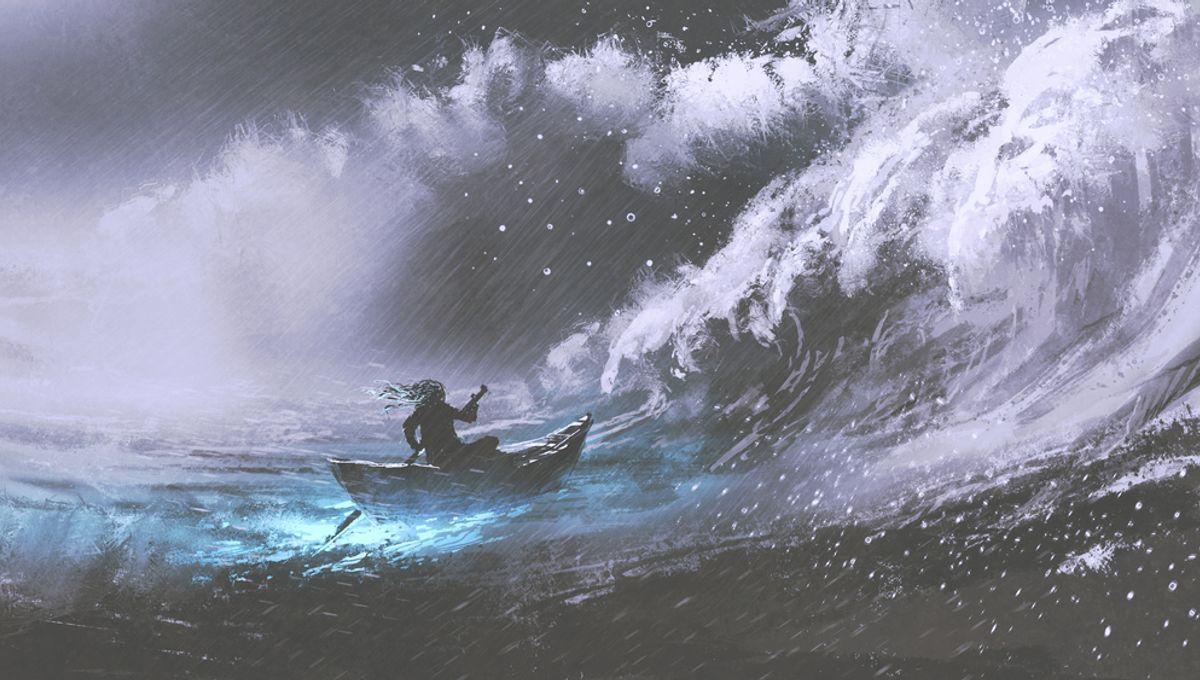
For hundreds of years, sailors have reported freak, gigantic waves hundreds of feet high, and seemingly appearing out of nowhere. Hundreds of leagues from land, or any other witnesses, they would swallow up ships whole, only rarely leaving a survivor or two to tell the tale.
The rest of this article is behind a paywall. Please sign in or subscribe to access the full content. But, well, sailors have said a lot of stuff over the years. Mermaids that turned out to be dugongs; monstrous sea snakes that are later found to be whale dicks; after a while, you’re going to stop taking these stories at face value and maybe start putting it down to a little too much tapping the Admiral. After all, it was well-known by the 19th century that waves couldn’t physically exceed about 30 feet in height – far more likely, then, was that these “sightings” of so-called “rogue waves” were either exaggerations or imaginations. Then, on New Year’s Day 1995, the sailors were proven right. A huge, 84-foot wave crashed into the Draupner oil platform in the Norwegian North Sea, bigger and more destructive than any the designers had thought to prepare for. “It confirmed what seafarers had described for centuries,” said Francesco Fedele, associate professor Georgia Tech's School of Civil and Environmental Engineering and lead author of a new paper detailing how rogue waves are created, in a statement this week. “They always talked about these waves that appear suddenly and are very large – but for a long time, we thought this was just a myth.” But just confirming the existence of rogue waves was one thing – actually explaining them? That was quite another. Existing models of wave formation and interaction didn’t seem to suffice; new suggestions – concepts like nonlinear focusing and modulational instability – were “mainly accurate when the waves are confined within channels, like in lab experiments,” Fedele argued, “where energy can only flow in one direction.” “In the open ocean, though, energy can spread in multiple directions,” he said – which is why he and his team took a different approach. Rather than starting with the math, they looked at 18 years’ worth of wave records – a total of 27,500 from 18 years of data – and tried to find the evidence. What they found stood in contrast to the most common explanation for rogue waves – that of modulational instability, where a slight deviation in a wave gets amplified by nonlinear effects. What they found instead was a combination of two factors: linear focusing, where waves traveling at different speeds and in different directions happen to align and combine into a single taller wave; and second-order bound nonlinearities – natural effects that distort the shape of a wave, making it up to 20 percent taller. Add all that to the natural nonlinear behavior of the ocean itself, and the result is, every so often, a huge and destructive rogue wave. “Rogue waves follow the natural orders of the ocean – not exceptions to them. This is the most definitive, real-world evidence to date,” Fedele explained. “They're extreme, but they're explainable.” The results stand as more than just a vindication of Fedele’s skepticism. Updating ocean forecasting models to account for this explanation is “fundamental,” he argued, to ensure “the safety of ship navigation, coastal structures, and oil platforms. They have to be designed to endure these extreme events.” Now, with updated models and a view to extend the results to machine learning, using the data to train algorithms to predict rogue waves before they occur, life at sea may soon be safer – albeit perhaps a little less supernatural in reputation. “Rogue waves are, simply, a bad day at sea,” Fedele concluded. “They are extreme events, but they're part of the ocean's language.” “We're just finally learning how to listen.” The paper is published in the journal Nature Scientific Reports.

 English
 Arabic
 French
 Spanish
 Portuguese
 Deutsch
 Turkish
 Dutch
Dutch
 Italiano
 Russian
 Portuguese (Brazil)
 Greek
Greek