


New Island Emerges In Alaska As Glacier Rapidly Retreats, NASA Satellite Imagery Shows
New Island Emerges In Alaska As Glacier Rapidly Retreats, NASA Satellite Imagery Shows
Global warming is a tricksy beast. In some places, it’s transforming once-lush environments into barren deserts; in others, it’s doing essentially the opposite – albeit through an irony-fueled, monkey’s paw kind of interpretation of “re-green the Earth’s deserts”.
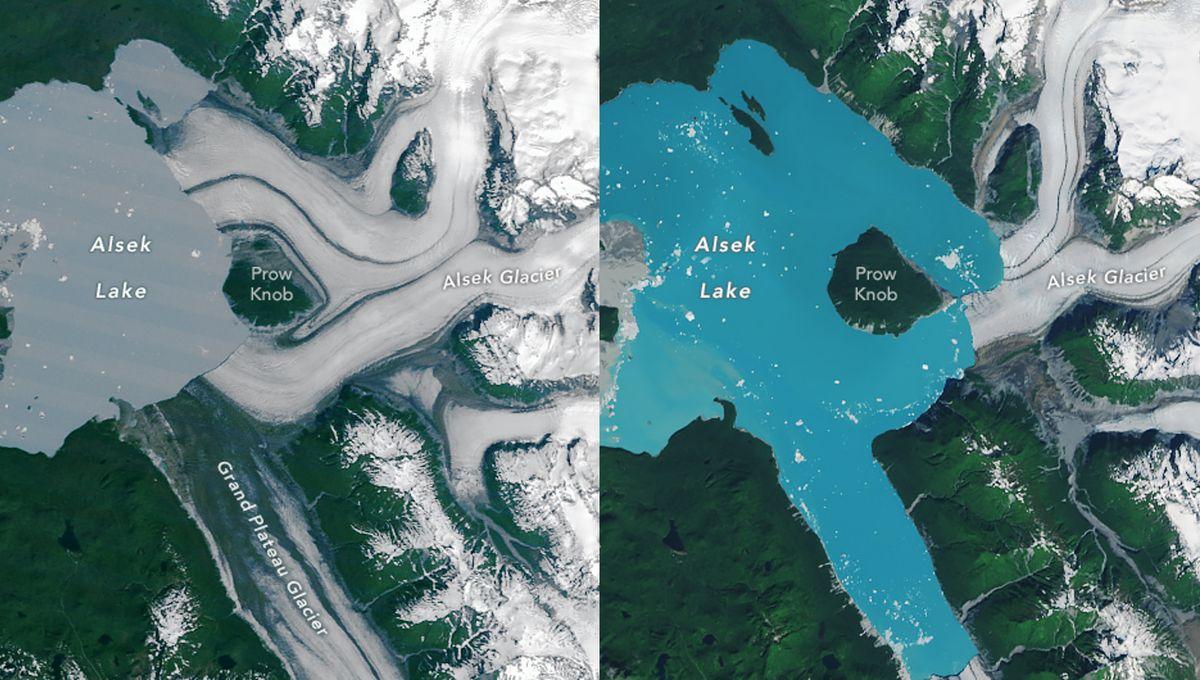
The rest of this article is behind a paywall. Please sign in or subscribe to access the full content. Now, a new set of photos from NASA has laid bare a striking example of the latter effect – and it’s right on our doorstep. Alaska, it turns out, has a new island – not thanks to new land rising up through the seas, but because of glacial melt so dramatic that it has surrounded a piece of land previously connected to the mainland. “Along the coastal plain of southeastern Alaska, water is rapidly replacing ice,” NASA announced in an Earth Observatory Image of the Day post this week. “Glaciers in this area are thinning and retreating, with meltwater forming proglacial lakes off their fronts. In one of these growing watery expanses, a new island has emerged.” “The Alsek Glacier once encircled a small mountain known as Prow Knob near its terminus,” they explain. “In summer 2025, the glacier lost contact with Prow Knob, leaving the approximately 2-square-mile (5-square-kilometer) landmass surrounded by the water of Alsek Lake.” The melting of the Alsek Glacier happened slowly, until it didn’t. In 1894 – the earliest observations of the glacier on record – the ice basically covered what’s now Alsek Lake; reports from 1907 described it as being “anchored to a nunatak,” according to a US Geological Survey review from 2005 – the term refers to a rocky island surrounded by flowing glacier ice rather than water – with an iceface “as much as 50 m[eters, 164 feet] high.” But “by 1948, the glacier had retreated 1.5 to 2.5 km,” the survey continues. “By 25 August 1960, retreat was as much as 5 km.” By the late 1970s, the glacier, now much reduced in size and reach, seemed like it was about to separate into two ice tongues; two decades later, it had done precisely that, and “by 2003, the terminus separated into three distinct ice tongues,” the authors write. Wuh-oh. Image credit: NASA Earth Observatory images by Michala Garrison, using Landsat data from the U.S. Geological Survey All of these changes can be seen in the images published this week by NASA – but it’s the most recent couple, from 2018 and 2025, which are most striking. In the space of just seven years – a short enough time that you probably think of yourself as not having aged at all throughout it – Alsek Lake has grown from abutting most of Prow Knob to entirely surrounding it. At the same time, the ice has retreated, melting into the lake and calving away from itself as soaring temperatures make it warmer and less stable. It’s a trend that’s likely to continue, NASA warns – and one that’s becoming all too familiar in the once-icy Arctic state. Along with the Yakutat and Grand Plateau Glaciers, the melting of Alsek has resulted in lakes almost double the sizes they once were – not in times long past, but within living memory. “The lakes that are forming in this region are immense,” Mauri Pelto, a glaciologist at Nichols College, told NASA in November last year. “Starting at the mountains and spreading toward the coast,” the waters coming from these melting glaciers likely represent the fastest lake growth in the US this century, he believes. Alaska now is “a new lake district,” he said. “[One] that is unique in our nation.”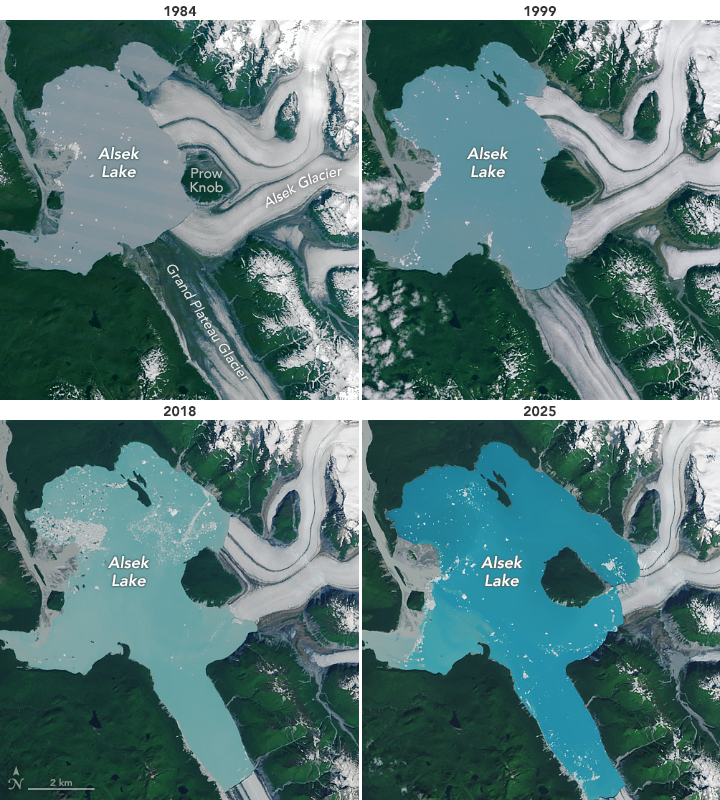

 English
 Arabic
 French
 Spanish
 Portuguese
 Deutsch
 Turkish
 Dutch
Dutch
 Italiano
 Romaian
 Portuguese (Brazil)
 Greek
Greek