


What Would You Reach If You Kept Digging Under Antarctica?
What Would You Reach If You Kept Digging Under Antarctica?
Whilst standing on Antarctica or the Arctic during winter, you might not notice too much of a difference, looking down at the snow-covered ice. But the Arctic and Antarctic are very different, as you would soon discover if you were able to keep drilling your way down through the ice.
The rest of this article is behind a paywall. Please sign in or subscribe to access the full content. For a start, if you dug down through the Arctic ice, you would find you didn't have to dig all that far before your job was complete. "Arctic sea ice is typically 2 to 3 meters (6 to 9 feet) thick," the National Snow and Ice Data Center (NSIDC) explains. "In some Arctic regions, ice thickens up to 5 meters (15 feet). However, Arctic sea ice has been thinning with more and more ice measuring only 1 to 2 meters (3 to 6 feet) thick." Beneath that, you would hit the frigid waters of the Arctic Ocean, at which point it is probably time to stop drilling. "The primary difference between the Arctic and Antarctica is geographical. The Arctic is an ocean, covered by a thin layer of perennial sea ice and surrounded by land. ("Perennial" refers to the oldest and thickest sea ice.)," NASA explains. "Antarctica, on the other hand, is a continent, covered by a very thick ice cap and surrounded by a rim of sea ice and the Southern Ocean." The Antarctic's ice is a lot thicker, though it varies through the seasons and with location. Together with the Greenland ice sheet, the Antarctic ice sheet contains over 68 percent of the Earth's fresh water supply, and 99 percent of our land ice. "The Antarctic Ice Sheet measures nearly 4.9 kilometers (3 miles) at its thickest point and contains about 30 million cubic kilometers (7.2 million cubic miles) of ice," NSIDC adds. "If the entire Antarctic Ice Sheet melted, sea level would rise about 58 meters (190 feet)." Dig through it, and you'd eventually find something interesting. "The largest lake in Antarctica, Lake Vostok, one of numerous subglacial lakes on the White Continent, lies a staggering 2.5 miles (4 kilometers) below the surface of the East Antarctic Ice Sheet," Antarctica Cruises explains, adding that most of the East Antarctic Ice Sheet is above sea level, but not all of it. "Denman Canyon, for example, a sub-ice landform of the East Antarctic Ice Sheet, attains the greatest depth of any terrestrial canyon on Earth, plunging more than two miles below sea level. And a quite significant zone of below-sea-level bedrock underlies the East Antarctic ice of the Wilkes Subglacial Basin." Scientists have drilled down into the Antarctic ice sheet, largely in an attempt to understand the Earth's past climate. The furthest they have reached is around 2.8 kilometers (1.7 miles) deep, reaching the bedrock and sampling ice around 1.2 million years old. While digging is the classic method of finding out "what's under this", there are of course many other options available. By combining radar, seismic reflection, and gravity measurements, researchers have created a map of the underlying continent, known as Bedmap3. The continent underneath the Antarctic Ice. In the map, you can see the deep valleys and tall mountains buried beneath the ice sheet. “This is the fundamental information that underpins the computer models we use to investigate how the ice will flow across the continent as temperatures rise. Imagine pouring syrup over a rock cake – all the lumps, all the bumps, will determine where the syrup goes and how fast. And so it is with Antarctica: some ridges will hold up the flowing ice; the hollows and smooth bits are where that ice could accelerate,” Dr Hamish Pritchard, a glaciologist at BAS and lead author on the study introducing the new map, explained in a statement earlier this year. “In general, it’s become clear the Antarctic Ice Sheet is thicker than we originally realised and has a larger volume of ice that is grounded on a rock bed sitting below sea-level," Peter Fretwell, mapping specialist and co-author at BAS, added. "This puts the ice at greater risk of melting due to the incursion of warm ocean water that’s occurring at the fringes of the continent. What Bedmap3 is showing us is that we have got a slightly more vulnerable Antarctica than we previously thought." As rich as the map is, there is likely plenty to be found underneath the ice. Recent findings have included lost continents and evidence that the continent was once home to lush rainforests and dinosaurs. Who knows what other surprises are waiting there to be discovered?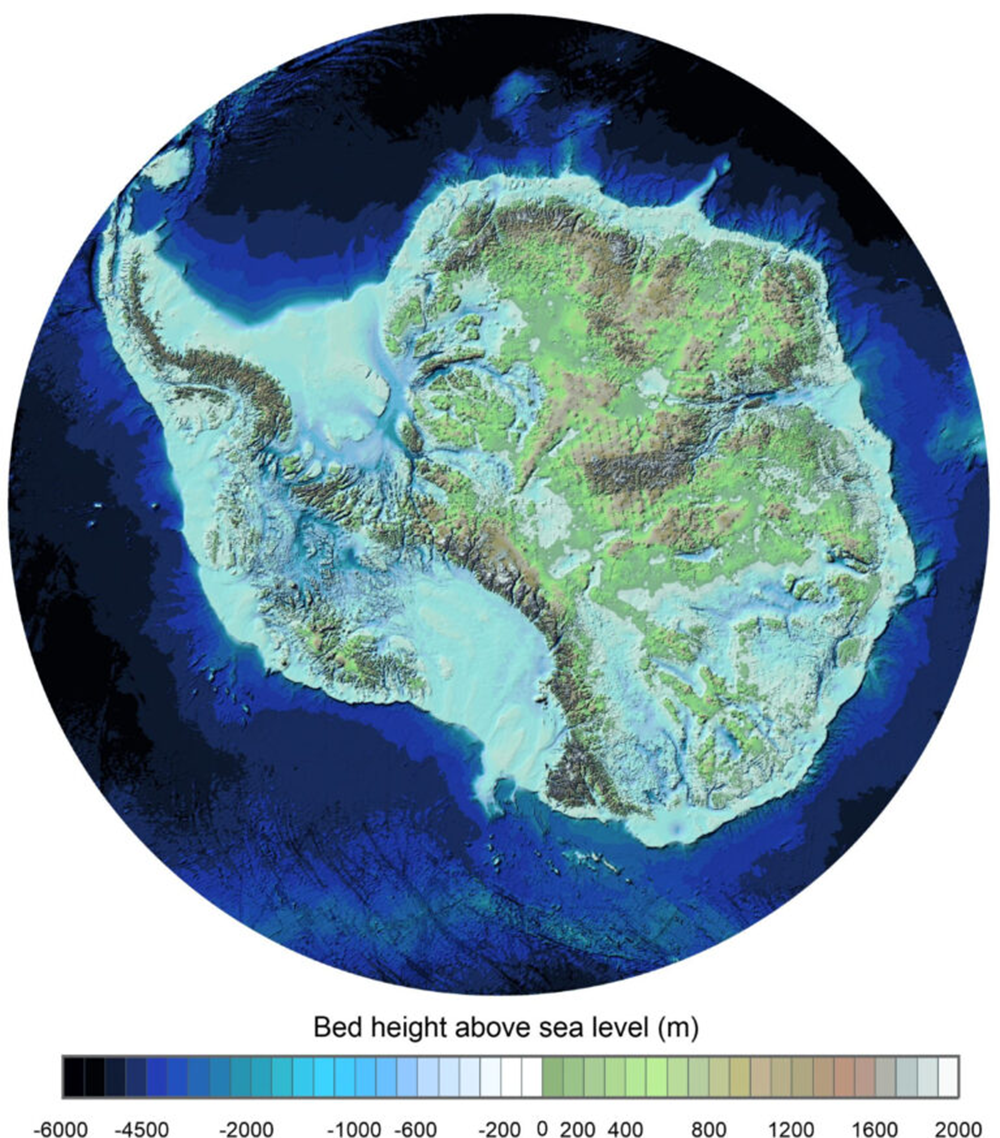

 English
 Arabic
 French
 Spanish
 Portuguese
 Deutsch
 Turkish
 Italiano
 Russian
 Romaian
 Portuguese (Brazil)
 Greek
Greek