


Stinky Seaweed Blob On Florida Beaches Thwarts Baby Sea Turtles' Dash To The Ocean
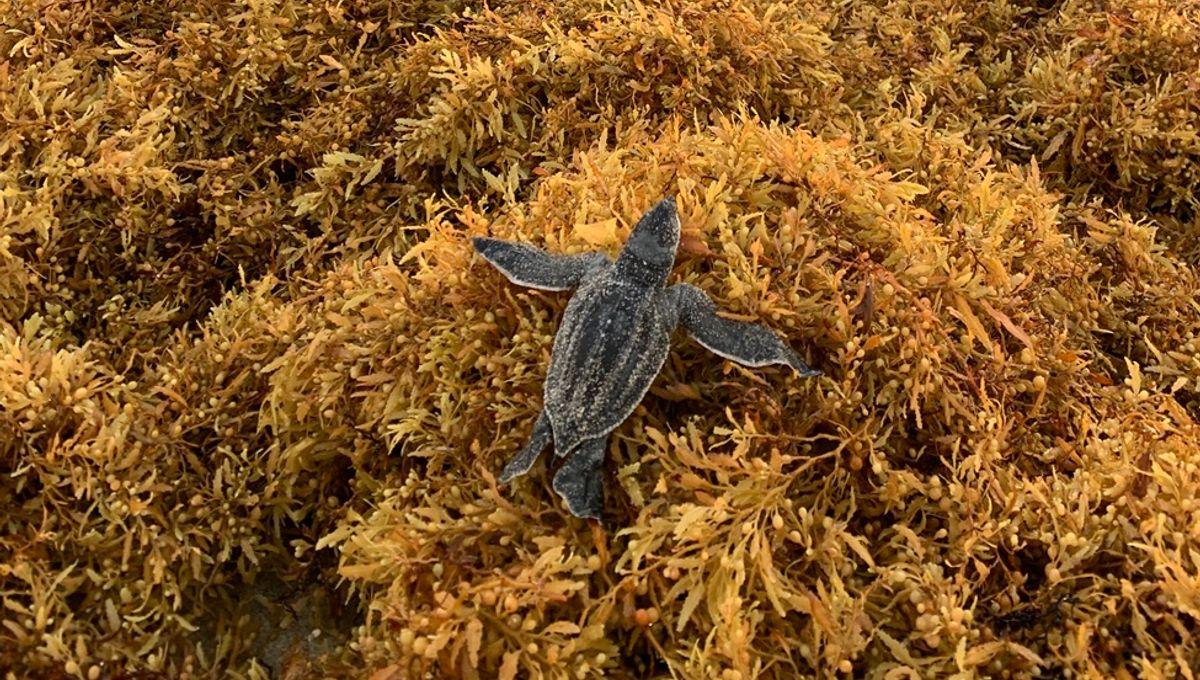
Stinky Seaweed Blob On Florida Beaches Thwarts Baby Sea Turtles' Dash To The Ocean
Every year, sea turtle hatchlings crawl across Florida’s beaches in search of the ocean. It’s a treacherous journey as it is – predators, debris, and light pollution all present roadblocks the tiny turtles must navigate – but it’s becoming even more so thanks to a stinky seaweed called Sargassum.
The rest of this article is behind a paywall. Please sign in or subscribe to access the full content. This floating brown macroalgae washes up in large – and, in recent years, record-breaking – quantities on beaches from Florida to South America, obstructing the already-vulnerable hatchlings' path to the water. Now, scientists from Florida Atlantic University’s Charles E. Schmidt College of Science have assessed just how big a threat this poses to sea turtle populations in a new study. The team focused on three species of sea turtle: Dermochelys coriacea, Caretta caretta, and Chelonia mydas, aka leatherbacks, loggerheads, and green turtles. The hatchlings – from three Florida beaches (Juno Beach, Jupiter, and Boca Raton) – traversed 13 meters (43 feet) of sand, followed by 2 meters (7 feet) of two different depths of Sargassum, created by the researchers to reflect their natural route to the sea. In all species, the addition of Sargassum – at depths of 7-9 centimeters (2.8-3.5 inches) and 17-19 centimeters (6.7-7.5 inches) – significantly increased the amount of time it took the turtles to crawl the length of the pathway. Leatherbacks, for example, took on average 54 percent longer to crawl through light seaweed and 158 percent longer to make it through heavy marine algae. Meanwhile, loggerheads slowed down 91 percent in the light patchway and 175 percent in the heavy option. Lastly, green turtles were delayed by 75 percent in light Sargassum and 159 percent in heavy. The extra time it took to climb up and over the piles of seaweed was cited as the main reason for this. Some hatchlings never made it to the other side of the seaweed, even in the lowest height condition. The turtles also routinely flipped upside down as they tried to cross the Sargassum, especially when it was at its thickest – one unlucky hatchling flipped over 20 times in a single trial. “The longer a hatchling stays on the beach, the more at risk it becomes – not just from predators like birds and crabs, but also from overheating and dehydration, especially after sunrise,” Dr Sarah Milton, the study’s senior author and chair and professor at Florida Atlantic University’s Department of Biological Sciences, said in a statement. “When Sargassum piles are higher – some can be over a meter (feet) high on South Florida beaches in the summer and extend for hundreds of meters down the beach – we can expect more failed attempts, particularly when hatchlings have to cross multiple bands of seaweed just to reach the ocean.” Extensive Sargassum accumulated on a beach in Juno Beach in July 2021. Image credit: Abbey M. Appelt, Florida Atlantic University In an attempt to see the physical toll this took on the turtles, the researchers measured their blood glucose levels to assess energy use and tested their righting response by assessing how quickly each hatchling could flip itself right-side-up when placed upside down in water. However, they found no significant differences between the different crawling conditions within species, suggesting that climbing the slippery, fetid obstacle, though time-consuming, didn’t drastically deplete their energy stores. “For sea turtle hatchlings, reaching the ocean is already a race against time – and survival. Now, increasingly large mats of Sargassum are adding new challenges to this critical journey,” added Milton. “As these seaweed accumulations grow taller and more widespread, they risk blocking hatchlings entirely, draining their limited energy or leaving them stranded. Beyond impeding movement, Sargassum may also reduce nesting space and alter incubation conditions.” With six out of seven species of sea turtles labeled either vulnerable to extinction, endangered, or critically endangered by the IUCN, this seaweed stumbling block is the last thing they need. Although it’s not all bad news: research published earlier this year revealed that marine turtle populations appear to be recovering around the world after decades of conservation efforts. The study is published in the Journal of Coastal Research..jpeg "Extensive sargassum accumulated on a beach in Juno Beach in July 2021")

 English
 Arabic
 French
 Spanish
 Portuguese
 Deutsch
 Turkish
 Dutch
Dutch
 Italiano
 Russian
 Romaian
 Greek
Greek