



A study using JWST observations of the early universe has uncovered an intriguing mystery: most galaxies seem to rotate in the same direction. This unexpected pattern, which defies current cosmological models, could suggest that our universe exists inside a black hole, the researchers propose.
The rest of this article is behind a paywall. Please sign in or subscribe to access the full content. The JWST has allowed astronomers to peer back further into the past than any other infrared or optical telescope, seeing infrared light that was emitted by distant galaxies just 300 million years after the Big Bang. With the infrared telescope, we were hoping to learn more about the formation of galaxies, as well as clear up mysteries about how supermassive black holes became so large. But we have been thrown a few surprises as we look further back into the past. One such surprise has just been found by researchers from Kansas State University. They looked at images taken of 263 galaxies in the early universe, which were clear enough to gauge the direction of rotation. Our current models of the universe assume that the universe is pretty much the same in every direction, at large enough scales. Most physicists and astronomers assume and predict that there should be no preferred direction of rotation of galaxies, and that this should be true of the modern and relatively early universe. But looking at the galaxies, the team found a significant difference between their rotations relative to the Milky Way. A total of 105 of the galaxies (40 percent) rotated in the counterclockwise direction, while 158 (60 percent) rotated in the clockwise direction. "The analysis of the galaxies was done by quantitative analysis of their shapes, but the difference is so obvious that any person looking at the image can see it," Lior Shamir, associate professor of computer science in the Carl R. Ice College of Engineering, said in a statement. "There is no need for special skills or knowledge to see that the numbers are different. With the power of the James Webb Space Telescope, anyone can see it." Similar findings have been reported before, though nothing as dramatic as this. So, what could be causing this? There are a few options available that would predict a preferred direction of rotation, but they're a little out there. "If the observation shown here indeed reflects the structure of the Universe, it shows that the early universe was more homogeneous in terms of the directions towards which galaxies rotate, and becomes more chaotic over time while exhibiting a cosmological-scale axis that is close to the Galactic pole," the team explains in their paper. "Some cosmological models assume a geometry that features a cosmological-scale axis. These include ellipsoidal Universe, dipole big bang, and isotropic inflation. In these cases, the large-scale distribution of the galaxy rotation is aligned in the form of a cosmological-scale axis, and the location of that axis in close proximity to the Galactic pole can be considered a coincidence." One possibility suggested by the authors is that the preferred direction is the result of the universe being on the interior of a black hole of a larger universe. Galaxies that rotate in the same way as the Milky Way are highlighted in red, the opposite way in blue. "One explanation is that the universe was born rotating. That explanation agrees with theories such as black hole cosmology, which postulates that the entire universe is the interior of a black hole," Shamir said. "But if the universe was indeed born rotating it means that the existing theories about the cosmos are incomplete." Such an explanation would need a whole lot more evidence to back it up. The team proposes another possibility, though this too could cause some issues. It could be caused by the Doppler shift effect, which can make light appear red or blue shifted depending on how the emitting object is moving relative to us. Because of this effect, galaxies rotating the opposite way to the Milky Way appear brighter. If the Milky Way's rotational velocity has more of an effect than astronomers have assumed, this may account for why galaxies spinning in the opposite way to the Milky Way are overrepresented as we look back further and further into the red-shifted universe; they simply appear brighter to us. "If that is indeed the case, we will need to re-calibrate our distance measurements for the deep universe," Shamir added. "The re-calibration of distance measurements can also explain several other unsolved questions in cosmology, such as the differences in the expansion rates of the universe and the large galaxies that, according to the existing distance measurements, are expected to be older than the universe itself." Though an intriguing study, many more observations will be needed to confirm or refute what was found, and then which explanation for the data is most likely. The study is published in Monthly Notices of the Royal Astronomical Society. An earlier version of this article was first published in March 2025.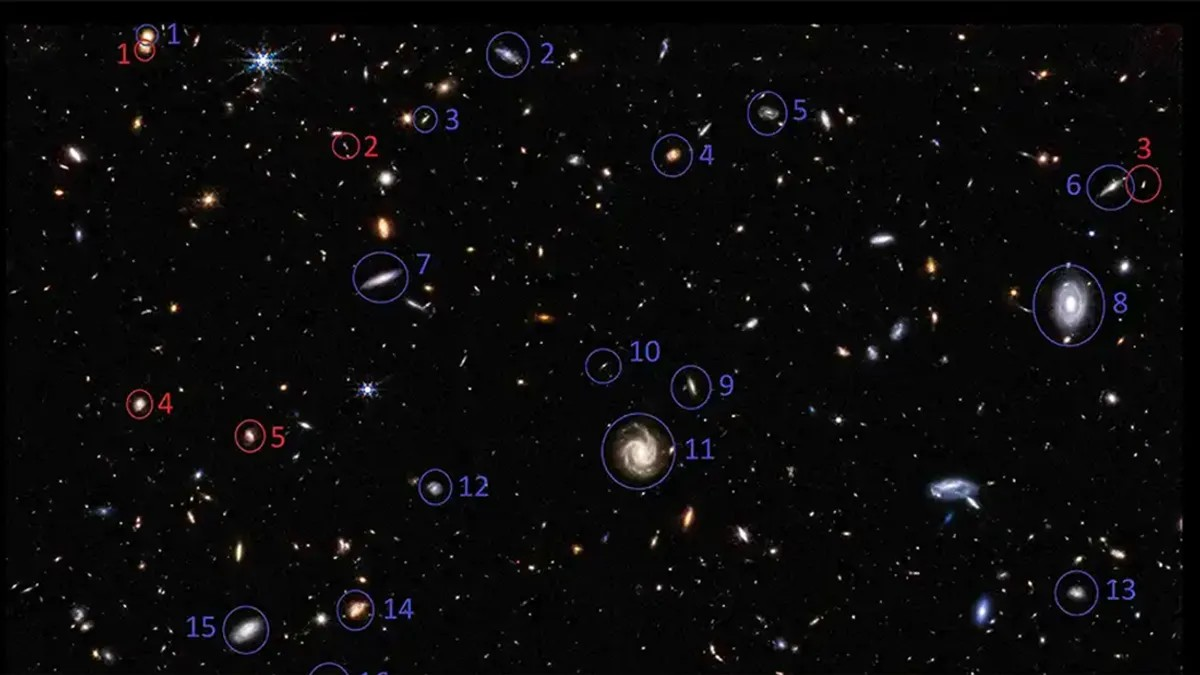

 English
 Arabic
 French
 Spanish
 Portuguese
 Deutsch
 Turkish
 Dutch
Dutch
 Italiano
 Romaian
 Portuguese (Brazil)
 Greek
Greek