


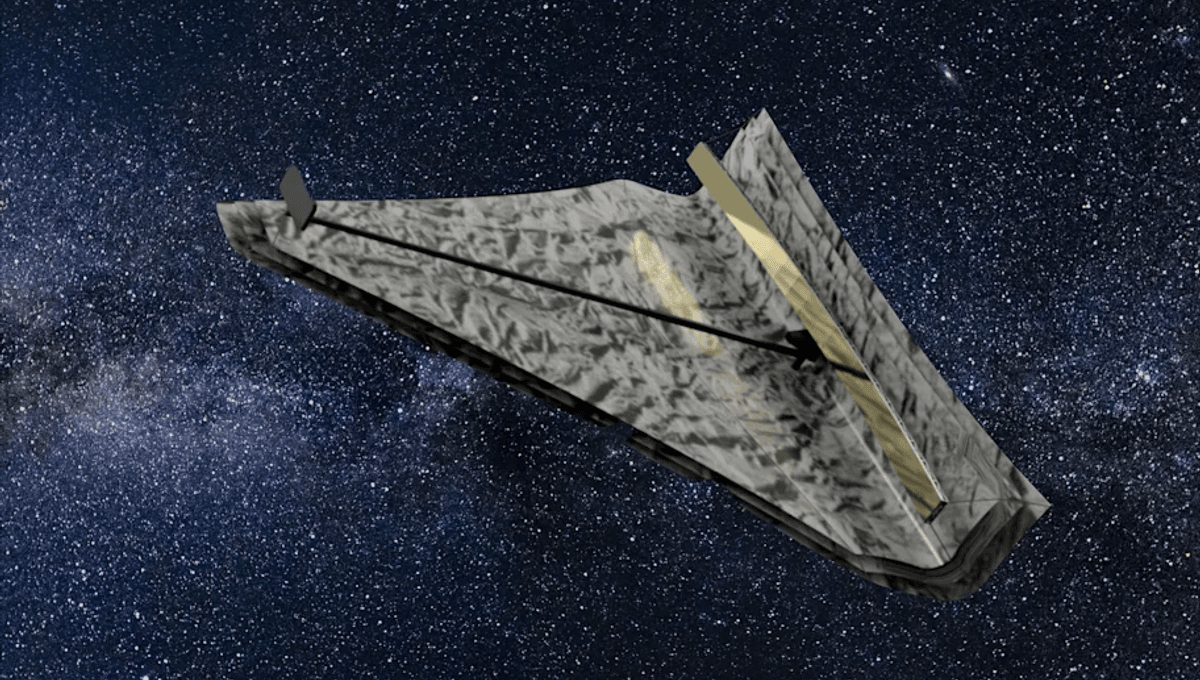

Since Galileo perfected the telescope and used it to look at the stars, we have made a giant leap forward in terms of technology. Materials, sizes, locations, and configurations have changed, but ultimately, a telescope has a mostly circular setup where mirrors and lenses magnify and direct light on detectors. A new paper argues that this setup might not actually be optimal for finding exoplanets that might host life. And they have a better solution: an extremely rectangular telescope.
The rest of this article is behind a paywall. Please sign in or subscribe to access the full content. Advanced telescopes are engineering marvels. Think of Hubble, JWST, the Very Large Telescope, or the shiny new one, the Vera Rubin Observatory. Magnificent instruments. Still, every human invention has its limits, and it seems that our best chance to find an Earth-like planet lies beyond. An Earth 2.0 would need water, so you would need to be studying it in infrared light – specifically mid-infrared, as water gives off most light with a wavelength of 10 microns. JWST does that already. Now the other issue is to be able to distinguish the planet from its star and block the light of the star, which will, of course, outshine the little planet. A telescope like JWST can see that wavelength, but it is not big enough to distinguish an Earth-like planet orbiting its star at the Earth-Sun distance. If it were hunting planets at that separation to up to 30 light-years, it would have to be 20 meters (66 feet) across. With a mirror of 6.5 meters (21 feet) across, JWST is the biggest telescope ever launched into space, and the deployment was nerve-wracking and slow. Hundreds of steps need to happen, and nothing can go wrong. Doing the same again, but even bigger, would be beyond current tech. A 20-meter mirror would likely be around 15 times larger than JWST – just too big for now. An alternative is to use shorter wavelengths, such as visible light. There, the problem is blocking sunlight. The Sun is 10 billion times brighter than the Earth at those wavelengths, so the blocking becomes fundamental and needs to be done extremely precisely. You can’t just put a sticker on a lens; the glare from the star will bleed through. A bold solution involves having a double-space system: a starshade spacecraft flies in front of the telescope, blocking the starlight. This is the principle of the successful Proba-3 mission, which uses two spacecraft flying in formation to block sunlight like a mini-eclipse on command. But the two components of Proba-3 are 150 meters (492 feet) apart; the proposed starshade would need to be tens of thousands of meters away. To solve most of these problems, a team led by Professor Heidi Newberg at Rensselaer Polytechnic Institute suggest a high aspect ratio rectangular mirror, with dimensions 1 meter by 20 meters (3 feet by 66 feet). This would give the benefits of the large mirror but with surface area that's actually smaller than JWST's. There are technical challenges to be solved for sure, but this design might be a winner. The team estimates that it would be able to image 27 Earth-size planets within 30 light-years from Earth. The proposal is outlined in a paper published in Frontiers in Astronomy and Space Sciences.


 English
 Arabic
 French
 Spanish
 Deutsch
 Turkish
 Dutch
Dutch
 Italiano
 Russian
 Romaian
 Portuguese (Brazil)
 Greek
Greek