


Outstanding Photos Show First Baby Planet Growing In The Grooves Of A Stellar Disk
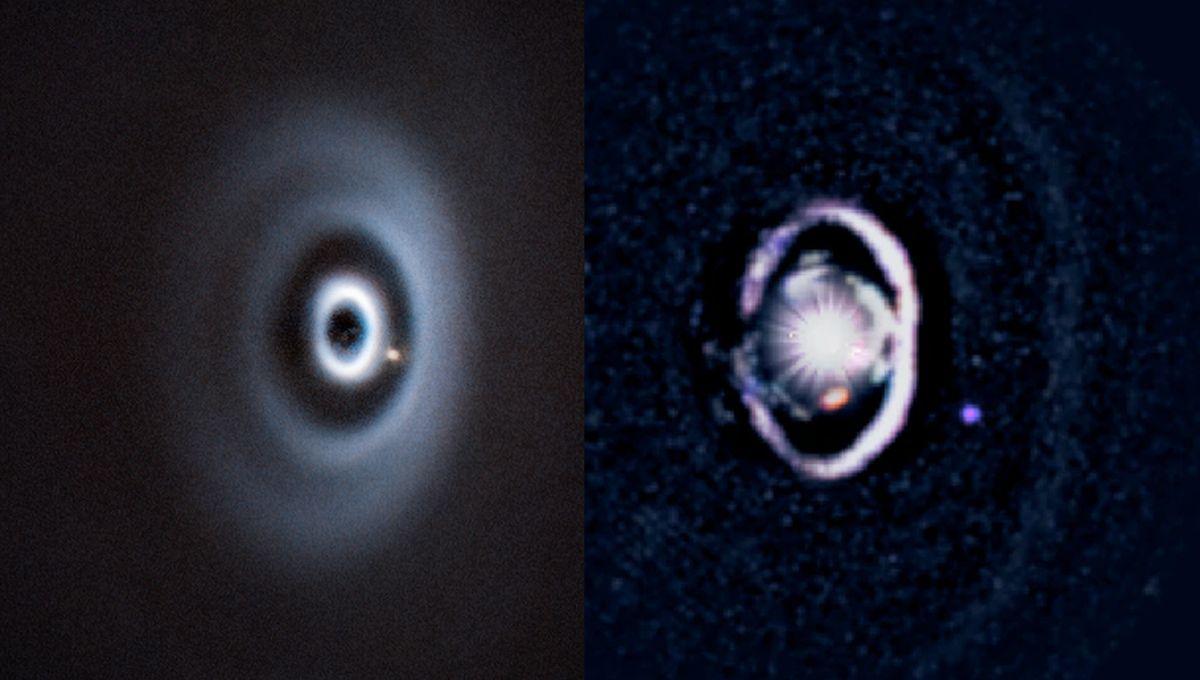
Outstanding Photos Show First Baby Planet Growing In The Grooves Of A Stellar Disk
For several years, astronomers have been seeing the hallmark of planet formation around stellar protoplanetary disks. A baby star is surrounded by a disk of gas and dust, and to observatories like ALMA, grooves in the disk appear as dark rings. These grooves are believed to be formed by fledgling planets, but no planets have been seen in them. Until now.
The rest of this article is behind a paywall. Please sign in or subscribe to access the full content. Researchers report revolutionary observations of WISPIT 2, which show – both in infrared light and optical – a planet among the dark rings. WISPIT 2b, as it is called, is estimated to be very young, but a lot more massive than the planets in the Solar System – around five times the mass of Jupiter, orbiting 56 times further away from its star than Earth is from the Sun. “Dozens of theory papers have been written about these observed disk gaps being caused by protoplanets, but no one's ever found a definitive one until today,” co-lead author Laird Close, professor of astronomy at the University of Arizona, said in a statement. “It's been a point of tension, actually, in the literature and in astronomy in general, that we have these really dark gaps, but we cannot detect the faint exoplanets in them. Many have doubted that protoplanets can make these gaps, but now we know that in fact, they can.” But that is not the only find in this system. The team also found evidence of a second candidate planet, currently named CC1, which is about nine times the mass of Jupiter but orbiting a lot closer, about 15 times the Earth-Sun distance. In Solar System terms, that’s between Saturn and Uranus. “Capturing an image of these forming planets has proven extremely challenging, and it gives us a real chance to understand why the many thousands of older exoplanet systems out there look so diverse and so different from our own solar system. I think many of our colleagues who study planet formation will take a close look at this system in the years to come,” co-author Dr Christian Ginski from the University of Galway said in a statement. This whole system is like looking back into the past of the Solar System. While we do not have planets quite as big around the Sun, we are seeing the birth of a planetary system not too dissimilar. “Discovering this planet was an amazing experience - we were incredibly lucky. WISPIT 2, a young version of our Sun, is located in a little-studied group of young stars, and we did not expect to find such a spectacular system. This system will likely be a benchmark for years to come,” co-lead author Richelle van Capelleveen, from Leiden University, explained. The work was possible thanks to the MagAO-X extreme adaptive optics system at the Magellan Telescope in Chile, the Large Binocular Telescope in Arizona, and the Very Large Telescope at the European Southern Observatory in Chile. The study is published in two papers in The Astrophysical Journal Letters.

 English
 Arabic
 French
 Portuguese
 Deutsch
 Turkish
 Dutch
Dutch
 Italiano
 Russian
 Romaian
 Portuguese (Brazil)
 Greek
Greek