


Meet The Spectral Bat, The Largest Carnivorous Bat Species In The World
Meet The Spectral Bat, The Largest Carnivorous Bat Species In The World
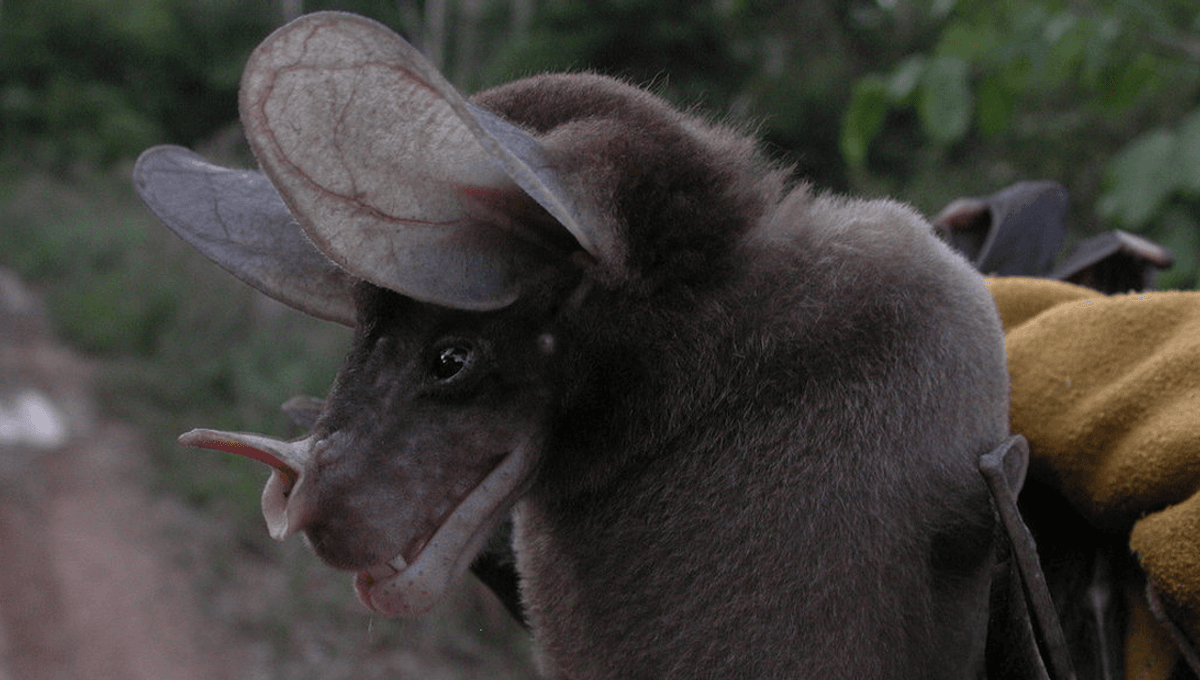
In tropical forests from Central America through South America lives the world’s largest carnivorous bat species. With a wingspan of almost 1 meter (3 feet), these creatures feed on birds, rodents, and even other bat species. But these giant flying mammals have a softer side, forming pairs to care for their young. Meet the spectral bat.
The rest of this article is behind a paywall. Please sign in or subscribe to access the full content. Spectral bats (Vampyrum spectrum) are both the largest carnivorous bat species and the Western Hemisphere’s largest bat. These creatures can weigh between 145-190 grams (0.3-0.4 pounds) and have noseleafs that can measure 17 millimeters (0.6 inches). They have no tail and are typically reddish brown. Spectral bats are somewhat social, forming roosts that typically contain the breeding pair and their offspring. The roosts themselves occur in hollow trees and can house between one and five individuals that hang tightly together. Males have even been seen enclosing both females and young within their wings. Both parents will bring back food for the young. Spectral bats are listed as Near Threatened by the IUCN, meaning they are not largely at risk. The main threat facing this species is habitat fragmentation and destruction since they mainly live in forest areas. In a study published earlier this month, researchers installed a motion-sensitive infrared camera inside a hollow tree in Costa Rica to record the four bats that were roosting inside. For three months, the camera captured footage and revealed to the team that the bats were far more social than they were expecting. The footage included clips of the bats playing, and even a social greeting whereby a bat would wrap its wing around the body of a returning family member. “Rather than hunting and raising young in isolation, V. spectrum shows complex cooperation behavior, strong monogamous pair bonds, as well as extended parental investment and biparental care – traits highly unusual in carnivorous mammals, especially bats,” said lead author Marisa Tietge in a statement. The four bats were thought to be the two parents and offspring from different years. This shows researchers that older offspring stay with their parents in the roost for an extended period. Prey was also recorded being passed from the male parent to the lactating female, as well as both bats leaving and returning to the roost together. “We were astonished by how gentle and cooperative these apex predators are,” continued Tietge. “The most endearing behavior was forming a tight cuddle-ball when falling asleep: each bat wrapping one wing around its nearest neighbor, all snouts touching.”How big are spectral bats?
Social behavior
Spectral bat conservation
Recent research

 English
 Arabic
 French
 Spanish
 Portuguese
 Deutsch
 Dutch
Dutch
 Italiano
 Russian
 Romaian
 Portuguese (Brazil)
 Greek
Greek