


Mercury Is Shrinking – And Its Surface May Have Just Revealed By How Much
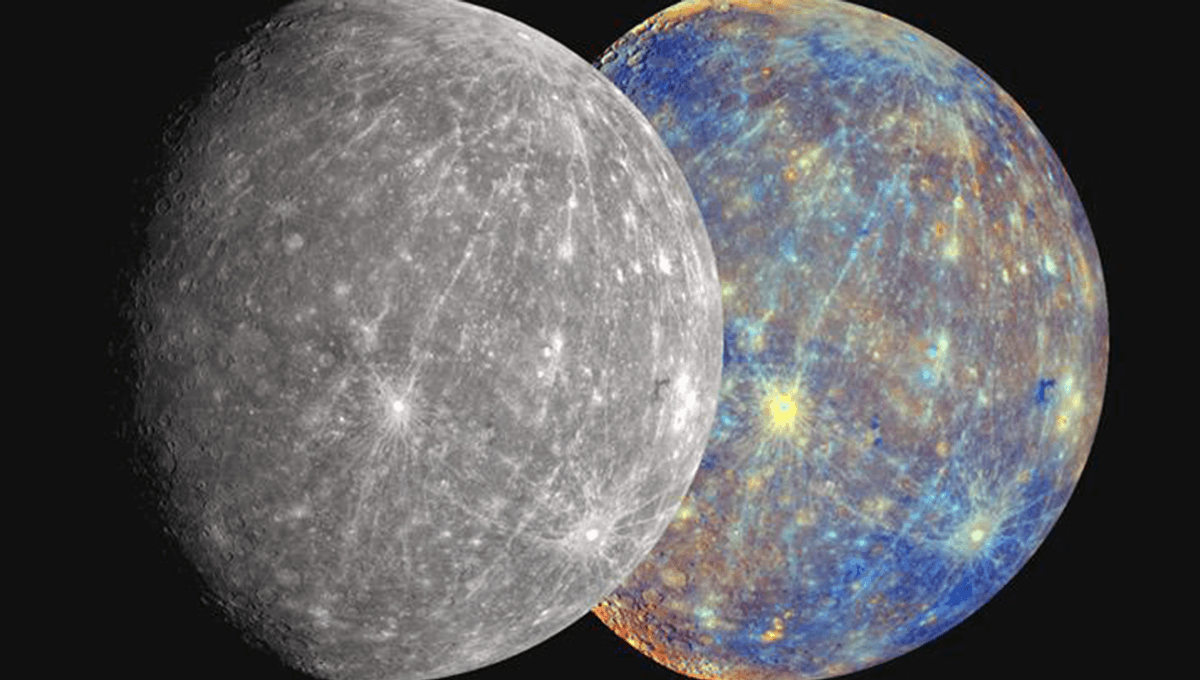
Mercury Is Shrinking – And Its Surface May Have Just Revealed By How Much
A new study has used an alternative method to work out how much Mercury has shrunk since its formation, finding that the planet has gotten significantly cooler in its first 4.5 billion years.
The rest of this article is behind a paywall. Please sign in or subscribe to access the full content. Back in 1974, NASA's Mariner 10 mission flew by Mercury and discovered evidence that, already the smallest planet in the Solar System, it was getting smaller in size. This evidence came in the form of kilometers-high slopes known as "scarps" all across the planet. These are caused by faults beneath the scarps called "thrusts" as the planet contracts due to thermal cooling. "Because Mercury’s interior is shrinking, its surface (crust) has progressively less area to cover. It responds to this by developing 'thrust faults' – where one tract of terrain gets pushed over the adjacent terrain," David Rothery, Professor of Planetary Geosciences at the Open University and author of a 2023 paper exploring the planet's contraction, explained in a piece for The Conversation. "This is like the wrinkles that form on an apple as it ages, except that an apple shrinks because it is drying out, whereas Mercury shrinks because of thermal contraction of its interior." Shortened craters are a sign of Mercury's contraction. Image credit: D A Rothery (CC BY 4.0) In 2014, it was estimated that the planet had contracted around 7 kilometers (4.4 miles). On Mercury, we can also get a pretty good idea of when this shrinking happened by looking at the many impact craters that cover its surface. While some of the craters have become shortened by the planet's contraction (shown in the above diagram), there are also craters on top of scarps, meaning that the impact that caused them happened after the fault shifted the planet's crust. Using these methods, and a few others, scientists had placed the shrinking of Mercury between 1 and 7 kilometers, with the estimates varying depending on the number of faults included in the dataset studied. A new study has refined this further by looking at the largest fault in the dataset and scaling the effect to place estimates on the total amount of shrinkage, rather than looking at each fault in the dataset individually. "Multiple studies use the uplifted topography that overlie these faults to estimate the amount Mercury has shrunk. However, these studies are in disagreement with one another due to the number of landforms that each study attributes to global contraction," the team explains. "Here, we use an alternate approach of calculating the change in volume caused by a population of faults by statistically scaling the change from the largest fault to the entire fault population." Using this method, the team found that no matter which dataset they used (representing over 6,000 faults altogether), the estimated shrinkage was between 2.3 and 3.5 kilometers (1.4 and 2.2 miles). "Accounting for the additional component of global contraction that could have taken place, 0.4–2.1 km [0.25–1.30 miles] of radial contraction may be considered to be added to any radial contraction estimates from faulting," the team concludes. "Adding these two components yields a range of radial contraction of 2.7–5.6 km that is likely to have occurred on Mercury. This result is in reasonable agreement with many thermal evolution modeling efforts and, in combination with timing and strain rate estimates of global contraction, may be used to tightly constrain future thermal evolution modeling." The team suggests that the new modeling should replace previous estimates of Mercury's shrinkage as it cools, and that the analysis could be applied to other bodies in the Solar System. After all, it isn't just Mercury that is shrinking. The study is published in AGU Advances.

 English
 Arabic
 Spanish
 Portuguese
 Deutsch
 Turkish
 Dutch
Dutch
 Italiano
 Russian
 Romaian
 Portuguese (Brazil)
 Greek
Greek