




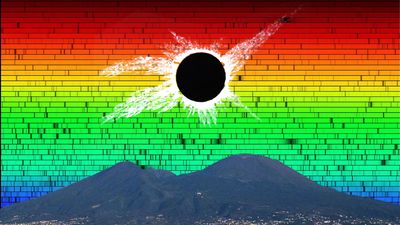
If you think of helium, you are probably thinking of party balloons and squeaky voices. That doesn't do the element justice. It has a large number of technical and industrial applications, and is the second most common element in the universe. On Earth, though, it is pretty scarce, and the fact that it is lighter than air and doesn’t react with other elements creates the perfect conditions for a much later discovery compared to other elements. A discovery that needed not just a solar eclipse, but also a deadly volcano to come to fruition.
The rest of this article is behind a paywall. Please sign in or subscribe to access the full content. On August 18, 1868, a total solar eclipse stretched from the Horn of Africa to Oceania. The eclipse has been called "The King of Siam's eclipse” because the most accurate calculation of the eclipse, made by King Mongkut, Rama IV of Siam (Thailand), was compared to those of contemporary French astronomers, who acknowledged his higher accuracy. French astronomer Pierre Janssen observed the eclipse from the city of Guntur, in India, at the time under British colonial rule. That’s where he saw something very special. It had been known since the beginning of the 1800s that if you were to take the spectrum of the Sun, you would see something peculiar. By spectrum, we mean using a prism or a dedicated instrument to reveal the different colors of the light in the uniform white light of the Sun. If you zoom in, the spectrum reveals specific dark lines, known as Fraunhofer lines after the scientist who classified over 570 of them. In 1859, Gustav Kirchhoff and Robert Bunsen (of Bunsen burner fame) discovered that several of those lines matched the emission lines of several heated chemical elements. They assumed, correctly, that those elements were present in the Sun’s atmosphere. A total solar eclipse is the perfect time to study the solar atmosphere (AKA the corona) since the bright solar disk is blocked by the moon. It has often been reported that the August 18, 1868, eclipse was the first after that discovery. This is not true, but it was the 1868 one that had Janssen ready to use a spectroscope. In that eclipse, he discovered lines that did not correspond to any known elemental line, suggesting a possible connection to sodium. British astronomer Norman Lockyer, who would go on to be the founder of the journal Nature, observed a prominence on the Sun on October 20, 1868 and also found this line, but he believed it was not a known element. Independently, they both sent their findings to the French Academy of Science in on October 26, 1868. Lockyer had called this new element helium. The name comes from the Greek word for Sun, Helios. It was certainly an otherworldly element, not something with an obvious connection with Earth. That is, until one was discovered, from the fiery eruption of one of the most dangerous volcanoes in the world: Mount Vesuvius. In 1881, Italian physicist Luigi Palmieri sublimated some of the material from a recent eruption (it's unclear if it was the 1872 or 1868 eruption) of the volcano, and he reported the presence of potassium, sodium, and the now-famous helium line. It would take another decade and a bit before William Ramsay would be able to extract helium gas from minerals where it has been trapped, showing that this celestial material is also found in the earthly soil.


 English
 Arabic
 French
 Spanish
 Portuguese
 Turkish
 Dutch
Dutch
 Italiano
 Russian
 Romaian
 Portuguese (Brazil)
 Greek
Greek