


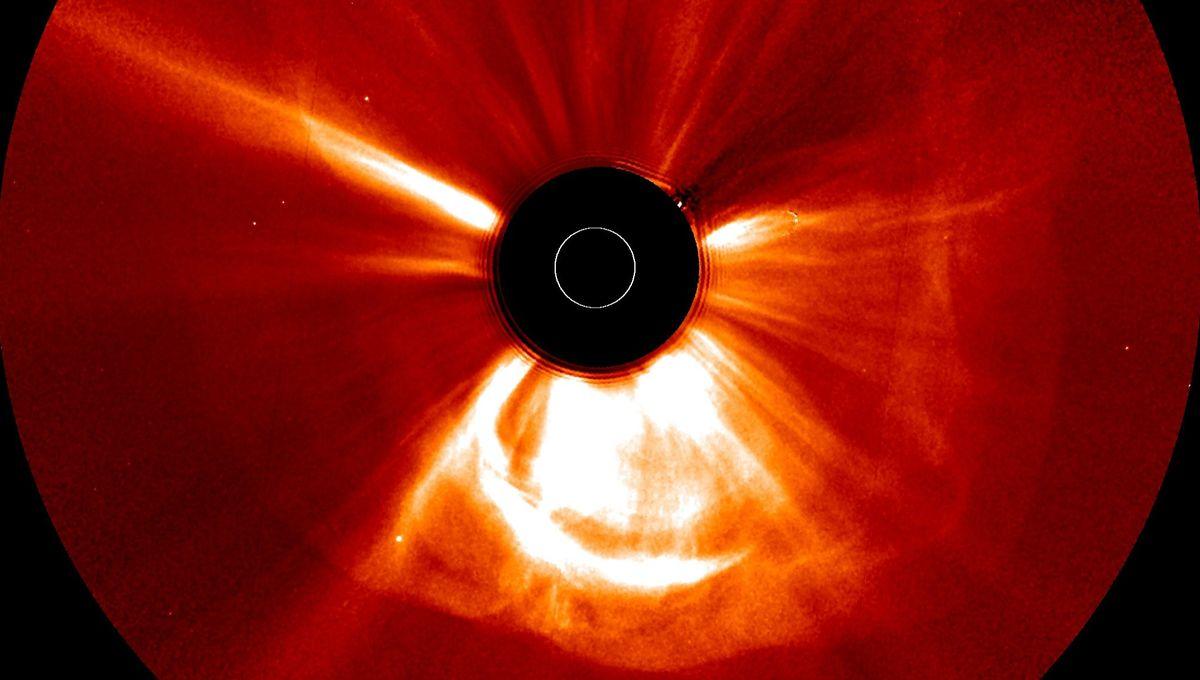

Across September 1 and 2, 1859, the Earth experienced the most intense geomagnetic storm in recorded history. It is known as the Carrington Event and caused aurorae visible almost to the equator and damage to electrical systems, which at the time mostly consisted of telegraphs. None comparable have hit Earth since, but we came really close in 2012, as a new NASA visualization shows.
The rest of this article is behind a paywall. Please sign in or subscribe to access the full content. Geomagnetic storms are caused by extremely fast releases of plasma from the Sun known as Coronal Mass Ejections (CMEs). Their speed depends on many factors, and they are usually associated with solar flares, which can cause radio blackouts independently of the CMEs. The Carrington Event is believed to have been powered by an extremely powerful flare, one of the earliest records of one, and possibly previous smaller CMEs cleared the way for the big one to arrive and cause the geomagnetic storm. Back then, we did not have the technology we have today, so it is difficult to know exactly how that happened. But we do know that in 2012, the planet risked experiencing a similar event when a Carrington Class CME was released and hit one of the solar monitor satellites, STEREO-A. Across July and August 2012, the Sun released several CMEs. Scientists considered four CMEs to be the prelude to an absolutely epic one, which was released from the Sun at 2:08 am UT of July 23. The flare was an X2.5, which is powerful but not as extreme as we have experienced, even in the last few years. But the CME was certainly something incredible, traveling at 2,000 kilometers (1,200 miles) per second. The trick, scientists believe, was having the previous CMEs pushing interplanetary plasma away, making it smooth sailing for the CME. NASA has released a detailed visualization of the coronal mass ejections that took place in July and August 2012 and how they spanned the Solar System, reaching the inner planets and the STEREO-A spacecraft. The event has concerned scientists since it happened. Solar Cycle 24, when the storm happened, was a weak solar cycle, so the fact that such an event was possible suggests that maybe they are not as infrequent as they were thought to be in the past. If the Earth had been nine days ahead in its orbit, the CME would have hit us, with damage to infrastructure globally that would easily be in the hundreds of billions of dollars.


 English
 Arabic
 French
 Spanish
 Portuguese
 Deutsch
 Turkish
 Dutch
Dutch
 Italiano
 Romaian
 Portuguese (Brazil)
 Greek
Greek