


There's A Very Intriguing Reason Why Great White Sharks Have White Bellies
There's A Very Intriguing Reason Why Great White Sharks Have White Bellies
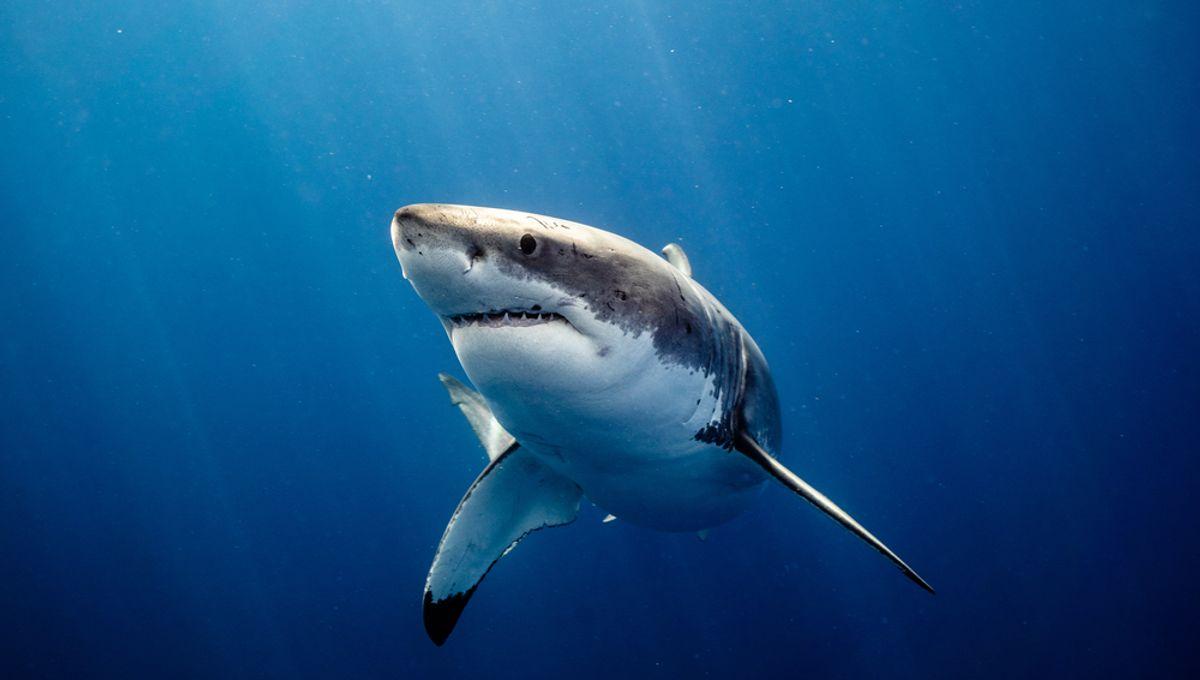
You ever noticed how a “great white” shark isn’t? White, that is – it’s grey, right? Except for its belly, of course. Why is that?
It turns out that whoever named the great white shark must have been underneath one, looking up, when they did so: “The name 'white shark' refers to the color of their bellies,” explains the UK’s Natural History Museum. But aside from being an iconic lewk, why would this apex predator of the seas sport such a pale underside? Well, it all comes down to camouflage – and it’s smarter than you might think. “Combined with their grey coloring on top, this works as effective camouflage whether their targets are looking up to the bright sky or down to the sea floor,” notes the Museum – which is true, but it’s not the whole story. This kind of dark-on-top, light-underneath pigmentation is called countershading, and it’s not just a color thing – it’s also a way of exploiting the natural action of light and shadow to make the shark almost invisible. “If an object be colored so that its tones constitute a gradation of shading and of coloring counter to the gradation of shading and of coloring which light thrown upon it would produce, and having the same rate of gradation, such object will appear perfectly flat,” wrote Abbott Handerson Thayer, the artist who first detailed the principle of countershading in 1909. The object will, he explained, “[retain] its length and breadth, but los[e] all appearance of thickness; and when seen against a background of color and pattern like its own will be essentially indistinguishable at a short distance.” In other, less Edwardian words: when you look at an object – or a shark, in this case – under natural light, it’ll generally be lighter on top and darker underneath. By being darker on top and lighter underneath, therefore, the shark’s coloring kind of cancels out this natural light, making it way harder for an observer to figure out where, exactly, it is. It’s actually the same reason some planes are painted lighter underneath, particularly those from World War II. That’s not the only advantage of countershading. In 2008, researcher Hannah Rowland, now a Senior Lecturer in Ecology Evolution, Ecology and Behavior at the University of Liverpool, found an overlooked aspect of this color pattern: by modeling a countershaded cylinder under natural light, she found that it also makes the edges of the object harder to make out. “When illuminated and viewed from above, a cylinder of uniform color exhibits unequal reflectance of light across the dorsal surface, with darkening at the edges of the cylinder,” she explained. “However […] in a countershaded cylinder, the reflectance at the edge of the body may exactly balance the dorsoventral gradation from which light is reflected, such that the outline of the object is obliterated when it is viewed from above. This may reduce the capacity of predators to detect the edges of a countershaded prey animal when that animal is viewed from above.” So, the reason for the great white’s pale belly? It’s a camouflage – and a pretty neat one, too. But here’s the kicker: those sharks are sneakier even than that. Recently, it was found that great whites can power up their countershading advantage by straight-up changing their color in real time. “From personal experience […] we definitely do notice changes in their color,” Michelle Jewell, who studies great white shark behavior at Michigan State University Museums, told National Geographic in 2022. “Usually those changes have happened over a series of days.” The leading hypothesis was previously that the sharks were simply getting a tan, after spending time in shallow water – and indeed, another benefit of the darker pigment being on top is UV protection. But early experimental evidence seemed to show a faster color change – and that it happens in response to hormones like adrenaline, which might be released when the shark sees a potential prey. “[T]his could potentially be something that they themselves are manipulating to get darker or to get lighter,” Jewell said. “It would make a lot of evolutionary sense.”

 English
 Arabic
 French
 Spanish
 Portuguese
 Deutsch
 Turkish
 Dutch
Dutch
 Italiano
 Romaian
 Portuguese (Brazil)
 Greek
Greek