


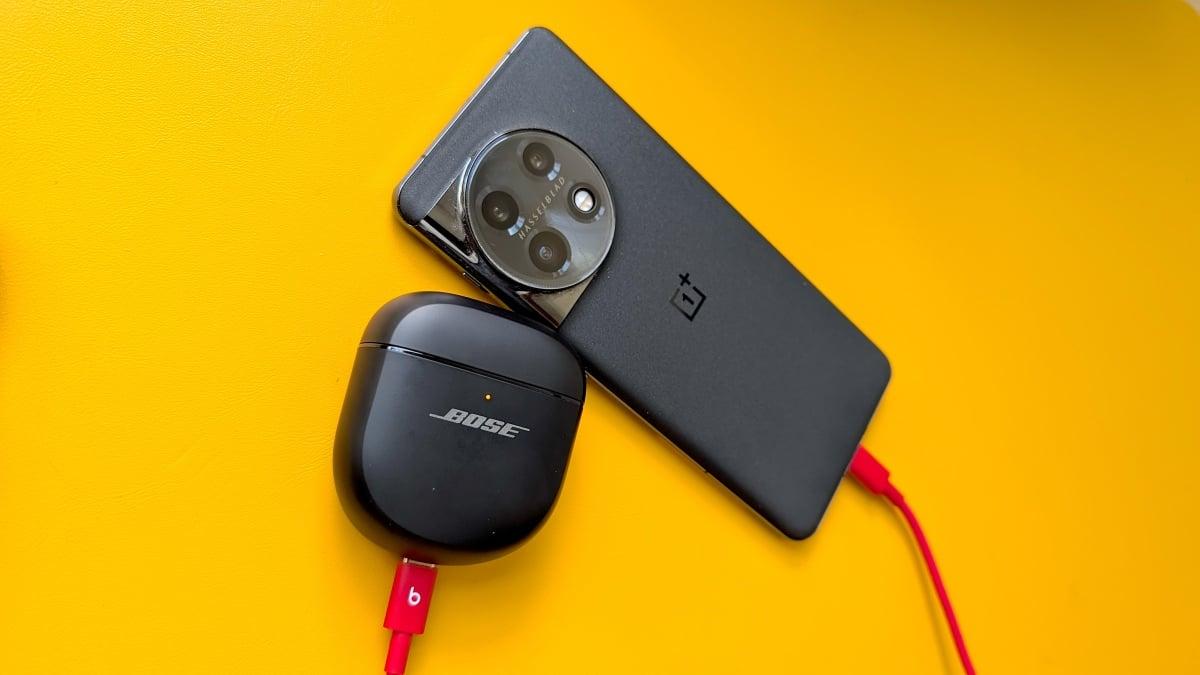
Battery life on the devices we use every day is never enough. We’re always scrambling for solutions to increase it when running low on power, be it a portable charger or tethering ourselves to the nearest wall outlet with an adapter plug in hand. But every now and then, we’ll lose track of the energy levels on these products.
Our devices often die at the most inopportune times, like on the way to the gym or when driving to pick up a toddler from daycare. It sucks not having battery life when you need it most. Well, lo and behold, there is a workaround for this predicament.
Ever heard of reverse charging? You’ve probably stumbled upon the term when reading Mashable’s latest headphones reviews (it’s been our priority to highlight releases that support the technology). This is one of the more underrated features of modern devices like smartphones and earbuds that everyone should know about, especially those who are terrible with battery life management.
I’m here to give you a crash course on the topic and explain how it can be a lifesaver. All that is needed for the most part is a USB-C charging cable, and we have three solid options to look at once the lesson is over.
What is reverse charging, and how does it work?
Reverse charging is the ability of a smartphone (or another device) to transfer power to another device without using a charger, wall outlet, or power bank. In other words, you can charge up your AirPods using your iPhone. This can be done wirelessly, or more often, with a compatible charging cable.
I do this all the time when my fitness headphones are almost dead and require extra juice to get through lengthy workouts (they’ll be connected to my Google Pixel 9 when performing pre-workout stretches).
The one misconception about reverse charging
Reverse charging isn’t exclusive to smartphones. In fact, most portable devices employ this feature. You can use a laptop to recharge a smartphone or wireless earbuds. An iPhone can even be used to recharge a portable speaker (*cough* the Beats Pill cough).
Mashable Light Speed
Some of the best portable Bluetooth speakers come with a built-in power bank to recharge smaller devices. For the ones that don’t, they can rely on a smartphone for an electric surge.
What’s this about wireless reverse charging?
Samsung deserves credit for popularizing wireless reverse charging. The company’s PowerShare technology debuted on Galaxy smartphones several years back, allowing users to wirelessly charge a secondary device by placing it on the back of the phone. This includes Samsung smartwatches and wireless earbuds, as well as other Android- and Apple-based devices (iPhone, AirPods). Mobile manufacturers like Google, Huawei, and Xiaomi also offer this feature on their latest smartphones. It’s something to keep in mind when your buds are near depletion and that brand-new Galaxy Z Fold 7 is sitting in your pocket with plenty of power to spare.

Credit: Alex Bracetti / Mashable
Our three favorite charging cables for reverse charging
Beats USB-C to USB-C Cable
Beats just launched a variety of charging cables that pair perfectly with its popular wireless audio releases, such as the Pill portable speaker and Powerbeats Pro 2 earbuds. The cable length is adequate, and its charging strength is superior to what the standard iPhone cable delivers. Furthermore, the USB-C version grants lossless audio playback for the AirPods Max and current Beats headphones (e.g., Solo 4, Studio Pro). | Read our full Beats charging cable review.
Anker Prime USB-C to USB-C Cable
Designed to “boost a 16-inch MacBook Pro (M3 Pro) to 50% in just 26 minutes,” Anker’s flagship charging cable comes in three lengths (1 ft, 3 ft, and 6 ft.) and has extreme temperature resilience to maintain ultra-fast 240W charging without overheating devices. It’s a super-thick cable covered in flexible hard-woven material that can bend up to 300,000 times before breaking. Not to mention it comes with ridiculously fast transfer speeds; you can send four 3-minute songs to another device in one second.
UGreen 240W PD3.1 USB-C to USB-C Cable
This budget alternative charges slightly faster than Anker’s cable and can be used with a vast number of devices. This includes laptops, phones, tablets, and even handheld gaming consoles (e.g., Nintendo Switch 2, Steam Deck). It works best when paired with brand accessories like the Uno Charger, which is a cool-looking power adapter with an LCD screen that informs you of charging statuses via facial expressions.

 English
 Arabic
 French
 Spanish
 Deutsch
 Turkish
 Dutch
Dutch
 Italiano
 Russian
 Romaian
 Portuguese (Brazil)
 Greek
Greek