


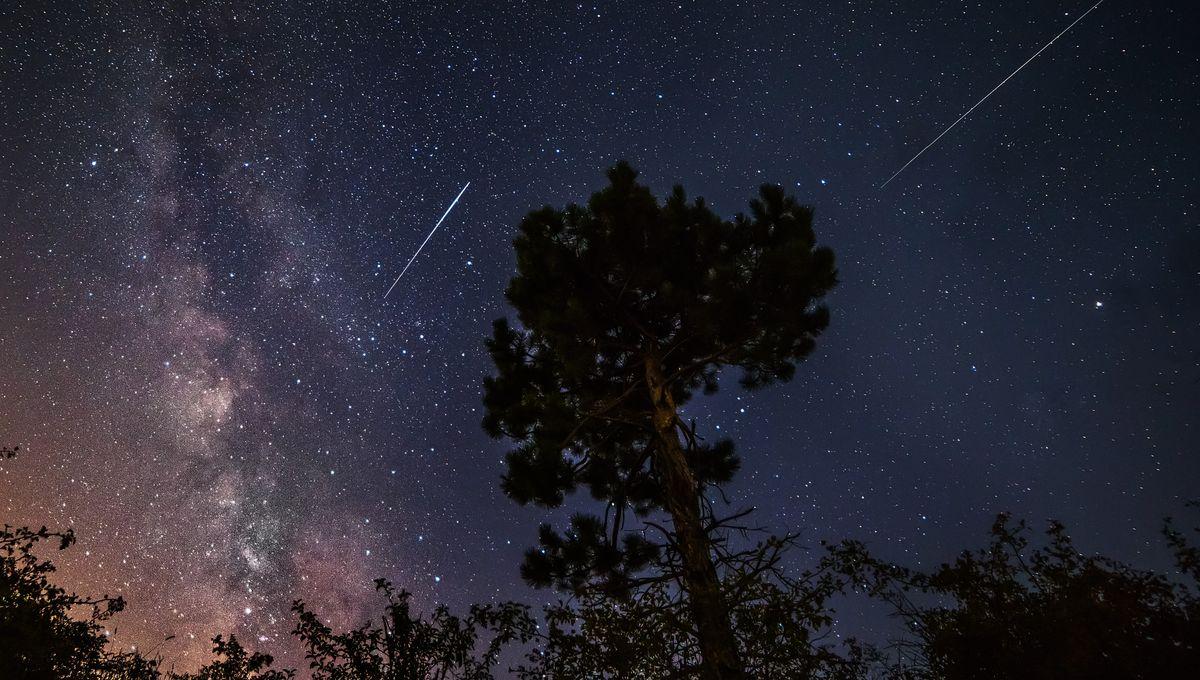

The peak of the Perseids is almost here, but the run-up to it is going to be a bit dampened by the pesky Moon. Our natural satellite reaches its fullness tonight, which means if you were planning to go meteor hunting this weekend, you will have to contend with its glaring light for most of the night. This doesn’t mean it's impossible to catch a meteor, or even "fireball," but it won’t be the best time to do that. That will be next week, when the peak viewing hits.
The Perseids are considered the best meteor shower in the Northern Hemisphere because they are both impressive – known for the occasional bigger, longer, and brighter fireball – and reliable. They happen in the middle of summer, they are bright, and often numerous enough to deliver a grand spectacle. The peak this year is expected to be on August 12 at 8pm UTC, so given the full Moon tomorrow, if you really want to see the best of it and can only go out one night, then after the weekend is better. The average peak is about 100 meteors per hour, but some years are better, like in 2016, with over 130, and some years are worse, like 2024, with 80. Still, if the last few years are anything to go by, the days after the peak are not too bad either, with more than one meteor a minute and not falling below 10 an hour for several days. So you have chances to see something pretty and bright even if you can’t go out on August 12. However, it's not just the Perseids lighting up the sky right now. At the moment, you can see four planets with the naked eye aligned in the sky. Six, if you have a telescope. And while that will last for several weeks, Aug. 12 is a particularly good day because Venus and Jupiter will be in conjunction, less than one degree apart, and the Moon, Saturn, and Neptune will appear in a right-angle conjunction. The Perseids are caused by the debris left over by comet Swift-Tuttle. The comet is 26 kilometers (16.16 miles) wide and gets close to the Sun every 133 years, releasing a large tail. The tail is full of particles that Earth passes through each year. As some of these pieces of debris hit the atmosphere, they disintegrate, burning up and releasing light as they do, which we can see. Swift-Tuttle's next closest passage to the Sun is in 2125 and it will be brightly visible to the naked eye from Earth.


 English
 Arabic
 French
 Spanish
 Portuguese
 Deutsch
 Turkish
 Dutch
Dutch
 Italiano
 Russian
 Portuguese (Brazil)
 Greek
Greek