


Most Distant Black Hole Ever Confirmed From 500 Million Years After The Big Bang
Most Distant Black Hole Ever Confirmed From 500 Million Years After The Big Bang
The advent of JWST has revolutionized our understanding of the earliest universe. Its keen infrared eye has pushed the boundaries of how far we can see into the universe, and due to the finiteness of the speed of light, that means how far we can look into the past. We are now studying the earliest hundreds of millions of years after the Big Bang, and researchers have confirmed the most distant known black hole in the universe.
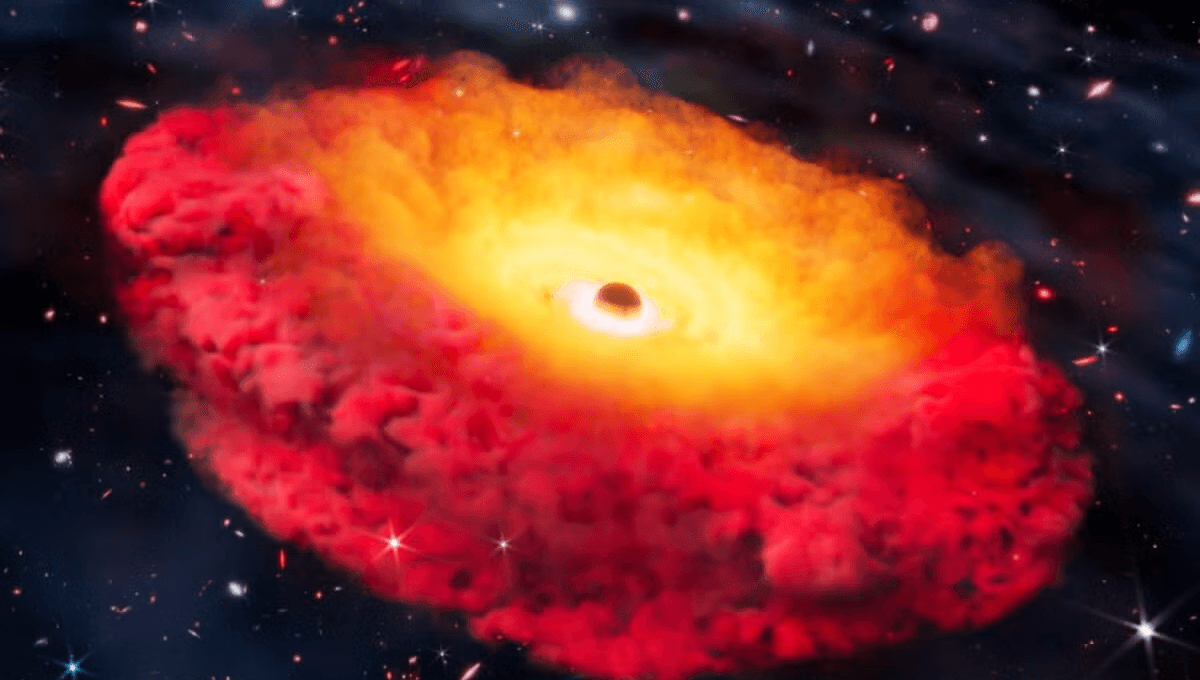
The cosmic object sits at the core of galaxy CAPERS-LRD-z9 and was already there 500 million years after the Big Bang – that’s just 3 percent of the universe's current age. The team used JWST's spectroscopic capabilities to find the undeniable presence of a black hole. While hints of earlier black holes have been observed, this is the earliest and so the most distant confirmed. "When looking for black holes, this is about as far back as you can practically go. We're really pushing the boundaries of what current technology can detect," lead author Dr Anthony Taylor, from The University of Texas at Austin's Cosmic Frontier Center, said in a statement. "While astronomers have found a few, more distant candidates," added Steven Finkelstein, a co-author on the paper and director of the Cosmic Frontier Center, "they have yet to find the distinct spectroscopic signature associated with a black hole." Both the galaxy and the black holes are fascinating windows into the formative years of the cosmos. CAPERS-LRD-z9 belongs to the new class of galaxies known as "Little Red Dots". They only existed for the first 1.5 billion years of the universe. They are very compact, red, and very, very bright. Their brightness is a key aspect of their mystery. This would normally indicate a large number of brand-new stars, but there hasn't been enough time for this number of stars to have formed. The other alternative is a black hole, responsible for most of the emission. The team found evidence of a cloud shrouding the black hole, pushing its light to redder wavelengths. Could this be the secret of the Little Red Dots? "We've seen these clouds in other galaxies," explained Taylor. "When we compared this object to those other sources, it was a dead ringer." There is another issue with this galaxy: the size of its black hole. It is estimated to be up to 300 million times the mass of the Sun. Our galaxy's supermassive black hole, Sagittarius A* is 4.6 million times the mass of the Sun, and it has had 13.8 billion years to grow to that size. How the one inside CAPERS-LRD-z9 bulked up to its incredible size is unknown. "This adds to growing evidence that early black holes grew much faster than we thought possible," said Finkelstein. "Or they started out far more massive than our models predict." "This is a good test object for us," said Taylor. "We haven't been able to study early black hole evolution until recently, and we are excited to see what we can learn from this unique object." The study is published in The Astrophysical Journal Letters.

 English
 Arabic
 French
 Spanish
 Portuguese
 Deutsch
 Turkish
 Dutch
Dutch
 Russian
 Romaian
 Portuguese (Brazil)
 Greek
Greek