


Don’t Stand So Close To Me: 2 Meters Of Socially Distanced Queuing Is Not Always Enough
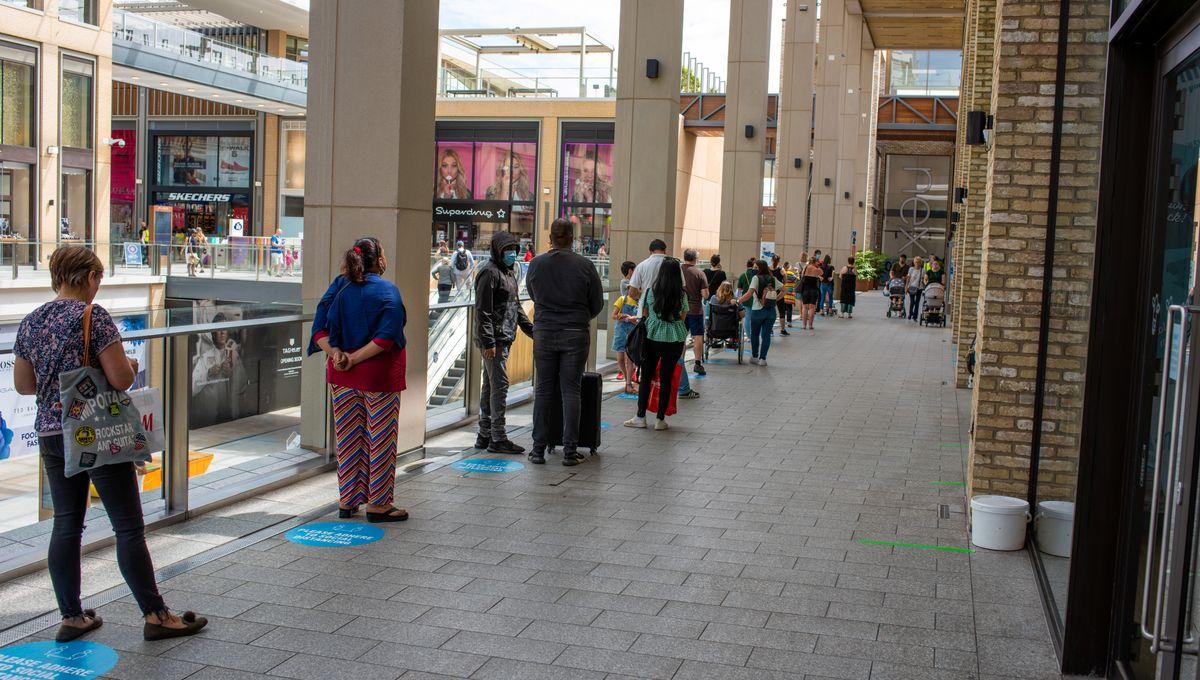
Don’t Stand So Close To Me: 2 Meters Of Socially Distanced Queuing Is Not Always Enough
Room temperature plays a surprisingly important role in determining how far apart people need to be to prevent disease transmission in a queue, a new study suggests. Consequently, the 2 meters (6 feet) apart queuing adopted during the pandemic was not always appropriate. How many lives may have been lost for lack of this information is still to be determined, even if this still-tentative assessment is right. Nevertheless, if another pandemic occurs, all those memes about standing the wingspan of your favorite giant bird apart might need to be rewritten.
The outbreak of COVID-19 showed how woefully underprepared the world was on many counts, including how little we knew about the methods of transmission of airborne diseases. Good science usually takes time. In the crucial first months much damage was done through wrong advice about the benefits of masks, the value of disinfecting surfaces, and the risk of transmission outdoors, before research caught up. Now it is possible another example should be added to the list, in the form of the advice that social distancing means standing more than 2 meters apart. University of Massachusetts Amherst students Ruixi Lou and Milo Van Mooy had wondered where the "6 feet" advice came from, and when given a chance to conduct their own research as undergraduates, decided to investigate. “We wanted to know how the aerosols we breathe out are transported, but it turns out this is very difficult to do in a real waiting line,” Lou, now a graduate student at the University of Chicago, said in a statement. Real lines for the grocery store or (to get vaccinated), where people periodically shuffle forwards, are complex to observe, and dangerous if some participants might really have COVID-19. Lou, Van Mooy and colleagues came up with a novel solution. They 3D printed human-shaped models and put them on a conveyor belt, with cylinders that released colored droplets in doses designed to replicate breathing, as well as with additional force to represent coughs or sneezes. The observed movements of particles less than 10 μm across – now thought to be the prime viral carriers – through the air were then modeled on computer. This approach is in stark contrast to most previous modeling that assumed static conditions, such as seated students and a standing teacher. “What we found was really surprising,” Van Mooy said. The team determined that temperature plays a surprisingly important role in determining how far aerosols carry. They anticipated the warmth from our breath would carry particles upwards, but found this was overcome through a “downwash” effect when room temperature was close to body heat. In air-conditioned spaces, the warmth of human breath pushed particles upwards towards the roof. By the time these particles sunk they had usually dispersed to the point of little danger. However, at 28°C (82°F), the virus could easily hover just high enough that when the line moved forward virus-carrying aerosols would be inhaled. Walking speed also affected the particles’ buoyancy, as did ventilation. “Ultimately, there are no hard-and-fast rules about social distancing that will keep us safe or unsafe,” said Dr Varghese Mathai, senior author of the paper published on the work. “The fluid dynamics of air are marvelously complex and general intuition often misleads, even for something as simple as standing in a line. We need to take space and time into account as we come up with our public health guidelines.” Although the work probably represents queuing conditions more accurately than anything done before, it’s also a reminder that any model can be incomplete, and without getting real (hopefully non-infectious) people involved answers can never be definitive. In the meantime, watch out when the air con is keeping temperatures bearable on a hot day, but struggling to reach its target. The study is published open access in Science Advances.

 English
 Arabic
 French
 Spanish
 Portuguese
 Deutsch
 Turkish
 Dutch
Dutch
 Italiano
 Russian
 Romaian
 Portuguese (Brazil)