


North Sea “Sinkites” Appear To Defy Rules Of Geology On Never-Before-Seen Scale
North Sea “Sinkites” Appear To Defy Rules Of Geology On Never-Before-Seen Scale
Much of the bottom of the North Sea is upside down, with older layers of sand lying on top of younger ones. This defiance of basic geological principles has been seen elsewhere, but never on this scale. Now, two geologists think they have an explanation.
The North Sea has been extensively drilled for oil, hosts the greatest concentration of offshore wind farms in the world, and is shallow enough to make exploration relatively easy. Consequently, you might expect it to be well understood, but its capacity to surprise us remains undiminished, particularly in more northern regions. Extensive 3D seismic imaging has revealed enormous mounds of sand, some stretching for kilometers, that lie beneath the sea floor with older layers on top. “This discovery reveals a geological process we haven’t seen before on this scale,” said Professor Mads Huuse of The University of Manchester in a statement. “What we’ve found are structures where dense sand has sunk into lighter sediments that floated to the top of the sand, effectively flipping the conventional layers we’d expect to see and creating huge mounds beneath the sea.” Huuse and co-author Jan Rudjord of Aker BP call these structures sinkites and floatites, and say they are the largest of their type ever seen, kilometers wide and up to 200 meters (660 feet) deep. The intrusions are thought to date to the Late Miocene and Pliocene, 7-4 million years ago, and Rudjord and Huuse attribute their presence to a combination of three factors. The first ingredient is a deposit of rigid but quite porous – and therefore light – material, made mostly of small marine fossils with an average density of 1.8 grams per cubic centimeter (less than double water). Rudjord and Huuse call this bio-silicious ooze, and attribute it to a blooming of microscopic marine creatures when the North Atlantic sent an upwelling of nutritious water into the North Sea. The next ingredient is quantities of denser (2.1 grams per cubic centimeter) sand capable of liquifying and flowing through at least some of the older rock. The third necessary component was something that triggered the sand’s downward flow. Huuse and Rudjord think either earthquakes or sharp changes in underground pressure could have been responsible. Once some of the sand sank beneath the ooze, “This caused a buoyancy force on the lighter ooze blocks, which detached and started floating like rafts in the sand,” the authors write. An intrusion of younger sand sank into the bio-silicate ooze on the Northern North Sea floor. Image Credit: Mads Huuse “This research shows how fluids and sediments can move around in the Earth’s crust in unexpected ways. Understanding how these sinkites formed could significantly change how we assess underground reservoirs, sealing, and fluid migration — all of which are vital for carbon capture and storage,” said Huuse. Understanding the processes that created the sinkites could also make it easier for future operations to find the region’s remaining oil and gas. The existence of enormous sandstone intrusions on the floor of the Northern North Sea has been known for decades, but geologists have debated their origins. Rudjord and Huuse hope their explanation will resolve the question, although Huuse admits not everyone who has seen their work is convinced yet. To satisfy the doubters, the authors hope to find other examples, but admit they do not at this point know whether intrusions on this scale exist anywhere else in the world. They also propose more detailed sampling, which they argue could confirm their explanation. The study is published in Communications Earth & Environment.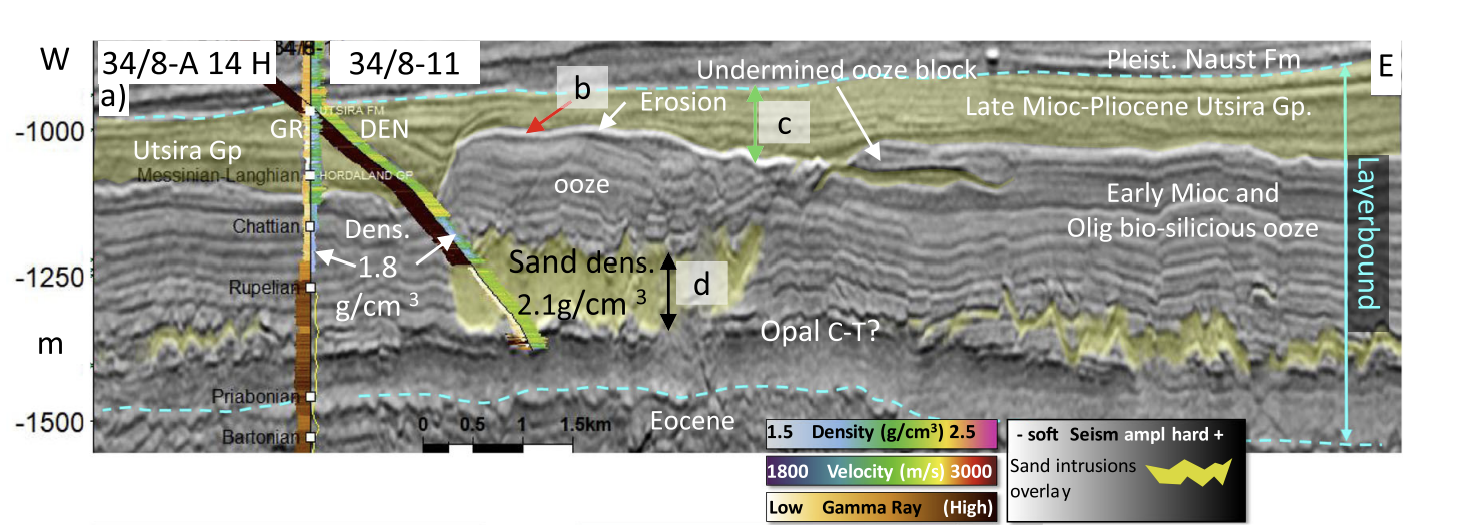

 English
 Arabic
 French
 Spanish
 Deutsch
 Turkish
 Dutch
Dutch
 Italiano
 Russian
 Romaian
 Portuguese (Brazil)
 Greek
Greek