


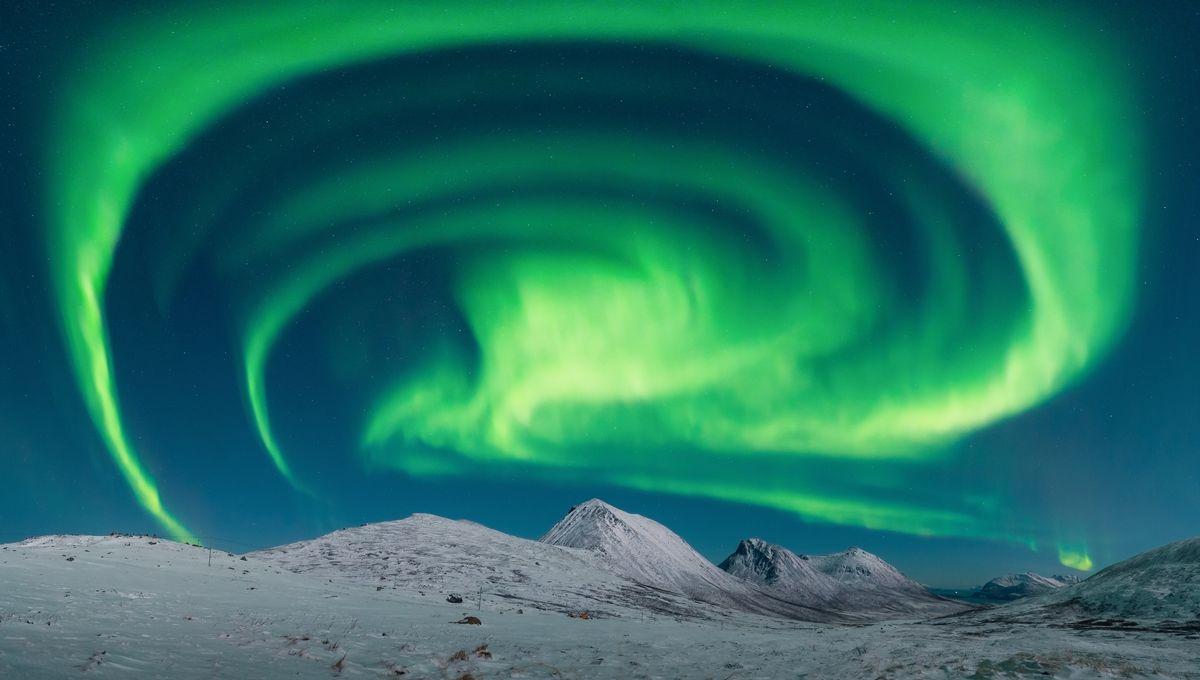


Around the polar region of our planet (and even elsewhere in the Solar System), electrically charged particles can form enormous vortices. These space hurricanes, as they are called, deliver a significant amount of energy into the atmosphere, leading to the creation of special auroral displays. Researchers have now published new insights into how they affect the magnetic field of our planet and even satellites.
A space hurricane has every feature you might expect in a regular hurricane, but space-y. In a regular atmospheric tornado, the movement of particles can generate a zone of low pressure, which draws in warm air. As the rising air cools, the heat loss fuels the storm, making it stronger. Space hurricanes feature the spiral arms, the cyclonic spot, and circular flow, but it's plasma – a fluid of electrically charged particles – that moves about, not air. Space hurricanes have rain too, though it's made of electrons. Space hurricanes are created by unusually large and rapid transfer of solar wind energy and charged particles into the Earth’s upper atmosphere, in particular the ionosphere. The new work, using the example of a typical space hurricane in 2014, highlighted that it can inject energy comparable to that of a magnetic storm at polar latitudes. This can cause geomagnetic disturbances on the ground at those high latitudes. They also report the fact that it can cause phase scintillation in the signals from Global Navigation Satellite Systems, such as GPS. These scintillations reduce the accuracy, continuity, and reliability of these signals, making it a problem for navigation. Space hurricanes were first identified as their own special phenomenon of space weather in 2021, but given that we have been keeping an eye on the magnetosphere for much longer, researchers were able to track them in archival data across the last two decades. That’s how this study uses a space hurricane from seven years before they were officially discovered. Previous research highlighted that there is still much for us to know about these events. Between 2005 and 2016, there were 329 space hurricanes in the Northern Hemisphere and 259 in the Southern Hemisphere. They are more likely to happen during the pole that is currently in daytime (which lasts six months) at a magnetic latitude greater than 80°. They also depend on the magnetic field, the solar cycle, and even the Earth's seasons. The study is published in the journal Space Weather.


 English
 Arabic
 French
 Spanish
 Portuguese
 Deutsch
 Turkish
 Dutch
Dutch
 Italiano
 Russian
 Romaian
 Portuguese (Brazil)