


Earth's Most Show-Stopping Electrical Storm Sees 280 Lightning Bolts An Hour
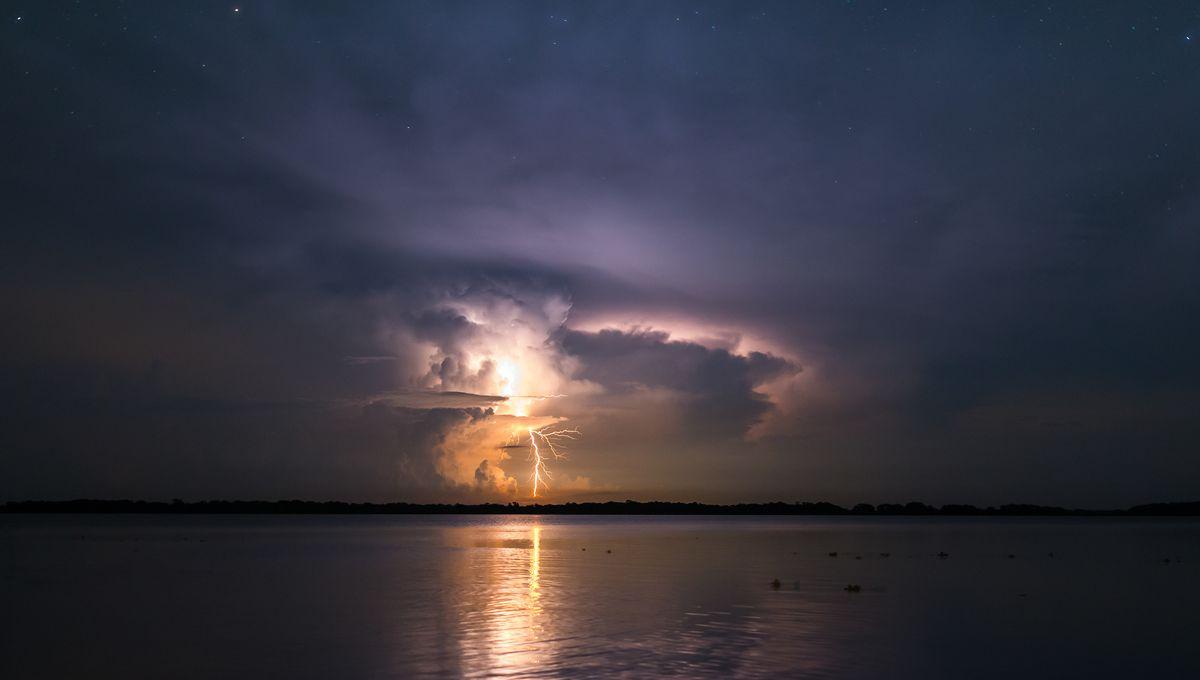
Earth's Most Show-Stopping Electrical Storm Sees 280 Lightning Bolts An Hour
What’s the longest lightning storm you’ve ever seen? For the people of Venezuela, seeing an electrical display that goes on for up to nine hours isn’t out of the ordinary. Here, at the mouth of the Catatumbo River, specific conditions for heat and humidity give rise to one of the most dramatic lightning displays on Earth.
Lasting as long as nine hours per night, the Catatumbo lightning reigns down at rates of 280 flashes per hour, igniting the night sky with dramatic forks of electricity. Known as the lightning capital of the world, it takes place where the Catatumbo River meets Lake Maracaibo, which is why it’s also known as the beacon of Maracaibo. The region holds the world record for the most lightning on Earth, experiencing around 250 lightning flashes per square kilometer every year, which adds up to around 1.6 million bolts annually. It's a remarkable display, but one that comes at a cost for the 20,000 or so sailors living in the lightning capital, sometimes in tin shacks. “A lot of people die each year,” Ángel G. Muñoz, a physicist and researcher at the National Oceanic and Atmospheric Administration (NOAA), told NASA. “The lightning can be so continuous that you see everything around you.” The lightning occurs with such frequency because of the way hot air rises at speed in the region, meeting with moist air to form cumulonimbus clouds that are associated with extreme weather like downpours, hailstorms, tornadoes, and lightning. Ice crystals above the lower portions of the clouds meet with warm air, creating static that builds up until it’s discharged in the electric zigzag we know as lightning. The power contained within this weather system is monumental, with NASA stating you could illuminate all of South America with just 10 minutes’ worth of Catatumbo lightning. Harnessing energy from lightning is an idea that’s intrigued scientists since Benjamin Franklin’s day, but nobody’s yet found a way to make it a viable source of energy. The ”river of fire” created by Catatumbo lightning has been used for centuries as a way marker for sailors navigating the ocean. Following the Maracaibo beacon was as good a heading as any, with the electric storm so illuminating that night is turned to day for those within striking distance. Due to its deadly intensity, many have come to fear extreme lightning, but among the Indigenous people in the region, it’s known as “ploi”, which translates to “curiosity”. Come rain or shine, the nocturnal lightning is a near-constant that’s become a symbol of strength and fortitude. This article first appeared in Issue 24 of our digital magazine CURIOUS. Subscribe and never miss an issue.

 English
 Arabic
 French
 Spanish
 Portuguese
 Turkish
 Dutch
Dutch
 Italiano
 Russian
 Romaian
 Portuguese (Brazil)
 Greek
Greek