


"Missing Link" Planet Detected? It Could Turn Into Two Different Types Of Worlds
"Missing Link" Planet Detected? It Could Turn Into Two Different Types Of Worlds
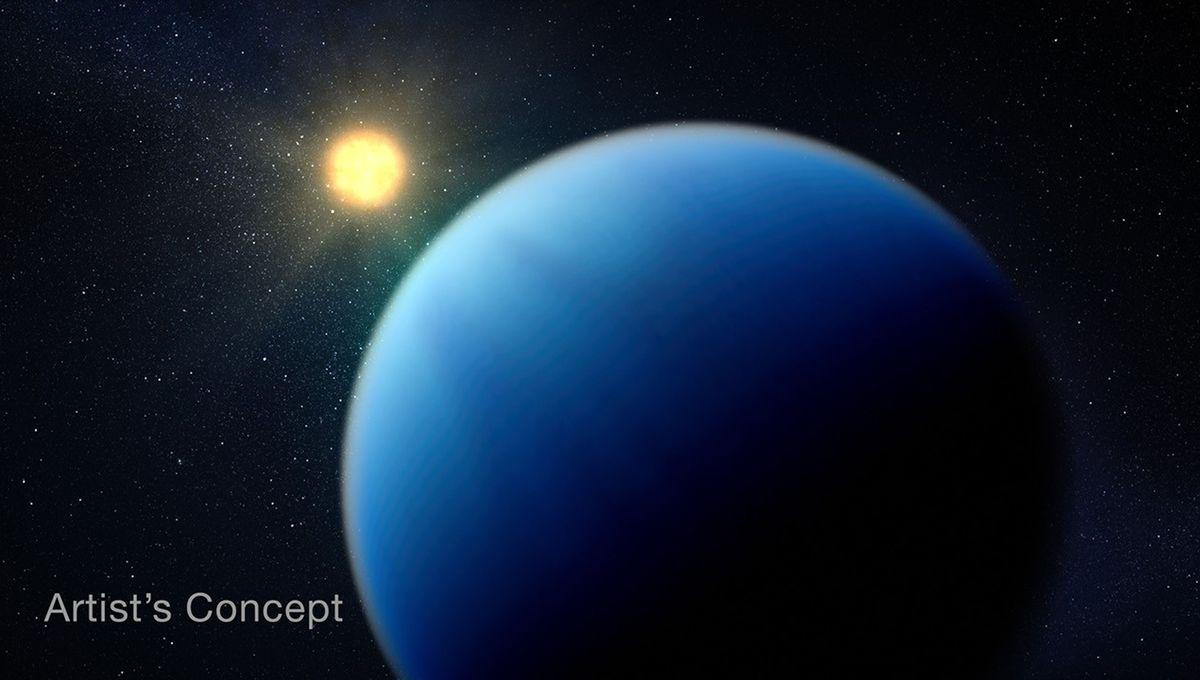
To misquote Hamlet, there seems to be more types of planets across the heavens than have been dreamt in our astronomy before the advent of dedicated planet-hunting telescopes. In the Solar System, we have rocky worlds, dwarf planets, gas giants, and icy giants. Beyond, we find super-Earths, sub-Neptunes, hot Jupiters, and more. Now, astronomers have measured the properties of a fledgling planet and are very unsure what it is growing up to be.
V1298 Tau b, as the planet is called, is a proto-sub-Neptune. With an estimated mass around times our planet, it is smaller than Neptune, which weighs over 17 Earths. The planet is extremely young, formed between 10 and 30 million years ago, so it is still changing. However, currently it does look very unusual. Thanks to observations from JWST, the team estimated the mass of this world, but also its atmospheric composition. They looked for different molecules: water (H2O), methane (CH4), sulfur dioxide (SO2), carbon dioxide (CO2) and carbon monoxide (CO) and found that the world has a much clearer hydrogen-rich atmosphere, a hotter interior, and a lot less heavy elements, which in astronomy are commonly referred to as metals. This world has 100 times less methane than expected and is, in general, 100 times less enriched in metals compared to a mature sub-Neptune. Its internal heat is also inconsistent with the formation model for a sub-Neptune. This might be an unexpected and yet-to-be-explained phase of sub-Neptune formation. Alternatively, this might be how super-Earths, rocky worlds larger than our own, come to be. “We found that V1298 Tau b has a much clearer and metal-poor atmosphere and hotter interior than what observations of sub-Neptunes have previously revealed. This suggests that evolutionary processes are still unfolding and will potentially transform the atmospheric composition of this planet with age,” lead author Saugata Barat, from the University of Amsterdam, said in a statement. Barat continued: “The JWST observations were needed to precisely constrain the mass and atmospheric composition as it gave us access to multiple molecular absorption features (H2O, CH4, SO2, CO2, CO) in the near infrared.” The team ran multiple simulations, trying to model how this world might change. In some, it becomes the expected sub-Neptune, in others, it is a sizable super-Earth. In some cases, this would not take long at all; it would lose its atmosphere in just 7.5 million years. While this world is a single example, it suggests that the expected formation mechanism for planets is more varied. What does the future hold for V1298 Tau b? Image Credit: Jean-Michel Désert/ Saugata Barat/ Kamalika Chakraborty. “Overall, these findings challenge our understanding of how sub-Neptune planets form and evolve. We showed that in their earliest stages, these planets possess atmospheres that differ significantly from those of their mature, billion-year-old counterparts,” co-author Jean-Michel Déser, also from the University of Amsterdam, added. The team is co-leading a large JWST program to look at seven young exoplanets, between 20 and 200 million years of age. This will hopefully provide new insights into the evolution of the atmospheres in these baby planets. A paper discussing the results is accepted for publication in The Astronomy Journal and is available on the ArXiv.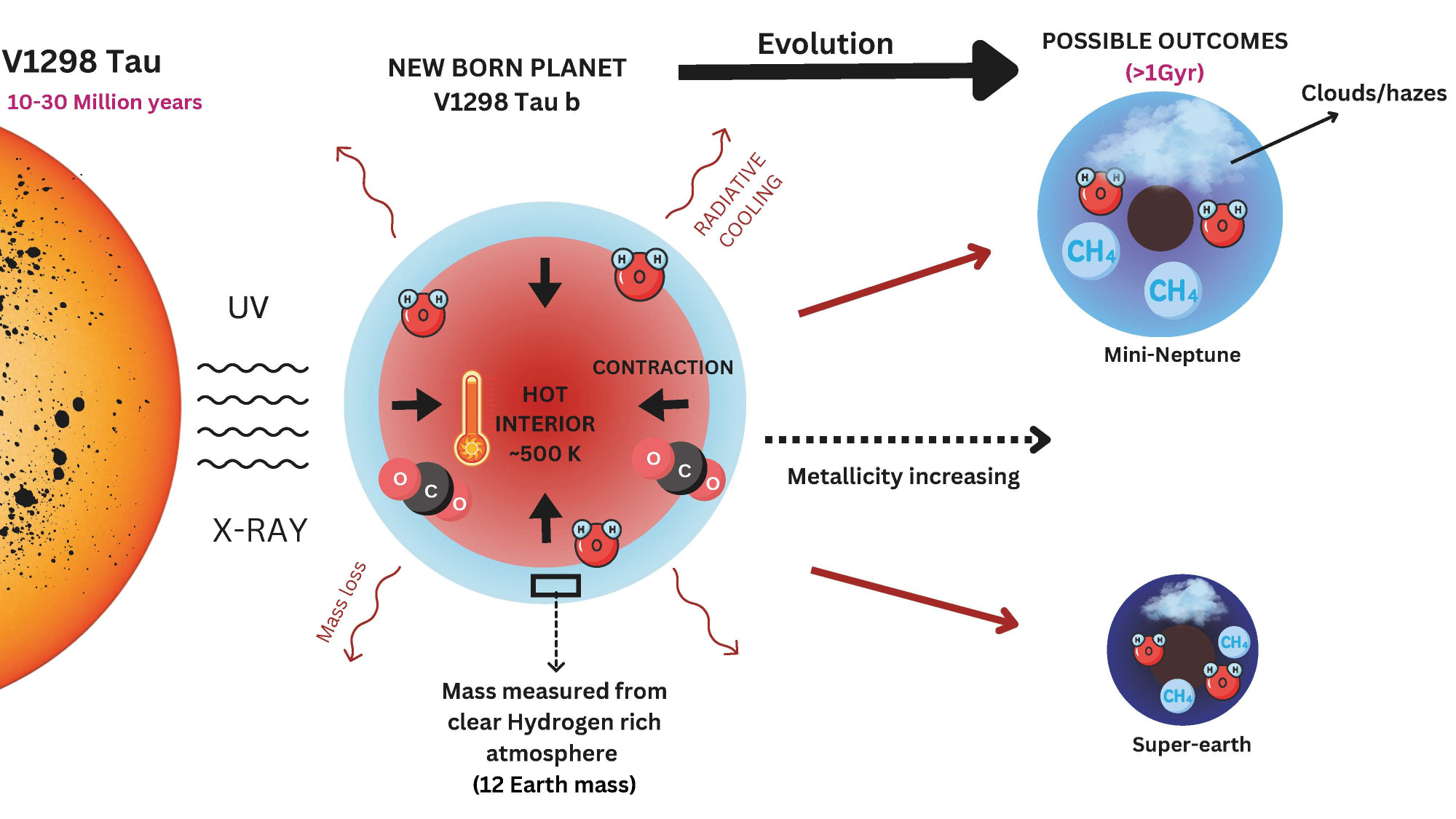

 English
 Arabic
 French
 Spanish
 Portuguese
 Deutsch
 Turkish
 Dutch
Dutch
 Italiano
 Russian
 Romaian
 Portuguese (Brazil)