


Over 86,000 Earthquakes Have Been Detected Under Yellowstone Using AI
Over 86,000 Earthquakes Have Been Detected Under Yellowstone Using AI
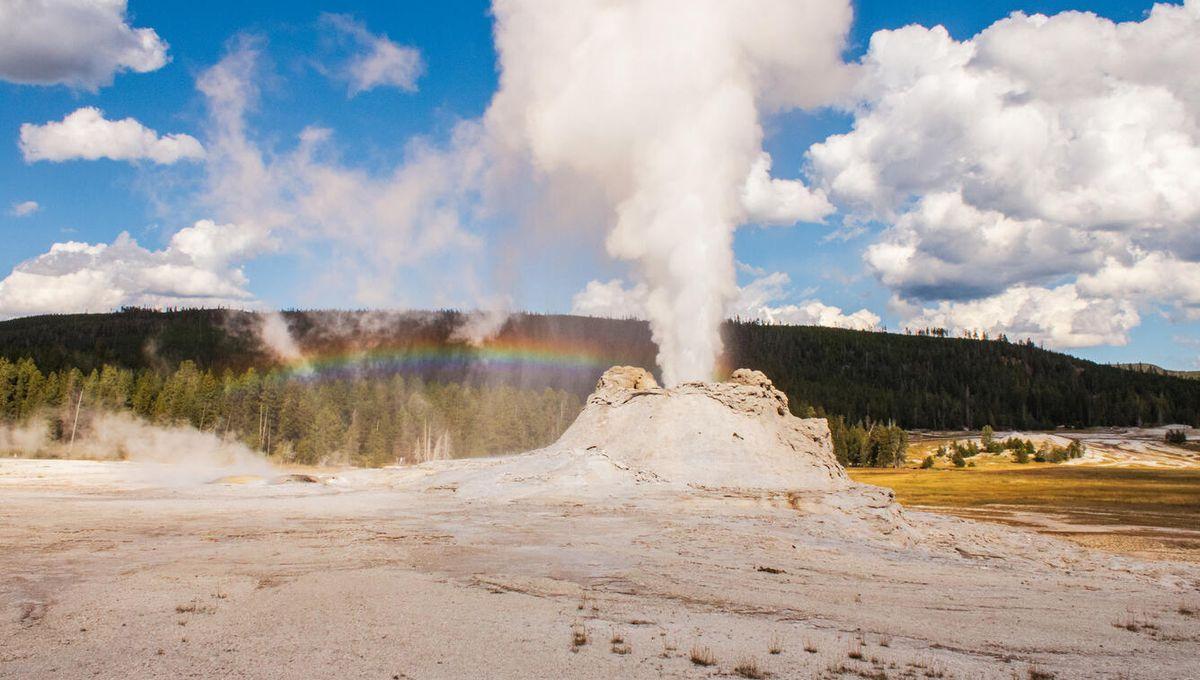
There’s rarely a quiet moment in Yellowstone. With constantly shifting geology and ever-bubbling hot springs, this sprawling landscape across Wyoming, Montana, and Idaho is no stranger to underground activity. But according to a new study, Yellowstone Caldera may be even more active than scientists previously realized.
Scientists at the University of Western Ontario, Industrial University of Santander in Colombia, and the United States Geological Survey have used artificial intelligence (AI) to identify over 86,000 earthquakes in the Yellowstone Caldera region between 2008 to 2022 – that’s 10 times more than previously recorded using traditional methods. This dramatic increase is thanks to AI’s ability to sift through vast amounts of seismic data and detect subtle patterns. In the past, human seismologists had to comb through endless charts and waveforms, an arduous task that advanced computers can do in a fraction of the time. "If we had to do it old school with someone manually clicking through all this data looking for earthquakes, you couldn't do it. It's not scalable," Bing Li, study author and engineering professor at the University of Western Ontario, said in a statement. The AI is also very skilled at sniffing out seismic swarms, clusters of interconnected mini-earthquakes that ripple through a certain region in short bursts. They’re generally thought to be triggered by the movement of underground fluids interacting with faults, although scientists don’t fully understand the dynamics behind them. Earthquake swarms don’t shake up the ground in a brief minute of violence. Instead, they quietly buzz through a series of smaller, clustered quakes over days, weeks, or even months, often without a single, defining shock. These swarms are often too subtle or complex for conventional techniques to pick up, but AI can spot the patterns and connections that humans might miss. "By understanding patterns of seismicity, like earthquake swarms, we can improve safety measures, better inform the public about potential risks, and even guide geothermal energy development away from danger in areas with promising heat flow," added Li. The Yellowstone Caldera, a bowl-shaped depression measuring 72 by 48 kilometers (45 by 30 miles), was formed about 631,000 years ago when land collapsed following a massive volcanic eruption, leaving behind a partially emptied magma chamber beneath. The study also found that earthquake swarms beneath the Yellowstone caldera tend to happen along the rougher, younger, and less-developed fault lines, as opposed to the smoother, older fault lines. To measure how "rough" these faults are, scientists used a mathematical concept called fractals. These are geometric patterns that repeat themselves at different scales. Think of the shape of snowflakes, broccoli, or the complex way blood vessels branch. No matter how much you zoom in, the patterns look similar. This fractal approach helped researchers compare the irregularity of the faults. Using these models, the team discovered that the rougher faults inside the caldera are likely influenced by a combination of slow-moving underground water and sudden bursts of fluid, which, as suspected, may be triggering the clusters of small quakes. "To a large extent, there is no systematic understanding of how one earthquake triggers another in a swarm. We can only indirectly measure space and time between events," explained Li. "But now, we have a far more robust catalogue of seismic activity under the Yellowstone caldera, and we can apply statistical methods that help us quantify and find new swarms that we haven't seen before, study them, and see what we can learn from them," he noted. The study is published in the journal Science Advances.

 English
 Arabic
 French
 Spanish
 Portuguese
 Deutsch
 Turkish
 Dutch
Dutch
 Russian
 Romaian
 Portuguese (Brazil)
 Greek
Greek