


Newly Discovered Space Rock Is Caught In A Unique 10:1 Dance With Neptune
Newly Discovered Space Rock Is Caught In A Unique 10:1 Dance With Neptune
There are a lot of worlds beyond the orbit of Neptune. Some are dwarf planets, while many others are much smaller rocks floating in the colder edges of our Solar System. But they do not orbit randomly. In particular, several bodies are in a complex dance with Neptune, including Pluto – but none quite like the newly discovered 2020 VN40.
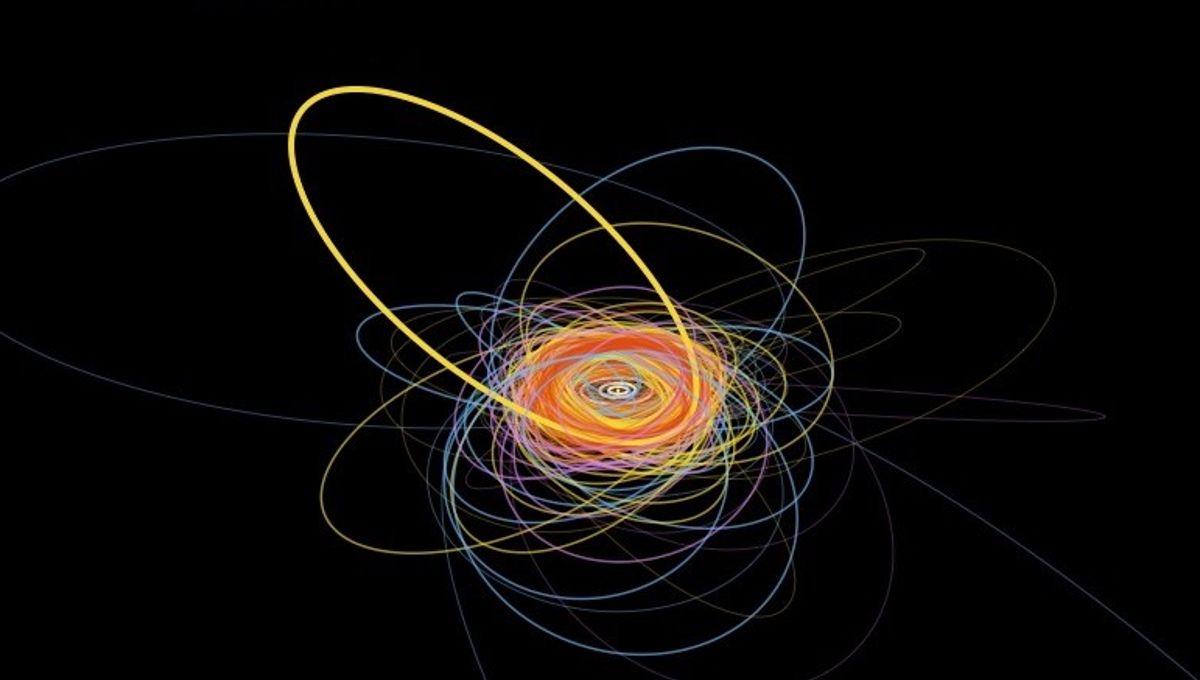
Celestial bodies are known to synchronize. This is a phenomenon known as resonance. Basically, whether they orbit a star or something else, worlds can organize themselves with a rhythm, and the number of orbits they do is in proportion. For example, Pluto and Neptune are in a 3:2 resonance. Neptune does three orbits for every two of Pluto. It is also very stable, and Pluto and Neptune can never collide because, during Pluto’s closest approach (which is closer to the Sun than the orbit of Neptune), Neptune is on the other side of its orbit. Many trans-Neptunian objects have something similar, but not 2020 VN40. This world orbits with a 10:1 resonance. Neptune takes about 165 years to do one lap around the Sun. 2020 VN40 instead takes 1,648 years. But if this was not weird enough, the closest approach to the Sun of this small world happens when Neptune is close by. "This new motion is like finding a hidden rhythm in a song we thought we knew," co-author Ruth Murray-Clay, from the University of California Santa Cruz, said in a statement. "It could change how we think about the way distant objects move." "This is a big step in understanding the outer Solar System," added Rosemary Pike, lead researcher from the Center for Astrophysics at Harvard & Smithsonian. "It shows that even very distant regions influenced by Neptune can contain objects, and it gives us new clues about how the Solar System evolved." There is no danger of 2020 VN40 colliding with Neptune, as the orbit of this distant world is very inclined with respect to the plane of the Solar System, at over 33 degrees. This resonance is short-term stable; it would not survive on a billion-year timescale. The object was discovered in 2020 and tracked over many months. The discovery is part of the Large inclination Distant Objects (LiDO) survey, which aims to classify and understand peculiar objects that exist at the edge of the Solar System. "It has been fascinating to learn how many small bodies in the Solar System exist on these very large, very tilted orbits," explained Dr Samantha Lawler of the University of Regina, a core member of the LiDO team. "This is just the beginning," added Kathryn Volk of the Planetary Science Institute. "We’re opening a new window into the Solar System’s past." A paper discussing this result is published in The Planetary Science Journal.

 English
 French
 Spanish
 Portuguese
 Deutsch
 Turkish
 Dutch
Dutch
 Italiano
 Russian
 Romaian
 Portuguese (Brazil)
 Greek
Greek