


Bernardinelli-Bernstein: The Biggest Comet In The Solar System Could Stretch From New York To Philadelphia
Bernardinelli-Bernstein: The Biggest Comet In The Solar System Could Stretch From New York To Philadelphia
Astronomers Pedro Bernardinelli and Gary Bernstein were searching through archive images from the Dark Energy Survey at the Cerro Tololo Inter-American Observatory in Chile when they noticed a comet around 4.1 billion kilometers (2.6 billion miles) from the Sun.
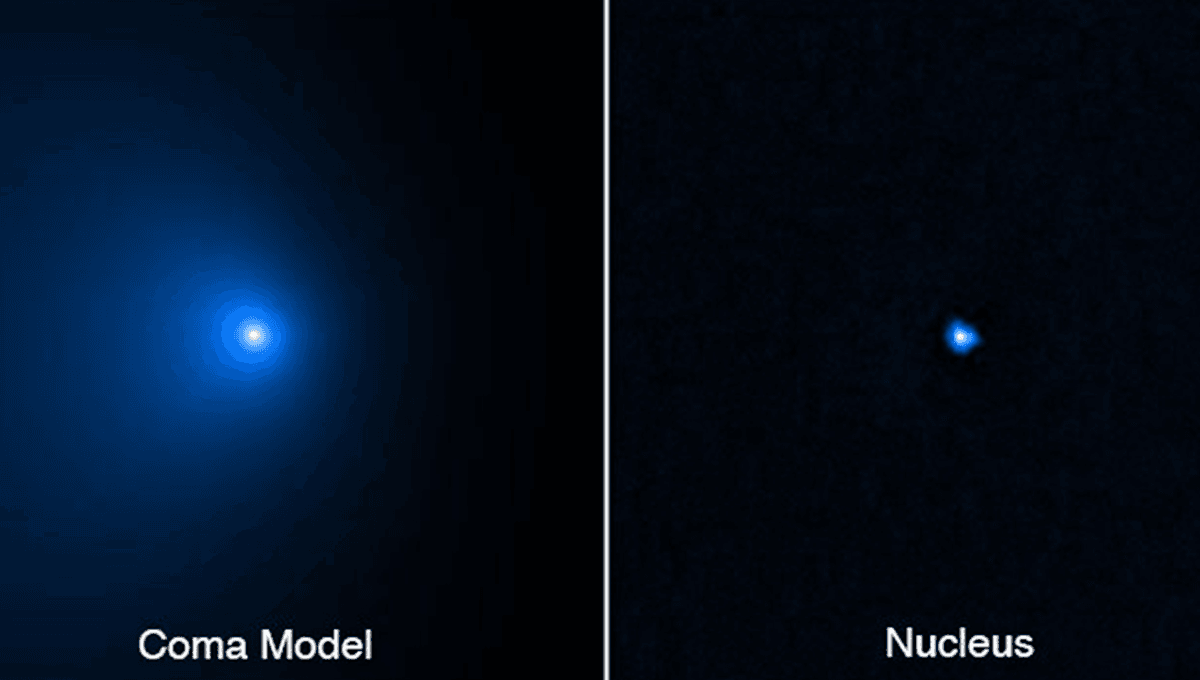
Comets are remnants of dust, ice, and rock left over from the formation of the Solar System, typically measuring 1 to 10 kilometers (0.6 to 6 miles) across, and generally going around the Sun on long orbits. They are much more easily spotted than asteroids due to their tails, which can stretch for tens of millions of kilometers. As comets approach the Sun in their orbit and heat up, they outgas, losing gas and later (when they are even closer to the Sun) dust, which forms their distinctive trail or coma. This outgassing acts like a thruster, slightly altering the trajectory, rotation, and speed of the comet. But this comet was unusual in that it was quite bright despite its significant distance from the Sun. "This is an amazing object, given how active it is when it's still so far from the sun," Man-To Hui, lead author on one study of the comet, explained in a 2022 statement. "We guessed the comet might be pretty big, but we needed the best data to confirm this." The comet – officially C/2014 UN271 – was viewed again by Hubble in January 2022, taking five images in an attempt to pin down its size and orbit. Sizing comets is a tricky business, primarily because to do so, you need to distinguish the comet from its coma. The team modeled the surrounding coma before adjusting it to fit the new images taken by Hubble, before removing the glow of the coma to reveal the size of its nucleus (or the rocky object at its center). "This comet is literally the tip of the iceberg for many thousands of comets that are too faint to see in the more distant parts of the solar system," said co-author David Jewitt, a professor of planetary science and astronomy at the University of California, in a NASA statement. "We've always suspected this comet had to be big because it is so bright at such a large distance. Now we confirm it is." According to the team's measurements, the comet's nucleus is around a whopping 128 kilometers (80 miles) across, making it bigger than the state of Rhode Island, and far larger than its closest competitor – comet C/2002 VQ94 – at 96 kilometers (60 miles) across. "The nucleus is about 50 times larger than found at the heart of most known comets," the NASA statement explains. "Its mass is estimated to be a staggering 500 trillion tons, a hundred thousand times greater than the mass of a typical comet found much closer to the Sun." C/2014 UN271 is a biggie. Image credit: NASA, ESA, Zena Levy (STScI) The comet is on an extremely long orbit, taking around 3 million years to travel around the Sun. At its closest approach, it will remain a reassuring 1.6 billion kilometers (1 billion miles) away. But even at these distances, as it approaches the Sun, it has been showing signs of complex outgassing of carbon monoxide from its nucleus, seen by the Atacama Large Millimeter/submillimeter Array (ALMA) in Chile. “These measurements give us a look at how this enormous, icy world works,” lead author on a recent study, Nathan Roth of American University and NASA Goddard Space Flight Center, said in a statement in June. “We’re seeing explosive outgassing patterns that raise new questions about how this comet will evolve as it continues its journey toward the inner solar system.” As it continues to approach the Sun, astronomers hope to observe Comet Bernardinelli-Bernstein further, hopefully learning more about the object, and potentially the hypothetical Oort cloud where it appears to have emerged from. Studying the comet, and other objects like it, can help astronomers to constrain the potential distribution of comets in the cloud, and the Oort cloud's total mass. Perhaps there are other whoppers out there, waiting to be found.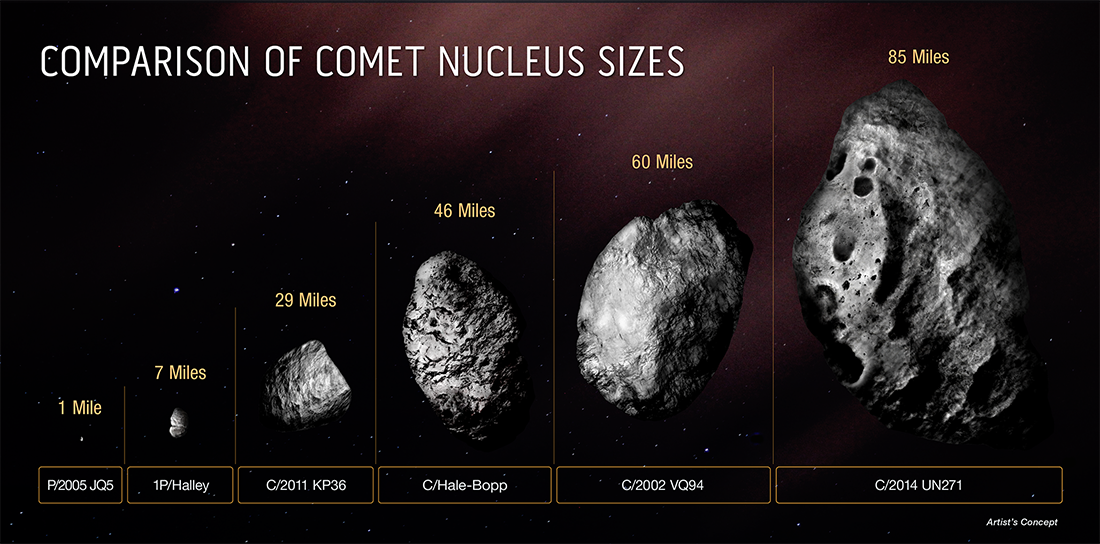

 English
 Arabic
 French
 Spanish
 Deutsch
 Turkish
 Dutch
Dutch
 Italiano
 Russian
 Romaian
 Portuguese (Brazil)
 Greek
Greek