


Lighting Hit Apollo 12 Just 36.5 Seconds After Launch – “After That It Got Very Interesting"
Lighting Hit Apollo 12 Just 36.5 Seconds After Launch – “After That It Got Very Interesting"
Apollo 12 landed on the Lunar Ocean of Storms, but it had to face storms here on Earth before it could reach its celestial destination. The goal was not just reaching the Oceanus Procellarum, the large dark basaltic plane on the western edge of the lunar nearside; it was landing in the crater that was visited years before by the robotic lander Surveyor 3. It was this specific plan that led to the pressure to have a specific launch date for the second attempt at landing on the Moon.
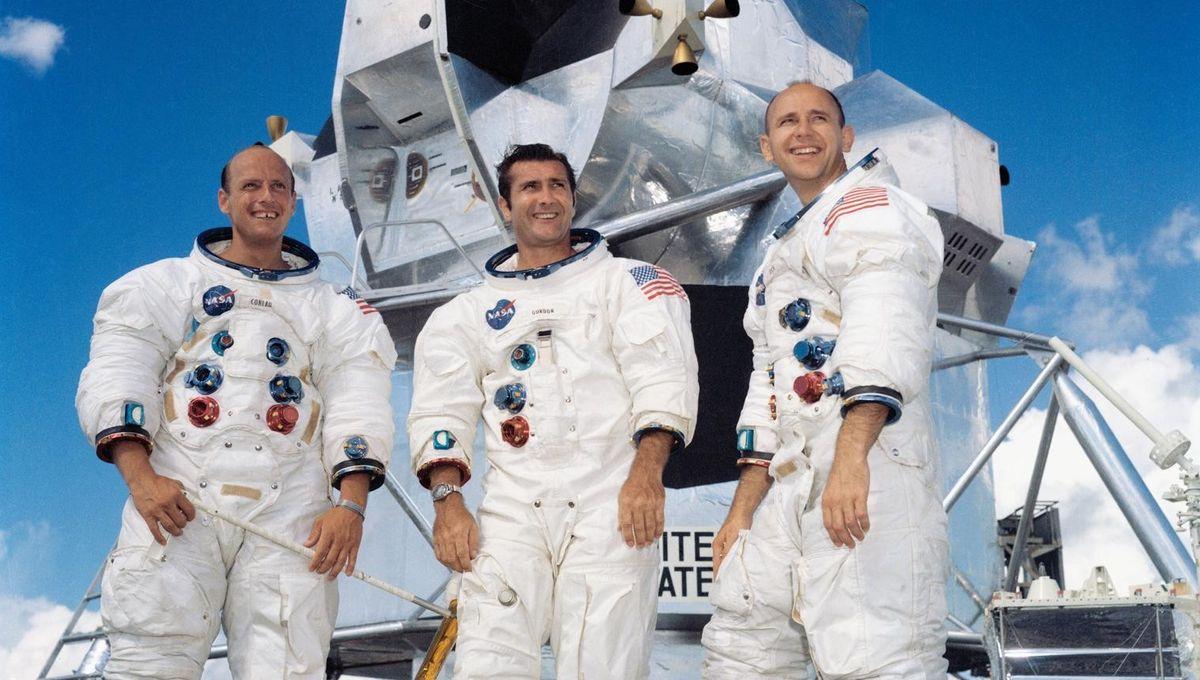
The weather in Cape Canaveral on November 14, 1969, was not great. The sky was completely overcast, it was rainy, and winds high in the atmosphere were very strong. Not a good day for a launch, but to get to the Surveyor crater, NASA would otherwise have to launch a month later. With President Richard Nixon in attendance, the first time a president had witnessed a crewed space launch live, the Apollo 12 launch went ahead. Commander Charles "Pete" Conrad, Lunar Module Pilot Alan L. Bean, and Command Module Pilot Richard F. Gordon took to the sky in the incredible machine that is the Saturn V rocket. It took the powerful engine 14 seconds to start and carry its weight past the launch tower. Twenty-two seconds later, the rocket was hit by lightning, which went all the way back down to the ground through the tower. The lightning was likely due to static discharge, triggered by the vehicle itself passing through such complex weather. As it traveled upwards, it experienced winds at 280.9 kilometers per hour (174.6 mph), the strongest for any mission. Not that the astronauts had time to be too worried about the weather, as the lightning messed with the system. “The flight was extremely normal for the first 36 seconds, and after that it got very interesting," Conrad recalled in the technical debrief. "Interesting" is never good when you are strapped to a controlled explosive device as tall as a skyscraper and moving several times faster than sound. The strike knocked the fuel cells offline, so the spacecraft was powered exclusively by its batteries. This was not a setup that could provide enough energy for the system to work properly. From the mission transcript: 000:00:37 Gordon (onboard): What the hell was that? 000:00:38 Conrad (onboard): Huh? 000:00:39 Gordon (onboard): I lost a whole bunch of stuff; I don't know... As far as the crew knew at that time, power had failed completely. This is what the system was telling them. But underneath them, Saturn V continued to soar farther and farther up. At T +52 seconds, a second lightning strike hit the vehicle. Conrad remembered later seeing a flash but it is inside that things are serious. A red warning light told them that they had lost their altitude and acceleration guidance system. They did not know where they were or where they were going. A double lightning strike is not something that NASA prepped for, but in mission control, John Aaron, the Electrical, Environmental, and Consumables Manager, remembered that a power loss caused a malfunction to the Command and Service Module in an earlier test. And he knew how to fix it. The system needed to switch to auxiliary power, a fix that sounds easy but was fairly obscure. Luckily, Alan Bean knew how to execute it. The switch fixed the problem, and the team worked out that the Saturn V suffered no damage and the command module had only very minor damage to some of its systems. NASA had a concern that the lightning might have damaged the bolts to open the parachutes on the way back down Earth. With no way to fix that, the mission proceeded with the astronauts unaware of this. Luckily, all went well; not only did Conrad and Bean land on the Moon with pinpoint precision, but together with Gordon, they came back safely to Earth. The double lightning strike was just a terrifying, but not long-lasting, concern of their mission.

 English
 Arabic
 French
 Portuguese
 Deutsch
 Turkish
 Dutch
Dutch
 Italiano
 Russian
 Romaian
 Portuguese (Brazil)
 Greek
Greek