


Over Past 250,000 Years, Three Major Waves Of Human-Neanderthal Interbreeding Have Been Identified
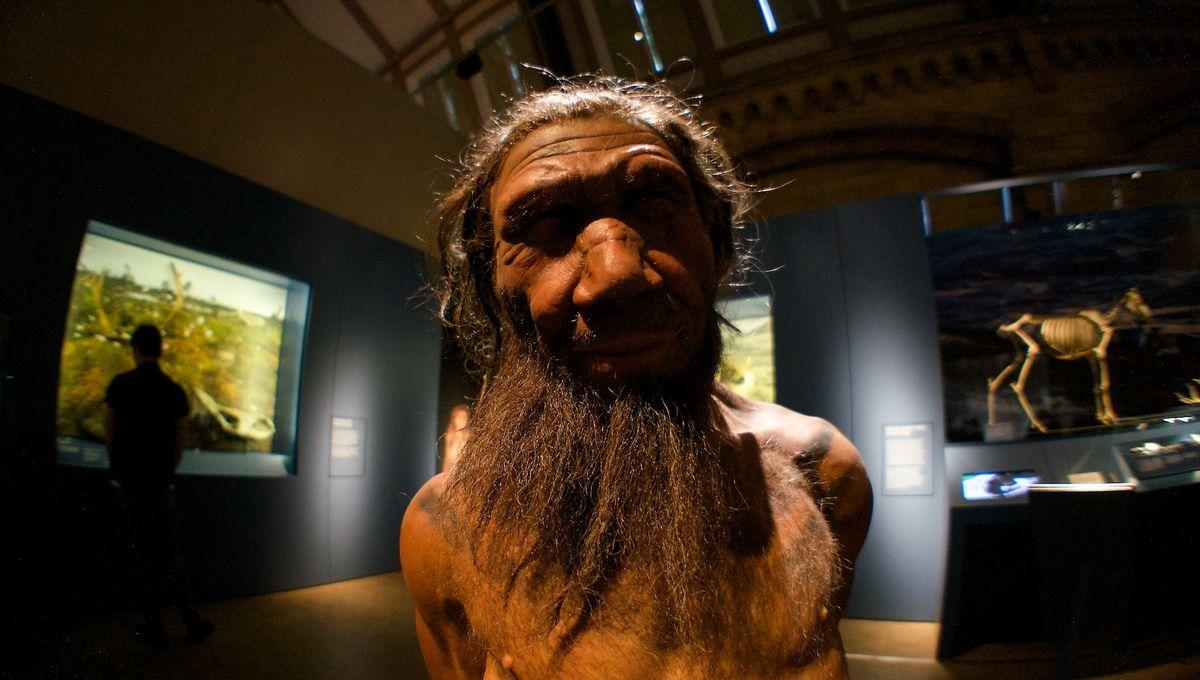
Scientists Find Three Major Waves Of Human-Neanderthal Interbreeding Over Past 250,000 Years
Neanderthals and Homo sapiens repeatedly interbred, shared genes, and merged populations over the course of nearly 250,000 years. With the help of artificial intelligence (AI), this intermingling of human species/subspecies is being revealed with never-before-seen clarity.
Scientists at Princeton University and Southeast University have mapped the gene exchange of H. sapiens (modern humans) and Neanderthals (Homo neanderthalensis) using an AI-powered genetic tool, called IBDmix, which uses machine learning techniques to decode genomes. Their findings suggest that H. sapiens were interacting and interbreeding with Neanderthals much more often – and much earlier – than previously recognized. Their research pinpointed three major waves of human intermingling: the first wave of contact about 200-250,000 years ago, another wave 100-120,000 years ago, and the largest one about 50-60,000 years ago. This stands in contrast to many contemporary theories of human migration. It’s commonly thought that modern humans evolved in Africa 250,000 years ago and stayed there for the next 200,000 years, before dispersing out of Africa around 60,000 to 50,000 years ago and populating Eurasia. It’s at this point in time that H. sapiens came into contact with Neanderthals, as well as Denisovans, who had emerged in Eurasia much earlier. However, this more recent study argues the story may be more nuanced. Instead of a single wave of interbreeding, shortly after they met around 50,000 years ago, they believe there was recurrent gene flow between Neanderthals and modern humans over the past 200,000 years, until Neanderthal extinction around 40,000 years ago. "Our models show that there wasn't a long period of stasis, but that shortly after modern humans arose, we've been migrating out of Africa and coming back to Africa, too. To me, this story is about dispersal, that modern humans have been moving around and encountering Neanderthals and Denisovans much more than we previously recognized," Joshua Akey, a professor at Princeton’s Lewis-Sigler Institute for Integrative Genomics, said in a statement. Bear in mind, there’s not an overwhelming amount of physical, archaeological evidence to suggest H. sapiens were sprawled across Eurasia before 50,000 years ago. A fossil skull from southern Greece has been identified as belonging to H. sapiens and dated as at least 210,000 years old, but that’s a significant outlier. The researchers say that their insights were, in part, revealed because they were looking for modern-human DNA in the genomes of the Neanderthals, rather than the other way around. "The vast majority of genetic work over the last decade has really focused on how mating with Neanderthals impacted modern human phenotypes and our evolutionary history — but these questions are relevant and interesting in the reverse case, too," explained Akey. According to Akey, the study also reinforced the idea that Neanderthals didn’t truly go extinct; they were absorbed into the genome of the other dominant hominin, H. sapiens. The research suggests that the Neanderthal population was much smaller than previously believed. When H. sapiens arrived from Africa in large numbers around 50,000 years ago, their significantly greater population size allowed them to outcompete and eventually absorb the dwindling Neanderthals, effectively acting as the final blow to their distinct lineage. "I don't like to say 'extinction,' because I think Neanderthals were largely absorbed," said Akey. "Neanderthals were teetering on the edge of extinction, probably for a very long time," he said. "If you reduce their numbers by 10 or 20 [percent], which our estimates do, that's a substantial reduction to an already at-risk population." The study is published in the journal Science.

 English
 Arabic
 French
 Spanish
 Portuguese
 Deutsch
 Turkish
 Dutch
Dutch
 Italiano
 Russian
 Romaian
 Portuguese (Brazil)