


24-Million-Year-Old Protein Fragments Are Oldest Ever Recovered, A Robot Listened To Spoken Instructions And Performed Surgery, And Much More This Week
24-Million-Year-Old Protein Fragments Are Oldest Ever Recovered, A Robot Listened To Spoken Instructions And Performed Surgery, And Much More This Week
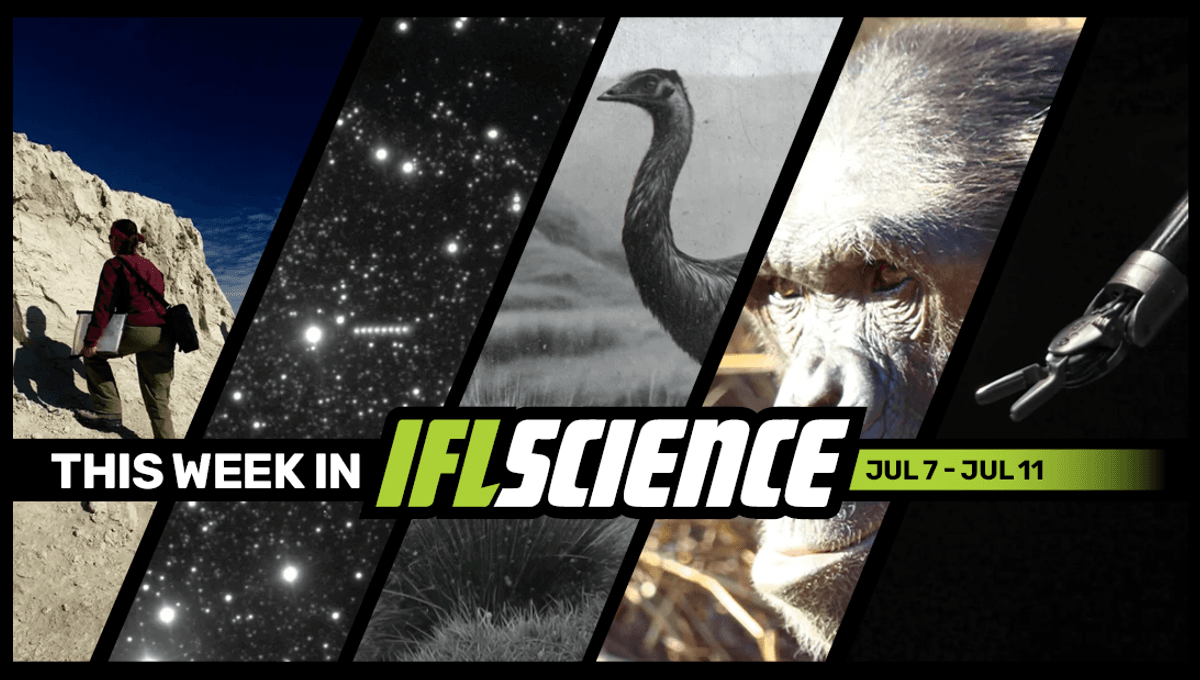
This week, a new interstellar comet’s origin region has been tracked and it’s thought to be “much older than the Solar System”, Colossal Biosciences has announced its plans to make one of the biggest birds to ever walk the Earth the 5th “de-extinction” species, and chimpanzees have been observed sticking grass in their ears and rears for seemingly no reason. Finally, 100 years on from America’s “trial of the century”, how much has changed since the Scopes (Monkey) Trial?
Scientists have got their hands on the oldest animal proteins yet, extracted from 18-million-year-old fossilized mammal teeth in East Africa, pushing the record back by an astonishing 14 to 15 million years. Even older partial fragments of proteins were obtained in North America from a rhino tooth dating up to 24 million years old, offering an unprecedented glimpse into life deep in the ancient past. Read the full story here Interstellar visitor Comet 3I/ATLAS was discovered just a week ago and ever since, astronomers across the world have been hard at work following it, trying to gather as much data on it as possible. The initial data on this object already suggested marked differences between it and the previous two known interstellar objects that crossed the Solar System. Thanks to a new model, it looks like it comes from a different region of the galaxy altogether. Read the full story here Humans once lived among enormous, wingless birds in New Zealand, but within a few hundred years of our species' arrival, they were wiped out. Now, Colossal Biosciences has announced its plans to functionally de-extinct the moa, building complete genomes for all nine species as part of a Māori-led initiative. Read the full story here It may be Paris Haute Couture Week, but the French capital isn’t the only place that fashionistas are making waves: In Zambia, a group of avant-garde chimpanzees have been sporting blades of grass protruding from their ears… and rears… It's called fashion, look it up. Read the full story here Robotic surgery has reached a new milestone after a robot successfully – and autonomously – performed gallbladder removal operations while listening and responding to voice commands. Just as a human trainee would be directed by a senior surgeon, the robot was able to act on verbal instructions after having been initially trained on videos of the procedure. Read the full story here Who gets to decide what children are taught in school? This politically charged question may resonate with many public debates, but it is far from being a new problem. In fact, this year marks the centenary of what is probably the most (in)famous response to this question, which played out as a public spectacle for audiences across the United States. It was dramatic, it was controversial, and it brought to American audiences a question some still ask today: Should schools be allowed to teach human evolution? Read the full story here Have you seen our e-magazine, CURIOUS? Issue 36, July 2025, is available now. This month we asked, “How To Fake A Fossil” – check it out for exclusive interviews, book excerpts, long reads, and more. PLUS, the We Have Questions podcast – an audio version of our coveted CURIOUS e-magazine column – continues. In episode 8, we ask, “Why Does Snow Sometimes Look Blue?” The Big Questions podcast has returned, and we’re continuing season 5 with episode 2’s big question: Are We Living Through A Sixth Mass Extinction?Create an IFLScience account to get all the biggest science news delivered straight to your inbox every Wednesday and Saturday.
Recovery Of 24-Million-Year-Old Protein Fragments From Extinct Animal Opens "New Chapter" Of Biology
New Interstellar Comet Tracked To Its Origin Region: “It’s Much Older Than The Solar System”
A Colossal Moa: One Of The Biggest Birds Ever To Walk The Earth Becomes 5th "De-Extinction" Species
Chimps Are Sticking Grass In Their Ears And Rears As They Embrace “Pointless” Fad
In A First, A Robot Listened To Spoken Instructions And Performed Surgery – Just Like A Human Would
TWIS is published weekly on our Linkedin page, join us there for even more content.
Feature of the week:
100 Years Since The Scopes (Monkey) Trial: How Much Has Changed Since America's "Trial Of The Century"?
More content:

 English
 Arabic
 Spanish
 Portuguese
 Deutsch
 Turkish
 Dutch
Dutch
 Italiano
 Russian
 Romaian
 Portuguese (Brazil)
 Greek
Greek