


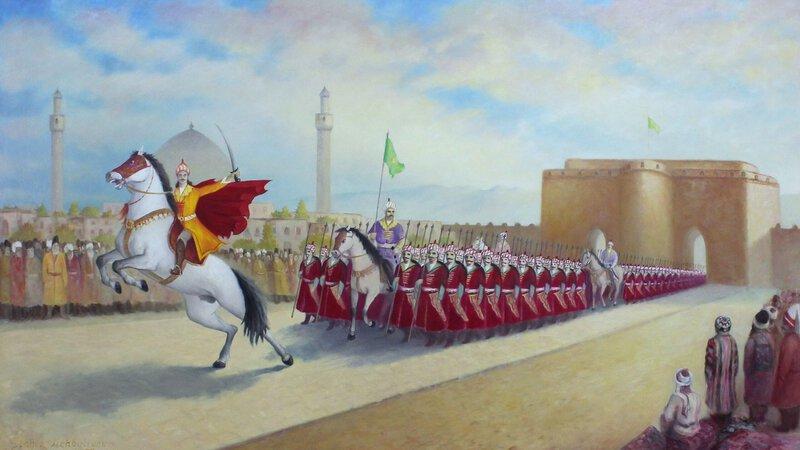

In the spring of 1501, a fourteen-year-old boy rode into the city of Tabriz at the head of a conquering army, seated himself on a throne that had not existed the week before, and announced that an entire civilization was about to change its religion — immediately, completely, and on pain of death.
The Boy Who Rode Into Tabriz and Rewrote History

His name was Ismail, and he was not, in his own mind, merely a king. He believed himself a semi-divine figure — a messianic descendant of the Shia imams, chosen by God to purify the world. His soldiers shared that belief with the ferocity of people willing to die for it. They wore distinctive red caps wound around their turbans, earning them the name Qizilbash, meaning “redheads,” and they followed their young shah with the devotion of disciples rather than the discipline of mercenaries. When Ismail declared that Persia would now be a Twelver Shia state, it was not a political announcement. It was a revelation delivered by a man who believed the divine was speaking through him.
What happened next was not a minor theological adjustment in a distant corner of the medieval world. It was a civilizational rupture that redrew the map of the Islamic world, set two great empires against each other in a conflict that fused politics and religion into something neither side could ever fully separate again, and established a Sunni-Shia fault line that still defines some of the most urgent conflicts in the Middle East today. The story of the Safavid dynasty is, at its heart, the story of how one teenager’s religious conviction became history’s most consequential act of nation-building.
From Mystic Lodge to War Machine: The Safavid Origins

To understand Ismail, you have to understand what he inherited. The Safavids did not begin as a royal family. They began as a militant Islamic Sufi order — a mystical brotherhood based in the shrine city of Ardabil in northwestern Iran — led by a succession of charismatic sheikhs who accumulated spiritual authority over generations. The order took its name from Sheikh Safi al-Din Ardabili, who led it in the early fourteenth century. By the time that authority passed to Ismail, it had been transformed into something far more explosive than religious devotion. It had become military loyalty of the most absolute kind.
The Qizilbash tribal warriors who formed the backbone of Ismail’s army were not professional soldiers calculating their odds. They were true believers who held that dying for their shah guaranteed paradise. That kind of fighting force is terrifying to face across a battlefield, and Ismail used it with ruthless efficiency. He also deployed gunpowder weapons — muskets and artillery — making the Safavid force one of the more technologically formidable in the region. The combination proved nearly unstoppable. Azerbaijan fell. Then Armenia. Then Khorasan. Within a decade, Ismail controlled the entirety of what is now modern Iran, and had made himself the strongest single power the region had seen in generations. The speed of it was staggering — an empire assembled while its founder was still a teenager.
The Forced Conversion: How You Change an Empire’s Religion in a Generation

Iran in 1501 was not a Shia country. The vast majority of its people were Sunni Muslims, following centuries of settled practice. Ismail intended to change that entirely, and he did not intend to wait for persuasion to do the work.
The mechanics of the conversion reveal both its ambition and its strangeness. Ismail needed Shia scholars to staff his new religious order — clerics who could teach the theology, run the seminaries, and staff the mosques. Iran barely had enough of them. He was forced to import Arab Shia scholars from Lebanon and Iraq, because the country he was converting did not have sufficient clergy of the faith he was imposing on it. There is a sharp irony in that detail: the revolution required foreign expertise to install a religion its own subjects were not yet equipped to practice.
The coercive tools were blunt. Public cursing of the first three Sunni caliphs — revered figures to Sunni Muslims everywhere — was made mandatory. Mosques were reconverted to Shia practice. Resistance was met with execution. Ordinary Persians who had been Sunni for their entire lives, whose parents and grandparents had been Sunni, were now required to learn new prayers, perform new rituals, and accept a new sacred hierarchy, all under threat of violence. The atmosphere was one of enforced conformity at a scale that had few precedents in Islamic history.
And yet — here is the crucial thing — it worked. Not immediately, and not without tremendous human cost, but over time the Safavids built institutions that made the conversion self-sustaining. Seminaries, shrines, a professional clerical class, and a calendar of sacred commemorations centered on the martyrdom of Imam Hussein at Karbala all embedded Twelver Shiism so deeply into Persian cultural life that it outlasted the dynasty that imposed it by centuries. Long after Ismail was dead, Iran remained Shia — not because anyone was still forcing it, but because the identity had taken root in language, ritual, and collective memory.
The Ottoman Collision: When Rival Empires Became Rival Faiths

To the west, the Ottoman Empire watched the rise of Safavid Persia with alarm shading into fury. Here was a newly powerful neighbor that was not only a military rival but a theological affront — a state that required its subjects to publicly curse the caliphs the Ottomans claimed to protect, that was actively encouraging Shia sympathies among Ottoman subjects in Anatolia, and that positioned its shah as a messianic figure challenging the very legitimacy of Sunni political authority. The Ottoman-Safavid rivalry became the defining geopolitical conflict of the sixteenth century, powered by something more combustible than territory: it was powered by sacred identity on both sides.
The confrontation reached its crisis point at the Battle of Chaldiran in 1514. Ottoman Sultan Selim I brought his army into Azerbaijan and met Ismail’s Qizilbash forces on an open plain. What followed was a lesson in the limits of religious fervor against superior firepower. The Ottomans deployed artillery on a scale Ismail could not match. The Qizilbash, who reportedly believed their devotion made them invulnerable, charged into cannon fire and were destroyed. Ismail fled the battlefield. He never personally led an army into battle again.
Chaldiran was a military defeat, but its psychological and geopolitical consequences were far larger than any single engagement. The Ottomans emerged as self-proclaimed defenders of Sunni Islam. The Safavids, nursing their wounds, leaned harder into the theology of Shia martyrdom — the tradition of Hussein at Karbala, of righteous suffering at the hands of unjust power, now mapped with uncomfortable precision onto their own political position. A political rivalry had calcified into a sacred war, with each side defining itself in opposition to the other in ways that ran deeper than territory or trade.
The line drawn then has never entirely been erased. The sectarian alignments established by the Ottoman-Safavid conflict are a direct ancestor of the Iran-Saudi Arabia rivalry, the fracture lines running through Iraq and Syria, and the proxy conflicts that have cost hundreds of thousands of lives in the twenty-first century. When analysts describe the Middle East’s Sunni-Shia divide, they are — whether they know it or not — describing a world that Ismail I helped engineer.
What the Safavids Actually Built: Art, Architecture, and a Persian Identity

It would be a distortion to tell the Safavid story only through conquest and coercion. The dynasty that began with forced conversion went on to produce some of the most breathtaking art and architecture in the Islamic world, reaching its peak under Shah Abbas I, who ruled from 1588 to 1629.
Abbas relocated the imperial capital to Isfahan and transformed it into one of the genuine wonders of the early modern world. Foreign ambassadors who arrived there — Europeans, Mughals, Ottomans — wrote home in astonishment. The great mosques with their cascading turquoise and cobalt tilework, the royal polo grounds laid out across the vast central square known as the Naqsh-e Jahan, the bazaars threading silk and spices and carpets through a city designed to announce imperial grandeur: Isfahan was a deliberate statement about what Safavid civilization was and what it intended to be. The Persian saying “Isfahan is half the world” was not vanity. By the standards of the early seventeenth century, it was close to accurate.
Abbas also pursued strategic diplomacy that the earlier, more messianic Safavids would have found unthinkable. He cultivated trade relationships with European powers, welcomed Christian Armenian merchants into the empire, and reorganized the military to reduce his dependence on the volatile Qizilbash. The result was a state that was simultaneously more orthodox and more cosmopolitan than the one Ismail had founded.
More durably, the Safavids fused Shiism with Persian language and cultural identity in a way that created something genuinely new: a Persian nationalism that was simultaneously religious and ethnic, anchored in a shared literary tradition, a shared theological calendar, and a shared sense of distinctness from the Sunni Arab and Turkic worlds surrounding it. The Safavid period is widely regarded as the foundation of modern Persian history — the moment when Iran became recognizably Iran in language, religion, borders, and self-conception. That is an extraordinary achievement, and it was inseparable from the coercion that preceded it.
Decline and Collapse: The Limits of a Dynasty Built on Zeal

The very qualities that made the early Safavid state formidable eventually became liabilities. The religious intensity that had driven conquest hardened, over generations, into institutional rigidity. The clerical establishment that Ismail had imported and empowered gradually accumulated independent authority, creating a tension between the shah’s political power and the clergy’s religious legitimacy that no dynasty ever fully resolved — and that would echo, centuries later, in the structure of the Islamic Republic of Iran.
Military stagnation compounded the problem. While the Ottomans and Mughals continued refining their armies, later Safavid shahs struggled to modernize. Internal tribal rivalries among the Qizilbash, which Abbas had managed through ruthless political balancing, resurged under weaker successors. The dynasty’s end, when it came, was sudden and humiliating: in 1722, an Afghan tribal force under Mir Wais Hotak’s son Mahmud swept into Isfahan and sacked the capital, ending more than two centuries of Safavid rule. The dynasty formally dissolved in 1736 when the military commander Nader Shah set aside the last Safavid claimant and seized power for himself.
The collapse was swift. What it had built was not.
The Long Shadow: Why 1501 Still Matters
The Safavid dynasty ruled for 235 years, from 1501 to 1736. In the sweep of world history, that is not an unusually long reign. But the transformation it accomplished was so total, and so structurally embedded in institutions, identity, and sacred geography, that its consequences multiplied long after the dynasty itself collapsed. Every major fault line in the contemporary Middle East — the competition between Iran and Saudi Arabia, the sectarian violence in Iraq, the war in Yemen, the fractures running through Syria and Lebanon — has identifiable roots in the world that Ismail I and his successors built.
The Sunni-Shia split did not begin with Ismail. The theological disagreement over the succession to the Prophet Muhammad is as old as Islam itself, tracing back to the events immediately following the Prophet’s death in 632. What Ismail did was institutionalize that split into rival states, rival armies, rival legitimacies, and rival civilizations. He transformed an old theological wound into a geopolitical permanent fixture. Before the Safavids, the Sunni-Shia division was a religious dispute within a broadly shared world. After them, it was a border — drawn in doctrine, defended in blood, and redrawn in every subsequent century.
The moral complexity of this legacy resists easy resolution. The same act of coercion that produced Isfahan’s extraordinary beauty, that forged a durable Persian cultural identity, that gave Iran the distinctiveness that prevented its absorption into the Ottoman empire — that same act also cemented a sectarian division that has generated centuries of mutual suspicion, persecution, and violence. It produced something magnificent and something terrible, and the two cannot be cleanly separated without falsifying both.
The question it leaves behind is genuinely hard: when a ruler forces his people to become something new, and that new identity endures and flourishes for centuries, does the coercion become history — or does it become heritage?
The Teenager Who Split the World
Ismail I died in 1524 at the age of thirty-seven. He had never recovered, by most accounts, from Chaldiran — the defeat that shattered the messianic certainty he had ridden to power, that proved his soldiers were not invulnerable after all, that exposed the distance between divine mission and military reality. He spent his final years increasingly withdrawn, a world-historical figure hollowed out by a single afternoon on a battlefield in Azerbaijan.
He was fourteen when he took Tabriz. He was dead before forty. In between, he founded an empire, forced an entire civilization to change its faith, ignited a rivalry between great powers that shaped the modern world, and — almost as a byproduct — created the cultural and religious foundation of a nation that exists, in recognizable form, today.
The facts about the Safavid empire that most people never encounter in school are precisely the ones that explain the most urgent headlines of the twenty-first century: why Iran is Shia in a predominantly Sunni region, why that distinction carries such explosive geopolitical charge, why the borders of the modern Middle East feel less like geography and more like theology made visible. All of it traces back to a boy on a horse, riding into Tabriz, certain that God was watching.
Ismail I has been dead for five centuries. The world he made is still arguing about what he did.

 English
 French
 Spanish
 Portuguese
 Deutsch
 Turkish
 Dutch
Dutch
 Italiano
 Russian
 Romaian
 Portuguese (Brazil)
 Greek
Greek