


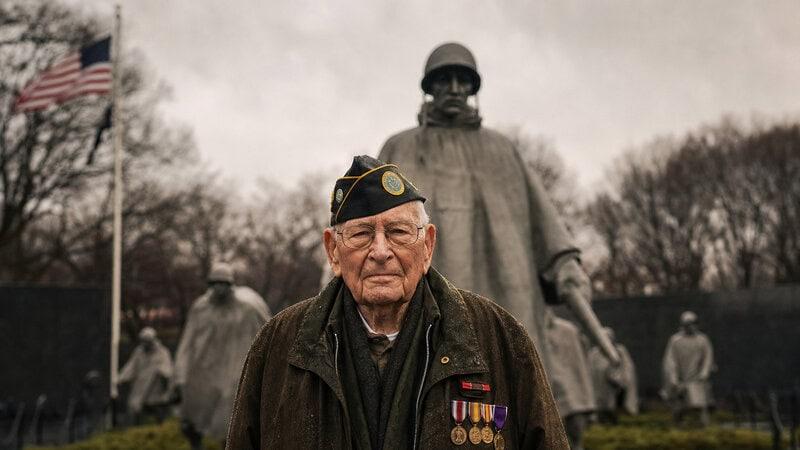

The guns fell silent on July 27, 1953, but no one ever signed a peace treaty — and the men who survived Korea’s frozen hills, river crossings, and night attacks came home to a country that had barely noticed they were gone. The story of the Korean War veteran runs through moments of extraordinary valor, institutional neglect, and a reckoning that arrived decades too late for many of the men who deserved it most.
June 25, 1950: A Sunday Morning Invasion That Dragged a Generation Into a ‘Police Action’

Before most families in South Korea had finished breakfast, 75,000 North Korean People’s Army soldiers were already pouring across the 38th parallel in a coordinated assault that shattered the peninsula’s fragile postwar calm. The South Korean military, outgunned and caught completely off guard, began folding within hours. President Truman’s response was swift but legally peculiar — rather than seek a congressional declaration of war, he framed American intervention as a “police action” under United Nations authority, a bureaucratic label that would dog Korean War veterans for the rest of their lives as they tried to claim the same recognition granted to the men who fought in World War II.
The troops rushed in to plug the breach were not ready for what they found. Soldiers pulled from comfortable occupation duty in Japan were thrown against a battle-hardened enemy and suffered catastrophic early losses at engagements like Task Force Smith’s stand near Osan in July 1950, where a poorly equipped battalion was overrun in hours. It was a brutal opening act for what history would come to call America’s Forgotten War — a conflict massive in scale, devastating in cost, and oddly invisible in the national memory it left behind.
Winter 1950-51: The Chosin Reservoir and the Making of a Veteran’s Nightmare

When China entered the war in late October 1950, roughly 15,000 U.S. Marines and soldiers suddenly found themselves encircled near the Chosin Reservoir by an estimated 120,000 Chinese troops, in temperatures that plunged to minus 35 degrees Fahrenheit. Weapons jammed. Morphine syrettes froze solid before they could be injected. Men who fell asleep risked not waking up. Over seventeen brutal days, those forces fought their way out in one of the most celebrated — and costly — fighting withdrawals in American military history, suffering approximately 17,500 U.S. casualties including killed, wounded, and those who succumbed to the cold.
The physical toll outlasted the medals. Thousands of survivors carried permanent frostbite injuries that reshaped their health for decades, a chronic reminder written into their bodies of what they had endured. The men who came to call themselves veterans of “the Frozen Chosin” became some of the most determined voices in the broader Korean War veteran community, organizing reunions and oral history projects with an urgency born of knowing how quickly a battle — and the men who fought it — could be forgotten.
The Armistice That Stopped the Shooting Without Making Peace

At 10:01 in the morning on July 27, 1953, after 575 days of grinding, often-suspended negotiations at the village of Panmunjom, U.S. Army General William Harrison and North Korean General Nam Il signed the Korean Armistice Agreement. The guns went quiet along a line that traced, with grim irony, roughly the same path as the 38th parallel where the war had begun three years earlier.
What was signed that morning was a ceasefire — a mutual agreement to stop shooting — not a peace treaty. No peace treaty between the belligerent parties has ever been negotiated, let alone signed, which means the Korean War has never formally ended under international law. The soldiers, Marines, sailors, and airmen who heard the last artillery rounds echo into silence that July morning became veterans of a conflict with no formal conclusion, a legal limbo that would shadow them and their families across the rest of the twentieth century and deep into the twenty-first.
The Paper Trail of Loss: Casualty Records and the National Archives

Behind every statistic is a name, and the effort to preserve those names began even while the fighting continued. State-level fatal casualty lists from the Korean Conflict are held at the National Archives, with records beginning from 1951, building the documentary foundation that researchers, journalists, and grieving families still rely on today to account for the more than 36,000 Americans who died in the conflict. The American Battle Monuments Commission maintains an Honor Roll that was assembled with the care owed to men whose deaths were sometimes reported in a sentence buried deep in a hometown newspaper.
That archive is not merely historical. More than 7,500 Americans were listed as missing in action when the armistice was signed, and the Defense POW/MIA Accounting Agency continues its active work of identifying remains. Each identification closes a decades-old wound for a family somewhere — a reminder that for some Korean War veterans and their descendants, the accounting is still not finished.
1953-1960s: Coming Home to Silence — the ‘Forgotten War’ Label Takes Hold

There were no ticker-tape parades. Many men described the experience of returning from Korea in almost mundane terms: stepping off a troop ship, collecting their gear, and catching a bus home. The country they returned to had not stopped in their absence. The economy was booming, the suburbs were growing, and a war that had cost tens of thousands of American lives had somehow failed to leave a deep mark on the national consciousness. The term “Forgotten War” — sometimes traced to a 1951 Washington Post column written while the fighting was still ongoing — turned out to be less a metaphor than a forecast.
The silence had real consequences beyond wounded pride. The VA’s mental health infrastructure of the era had been built around the World War II veteran experience, leaving Korean War veterans with little institutional support for the psychological wounds that would only later be understood and named as post-traumatic stress disorder. The war produced no defining popular songs, few major films, and no National Mall monument for a generation. The men came home carrying burdens their country had no language for and, for a long time, no particular interest in understanding.
1985: The Korean War Veterans Association Forms to Fight Fading Memory

By the mid-1980s, the veterans of Korea were entering their sixties, and the institutional silence surrounding their service had lasted long enough to feel permanent. The founding of the Korean War Veterans Association was, in part, an act of refusal — a determination to build the recognition that the broader culture had withheld. As a distinct veterans’ service organization, separate from larger groups like the American Legion and the VFW, the KWVA signaled something important: Korean War veterans felt their service occupied its own uniquely overlooked category in American memory, one that required its own dedicated advocates.
The association focused its energy on concrete goals — lobbying for a national memorial on the Mall, pushing for expanded VA benefits, and racing against time to document oral histories before the veteran population aged beyond the ability to tell its own story. The work was both civic and deeply personal, carried out by men who had spent three decades watching a war that consumed years of their lives fail to produce even a fraction of the cultural footprint left by World War II.
1986: Congress Authorizes a Memorial — but It Takes Almost Another Decade to Build

Thirty-three years after the armistice, Congress authorized the construction of the Korean War Veterans Memorial on the National Mall in Washington, D.C. The gap between the end of combat and that authorization speaks for itself. When the Korean War Veterans Memorial was finally dedicated on July 27, 1995 — chosen deliberately to mark the 42nd anniversary of the armistice — President Bill Clinton and South Korean President Kim Young-sam stood before nineteen stainless-steel statues of soldiers moving in patrol formation through a field of juniper bushes, their faces rendered with a realism that many visitors found quietly unsettling.
The memorial’s reflective granite wall carries the inscription “Freedom Is Not Free,” a phrase that Korean War veterans’ advocacy groups had wielded for years as a quiet rebuke to a nation that had accepted their sacrifice without much curiosity about its cost. The dedication drew thousands of aging veterans to Washington, many of whom had waited more than four decades for the moment. For some, it was the closest thing to a homecoming they would ever receive.
Ongoing Since the 1990s: South Korea’s Revisit Korea Program

While the United States spent decades slowly constructing its memory of the Korean War, South Korea built something different: a national practice of gratitude. The Revisit Korea Program, administered by South Korea’s Ministry of Patriots and Veterans Affairs, invites Korean War veterans from all twenty-two UN allied nations to return to the country they fought to defend — now one of Asia’s largest economies, transformed almost beyond recognition from the shattered landscape the veterans left in 1953. For many participants, the journey is their first return since the armistice.
Veterans who make the trip frequently describe seeing Seoul’s modern skyline as the most visceral proof that their anonymous, frozen, forgotten war had actually meant something. The contrast with their reception in their home countries is not lost on them. South Korea built a national ritual of remembrance around these men. In the United States, that recognition had to be fought for, lobbied for, and waited for across most of a human lifetime.
2020 and Beyond: More Than One Million Korean War Era Veterans — and a Closing Window

According to VA data, more than one million Korean War Era veterans were still alive in the United States in 2020 — men largely in their late eighties and nineties, representing one of the oldest cohorts the VA serves. The demographic reality is stark: the window for firsthand testimony, for the kind of memory that lives in a voice rather than a document, is closing faster with each passing year. Organizations like the KWVA have responded by shifting significant energy toward oral history documentation and legacy preservation, understanding that the work of memory will soon belong entirely to the generations that follow.
The unresolved armistice takes on a different weight in this context. The men who fought under a ceasefire rather than a peace treaty are dying before that treaty has ever been written. The legal limbo that began on July 27, 1953, has now outlasted most of the people who lived it.
No Peace Treaty, an Active DMZ, and a War That Legally Has No End

The 1953 Korean Armistice Agreement remains the only legal instrument governing the cessation of hostilities on the Korean Peninsula. No peace treaty has followed it. In the technical language of international law, the parties to the conflict remain in a state of suspended war — a fact that sounds abstract until you consider the Demilitarized Zone, where thousands of troops still stand watch along a fortified line laced with landmines, a frozen front that Korean War veterans crossed more than seventy years ago and that no diplomat has ever formally dissolved.
For the dwindling generation of Korean War veterans still living, none of this is abstract. They served in a war that was never declared, that ended in a ceasefire rather than a peace, that went unmonumented for a generation and underacknowledged in the culture for longer still. They are veterans of the Forgotten War in every sense of the phrase — and the war, technically, has still not found its ending.
The story of the Korean War veteran is, at its core, a story about a nation’s capacity for selective memory — and about the stubborn determination of the men who fought to make sure that selective memory does not have the final word.

 English
 Arabic
 French
 Spanish
 Portuguese
 Turkish
 Dutch
Dutch
 Italiano
 Russian
 Romaian
 Portuguese (Brazil)
 Greek
Greek