


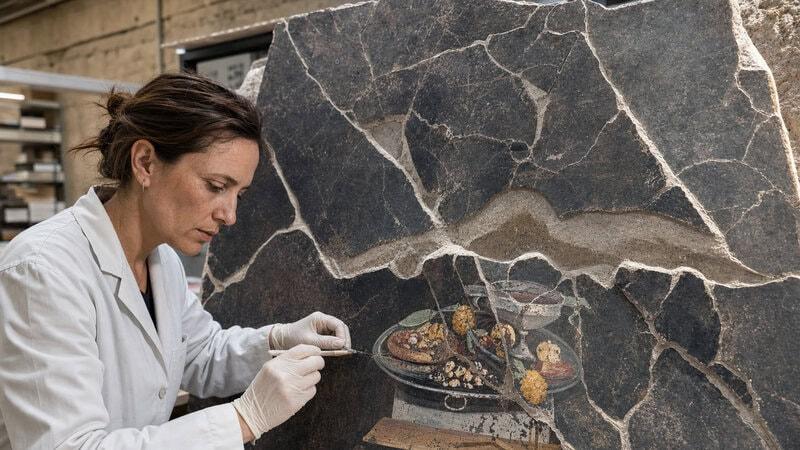

On a morning in the late summer or early autumn of 79 AD, the sky above Pompeii cracked open. Inside a richly decorated room somewhere in that prosperous, myth-saturated city, a painted ceiling — gods and lovers and wine-dark vines rendered in pigments still fresh with Roman ambition — crashed to the floor and shattered into pieces. It lay there, buried under metres of volcanic ash, in almost perfect darkness, for twenty centuries. Then, one shard at a time, archaeologists began bringing it back.
A Ceiling That Fell the Day the City Died

Picture the archaeologist’s tray: a shallow rectangle filled with fragments of painted plaster, none much larger than a human palm. Under the site lights, the colours are startling — ochre, cinnabar, and the particular luminous white that Roman craftsmen knew how to coax from lime. One piece shows the curve of something that might be a cheekbone. Another carries a cluster of grapes painted with a confidence that suggests a hand that had done this a thousand times. A third holds what can only be a relaxed, possibly divine hand. And slowly, the way a face emerges from a dream, the archaeologists crouching over that tray begin to understand what they are holding.
They are holding pieces of a ceiling fresco — a rare and largely vanished form of Roman domestic art — depicting scenes from Greek mythology centred on the marriage of Dionysus and Ariadne. It is a discovery that has excited the archaeological world, not only because of what the image shows, but because of what its survival, however fragmentary, represents: the possibility of reversing, even partially, the violence of a single catastrophic morning frozen in history.
Ceiling frescoes are vanishingly rare in the archaeological record. Wall paintings, held upright by the structures they decorated, sometimes survived Vesuvius’s fury with their colours intact. Ceilings did not. Gravity and the eruption’s seismic shockwaves conspired to bring them down first and hardest, and the collapse that followed ground most of them to powder. When a ceiling fresco survives in any recoverable form, it is a significant event. When it survives depicting one of Roman mythology’s most resonant love stories — painted above the heads of people who lived and slept and dreamed beneath it — it becomes something beyond routine archaeology.
What Was Lost: The Fresco Before the Eruption

To understand what was shattered, you have to imagine it whole. The fresco, as archaeologists are slowly coaxing it back into coherence, depicted scenes drawn from the deep well of Greek mythology that Roman culture absorbed so eagerly and so freely. At its heart was the marriage of Dionysus and Ariadne — a story that Romans understood immediately, in the way that people understand the stories they have grown up inside.
Ariadne’s tale was one of the ancient world’s great emotional arcs. She had helped Theseus navigate the Labyrinth and slay the Minotaur, only to be abandoned by him on the island of Naxos. Left alone on that shore, she was discovered by Dionysus — the god of wine, ecstasy, and transformation — who took her as his bride and elevated her to something approaching immortality. In the Roman imagination, it was a story about suffering redeemed, about the mortal rescued by the divine, about love arriving precisely when all hope had been lost.
It was also, painted overhead on a ceiling, an extraordinarily intimate choice of subject matter. Wall frescoes were social objects, visible to guests, clients, and the steady traffic of Roman domestic life. A ceiling painting was different. You saw it lying down, in private, in the most personal spaces of the home. To paint Dionysus and Ariadne above your head was to choose to fall asleep and wake up inside their story — to make their reunion the last thing you saw at night and the first thing you saw in the morning. It suggests an owner not merely decorating a room, but making a considered statement about how they wished to inhabit their inner world.
Pompeii on the eve of its destruction was a city fully capable of such sophistication. With a population estimated at roughly eleven thousand, it was a cosmopolitan trading hub where Greek mythology decorated not just walls but ambitions, business dealings, and social aspirations. Art was a language of status and belief, and those who could afford fine frescoes used them to signal everything about who they were and who they hoped to become.
The Eruption’s Violence: How the Fresco Was Shattered

Vesuvius’s eruption — now dated by many scholars to October rather than the traditionally cited late August, based on evidence including carbonised fruit and warm clothing found at the site — did not destroy Pompeii slowly. It annihilated the city in stages of increasing ferocity. The initial column of ash and pumice rained down for hours, loading roofs beyond their tolerance. Then came the pyroclastic surges: superheated avalanches of gas and volcanic matter that swept through the streets at lethal speed, collapsing whatever the pumice had not already brought down.
For the painted ceiling, the mechanics of destruction were specific and cruel. The structural collapse sent it crashing to the floor in an instant — not a slow deterioration but a sudden, catastrophic fall that shattered the plaster into many individual fragments. The volcanic material then buried everything under metres of ash, sealing the debris in a low-oxygen environment that, paradoxically, preserved the pigments almost perfectly. The colours that survived two thousand years of burial are, in many cases, as vivid as the day they were applied.
This is the great irony at the heart of every Pompeii discovery: the eruption that destroyed also preserved. The same violence that shattered the fresco also locked those pieces in conditions that protected them from light, air, moisture, and the slow biological processes that erase most ancient art. Vesuvius was simultaneously the destroyer and the archivist. The fragments it created and buried were, in a real sense, waiting.
The Excavation: Months of Patience in the Dark

The recovery of those fragments was not a moment of sudden revelation. It was the product of months of painstaking excavation — slow, methodical work in which every shovelful of earth is a potential act of destruction if applied too quickly or too carelessly. Each fragment, as it emerged, had to be logged, photographed, catalogued, and stored before analysis could begin. The researchers understood that haste was the enemy and patience was the only tool that mattered.
The scale of the challenge was considerable. Many individual pieces, none of them labelled, with no surviving guide to their original arrangement. Researchers knew that somewhere inside that chaos was a coherent image — but the image itself had to be reconstructed simultaneously with the physical reassembly, which meant working from art history, iconography, and materials science all at once. As The Times reported on the reconstruction effort, the process has been likened to assembling a jigsaw puzzle with no picture on the box — and with large sections of the puzzle potentially missing forever.
This excavation is part of the broader, systematic re-examination of Pompeii that has been generating remarkable results in recent years. The ongoing archaeological programme at the site — one of the most ambitious and technologically sophisticated heritage projects in the world — has consistently demonstrated that the city still has extraordinary secrets to yield. Significant new paintings and structural discoveries have emerged from the ongoing work, each one adding texture and detail to our understanding of how people in this remarkable city actually lived.
The Puzzle: How You Rebuild a 2,000-Year-Old Ceiling

The reconstruction methodology represents a marriage of ancient craftsmanship and modern technology. Experts have built a three-dimensional digital framework of the ceiling’s original structure, modelling the curvature and dimensions of the plaster surface so that individual fragments can be aligned in their true original positions without physical force being applied to fragile shards. The digital model allows researchers to test arrangements, correct mistakes, and build understanding incrementally — all without touching the actual material.
But the technology is only part of the story. Human detective work is equally essential. Researchers read the direction of individual brushstrokes, interpreting the painter’s hand movements to understand how the image flows across a given piece of plaster. They match the curvature of fragment edges against their neighbours. They follow the internal logic of the mythological composition — if a figure’s face turns in one direction, the positioning of other characters follows a logic that can guide the placement of surrounding fragments. The vine’s trajectory suggests where the next piece must lie.
It is, as multiple reports on the discovery have noted, unlike any ordinary puzzle. A conventional jigsaw gives you the complete image on the box lid. Here, researchers must reconstruct the image and determine the structure simultaneously, knowing that some pieces may be absent forever — reduced to powder by the collapse, lost in earlier excavations, or simply too small to identify. The fresco as it currently stands is as much a record of loss as of recovery. Gaps remain between recovered passages. And yet the coherence of what has been reassembled is striking: figures emerge, mythological narrative coheres, and colour relationships that have not been visible for two millennia resolve into legible meaning.
What the Fresco Reveals: Dionysus, Ariadne, and Roman Inner Life

To look at the partially reconstructed fresco is to be reminded, with some force, that the people of Pompeii were not historical abstractions. They were people who chose specific stories to live inside. The decision to commission a ceiling painting of Dionysus and Ariadne was not a casual one. It required considerable wealth, considerable artistic skill, and a considered engagement with the mythology’s meaning. Someone in that household — the owner, perhaps, or someone they consulted — thought carefully about what it would mean to have this particular story directly overhead, intimate and inescapable, night after night.
The story they chose was one about transformation through divine intervention — about a mortal woman’s suffering converted, by the arrival of a god who loved her, into something enduring. For Romans navigating the uncertainties of ordinary life — illness, financial precarity, the unpredictability of fortune — the image of Ariadne redeemed was not merely decorative. It was aspirational in the deepest sense: a painted hope that the divine might yet intervene, even on the most desolate shore.
Recent discoveries at Pompeii have consistently shown that this kind of personal engagement with Greek mythology was widespread, cutting across economic lines in ways that earlier scholarship sometimes underestimated. Ordinary Pompeiians were not passive consumers of mythological imagery. They selected it, arranged it, and invested it with meaning specific to their own lives and circumstances. The ceiling fresco is an unusually intimate example of that relationship — a private mythology chosen for the most private of moments.
What the reconstruction adds to art history, then, is not simply a recovered image. It is a recovered experience. For the first time in two thousand years, it is possible to stand in something like the position of the person who slept beneath this ceiling and look up at the story they chose to make their own.
Why It Matters: Pompeii as the World’s Greatest Time Capsule
Pompeii has been yielding its secrets since the first systematic excavations of the eighteenth century, and in all that time it has never quite stopped surprising us. The city was not frozen in an instant of ordinariness. It was frozen in an instant of interrupted life — bread still in ovens, graffiti still fresh on walls, frescoes still telling their stories to rooms that would never be occupied again. Every significant find is, in this sense, a word recovered from a sentence that was never finished.
The ceiling fresco is one of the most eloquent such recoveries in recent memory. It reminds us that Vesuvius buried art of extraordinary sophistication — not merely the famous wall paintings that fill museum collections and scholarly publications, but the rarer, more vulnerable, more intimate forms of domestic decoration that almost never survive. It demonstrates that the city’s losses, while immense, are not total: that methodical, patient, technologically informed archaeology can still reach through the ash and bring something back.
The three-dimensional modelling technology refined during this project also has implications beyond Pompeii. Fragmented ancient artworks exist in collections and excavation sites around the world, waiting for the tools and institutional commitment needed to attempt their recovery. The methodology being developed on this ceiling may in time be applied to other shattered surfaces, other fallen walls, other images lying in pieces in storage rooms with their coherence not yet found.
And so the fresco is partially whole again — Dionysus and Ariadne, reconstructed across many recovered shards, the story they were painted to tell still legible after twenty centuries of darkness. The household they watched over is gone. The city that contained it is gone. But the image of love arriving at the moment of abandonment, of the mortal lifted into something lasting, has crossed two millennia and arrived, still readable, in the hands of the people who went looking for it.

 English
 Arabic
 French
 Spanish
 Portuguese
 Deutsch
 Turkish
 Dutch
Dutch
 Italiano
 Russian
 Romaian
 Greek
Greek